





Why Is Water Consumption Planning Important for Industrial Evaporative Coolers?
Water consumption planning is important because it allows facility managers to budget utility costs, size water supply infrastructure and avoid operational disruptions before an industrial evaporative air cooler is installed. Unlike a small domestic unit, an industrial cooling system runs for extended hours across large factory floors, warehouses and production areas, so even modest differences in water use per hour can add up to a significant monthly requirement.
Water planning also supports better decision making during industrial cooling system design, since facility teams need to know whether existing water lines, storage tanks or softening equipment can support continuous operation. Underestimating supply needs can lead to unexpected water bills or shortfalls once the system is fully operational.
Symphony Venticool works with plant engineers and facility consultants to think through these requirements early, so water availability, cooling capacity and site infrastructure are aligned before an industrial air cooling installation begins.
How Does an Industrial Evaporative Cooler Consume Water During Operation?
An industrial evaporative cooler consumes water primarily through evaporation, the process where water absorbs heat from incoming air and converts to vapor, which produces the cooling effect. Air is drawn through water saturated cooling pads, and as the water evaporates into the airstream, the temperature of that air drops before it circulates into the facility.
Beyond evaporation, water is also used for bleed off and periodic drainage, explained later in this article. Together, these mechanisms determine total water usage, not evaporation alone.
A few related terms are often confused:
- Evaporation process: water changing from liquid to vapor, which creates the cooling effect
- Water circulation: the pumping of water across cooling pads for continuous saturation
- Bleed off water: water intentionally released to manage mineral concentration
- Drain water: water removed during scheduled tank cleaning or shutdown cycles
Understanding this distinction matters because higher water consumption does not automatically mean better cooling performance. A well maintained system should use water efficiently while still delivering consistent temperature reduction across the coverage area.
How Can Businesses Calculate Hourly Water Consumption of an Industrial Evaporative Cooler?
Hourly water consumption can be approached by identifying the core inputs that drive evaporation and bleed off, since these two elements combine to form the per hour water draw of the unit. Rather than relying on a single fixed number, businesses should treat hourly consumption as a function of operating conditions.
The main inputs to consider when estimating hourly usage include:
- Airflow volume moved by the cooler
- Ambient temperature and relative humidity at the site
- Cooling pad saturation efficiency
- Bleed off cycle frequency
These inputs shift with location, season and facility layout, so exact hourly figures should come from a site assessment or verified Symphony Venti-Cool specifications rather than a generic estimate. Symphony Venticool can help facility teams review these inputs to build an accurate hourly baseline.
How Can Daily Water Requirement Be Estimated for Industrial Cooling Applications?
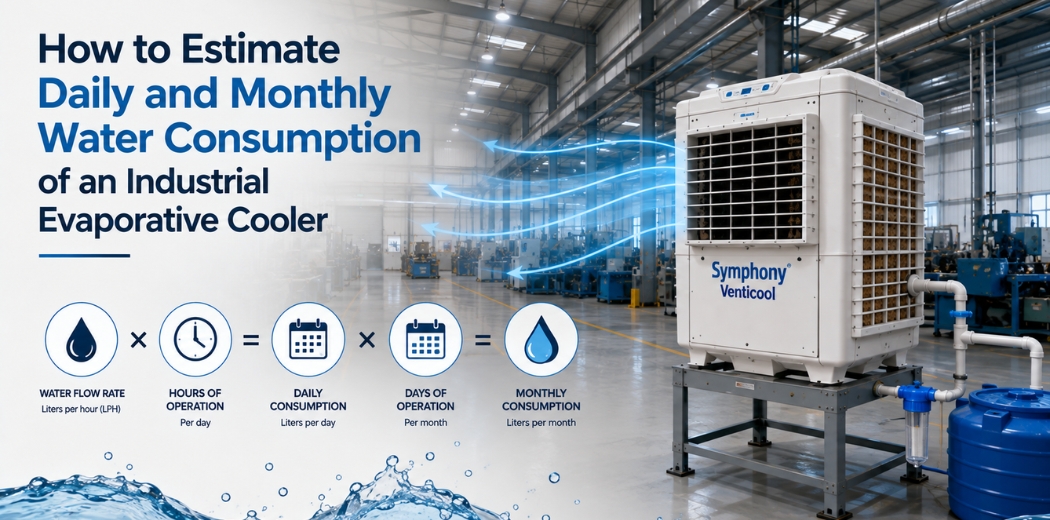
Daily water requirement is estimated by multiplying hourly water consumption by the number of hours the cooler runs each day, since total daily use scales directly with operating duration. A facility running two shifts will naturally require more water than one running a single shift with identical equipment.
The general working method is:
Water consumption per hour × Operating hours per day = Estimated daily water requirement
Practical daily planning should also account for variable factors such as:
- Shift patterns and production schedules
- Seasonal temperature peaks that increase cooling demand
- Days when the facility runs extended or reduced hours
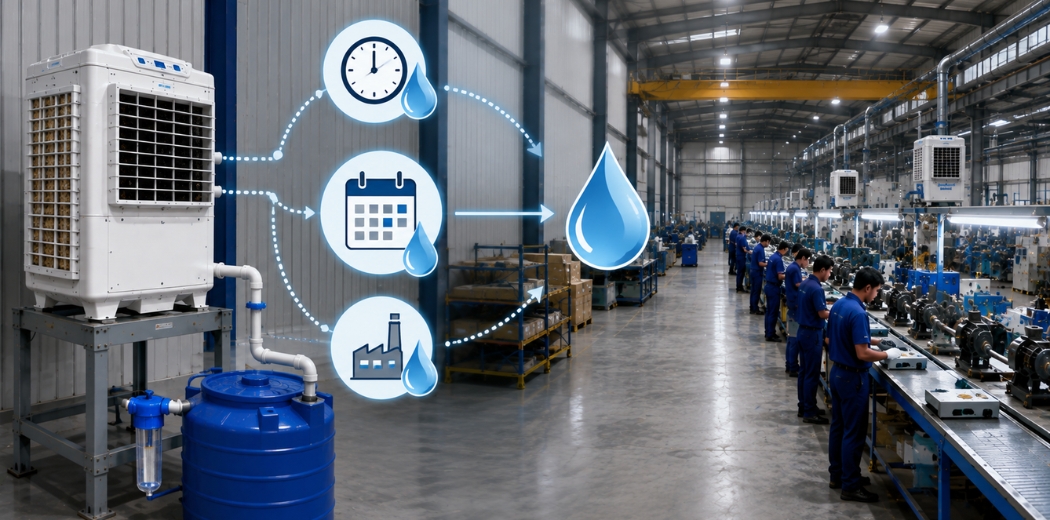
For example, a facility running cooling equipment for ten hours during a hot production shift will have a different daily requirement than one running only six hours during a cooler period, even with similar hourly consumption. This is why the operating hours entered into the formula should reflect the actual shift schedule for that day, not a rounded estimate.
How Can Monthly Water Consumption Be Calculated for Industrial Evaporative Coolers?
Monthly water consumption is calculated by extending the daily estimate across the operating days in that month, giving facility teams a planning figure they can compare against water supply capacity and cost.
The complete calculation method is:
Water consumption per hour × Operating hours per day × Operating days per month = Estimated monthly water requirement
When applying this formula, industrial teams should factor in:
- Total working days versus non operating days
- Seasonal shifts in ambient temperature across the month
- Planned maintenance shutdowns that reduce operating days
Because operating days and hours rarely stay perfectly constant, many facilities calculate a range rather than a single fixed monthly figure, using a lower bound for typical operation and an upper bound for peak season demand.
How Does Evaporation Affect Industrial Cooler Water Consumption?
Evaporation is the core process that determines base water consumption, since the volume of water that must evaporate to achieve the desired temperature drop directly sets the minimum water draw of the unit. The greater the airflow and the drier the ambient air, the more water is typically evaporated to achieve effective cooling.
Evaporation rate is influenced by:
- Airflow speed through the cooling pads
- Pad saturation and condition
- Ambient temperature and relative humidity entering the unit
Facilities in hotter, drier climates typically see higher evaporation activity than those in humid regions, since dry air can absorb more moisture before reaching saturation. This is one reason evaporation rate, rather than cooler capacity alone, sets the baseline figure used in the daily and monthly calculations described above.
What Is Bleed Off and Why Is It Important in Industrial Evaporative Cooling?
Bleed off is the controlled release of a portion of water from the cooling system to prevent mineral buildup, and it matters because it protects cooling pads, pumps and internal components from scale formation that reduces efficiency over time. As water evaporates continuously, dissolved minerals concentrate in the remaining water, and bleed off removes some of this concentrated water before mineral levels become damaging.
Without adequate bleed off, industrial evaporative coolers can experience:
- Reduced pad saturation efficiency
- Increased maintenance frequency
- Inconsistent cooling output
Bleed off adds to overall industrial cooler water consumption beyond evaporation alone, so it must be included in any realistic daily or monthly estimate. Symphony Venticool designs its Symphony Venti-Cool range with water management in mind, helping facilities balance component protection with efficient water use.
How Does Water Quality Influence Industrial Evaporative Cooler Water Usage?
Water quality directly influences how often bleed off and cleaning cycles are needed, because water with higher mineral content, commonly described as harder water, concentrates more quickly and requires more frequent bleed off to prevent scale buildup. Two facilities with identical equipment can still see different water consumption patterns purely due to local water quality.
Key water quality factors that affect consumption include:
- Total dissolved solids in the local water supply
- Hardness levels and mineral concentration
- Whether the facility uses treated or untreated water
Facilities working with harder water sources may need more frequent bleed off cycles or water treatment as part of their industrial cooling project planning. Evaluating local water quality early helps avoid underestimating actual consumption.
How Do Ambient Temperature and Relative Humidity Affect Water Consumption?
Ambient temperature and relative humidity are two of the most significant variables affecting water consumption, because evaporative cooling performance and water usage both depend on how much moisture the surrounding air can absorb. Hot, dry conditions drive higher evaporation and water usage, while humid conditions reduce both the cooling effect and the evaporation rate.
The relationship generally works as follows:
| Condition | Effect on Evaporation | Effect on Cooling Performance |
| Hot and dry air | Higher evaporation rate | Strong cooling effect |
| Hot and humid air | Lower evaporation rate | Reduced cooling effect |
| Cool and dry air | Moderate evaporation | Cooling may exceed requirement |
| Cool and humid air | Lower evaporation rate | Minimal additional cooling needed |
This is why a single national or regional consumption average is unreliable for planning purposes. Facilities should base their estimates on seasonal weather patterns specific to their own climate zone.
How Do Operating Hours Impact Daily and Monthly Water Requirements?
Operating hours have a direct and proportional impact on water requirements, since every additional hour of runtime adds a corresponding increment of both evaporation and bleed off water use, making this one of the simplest yet most important variables in the estimation process.
Facilities should account for:
- Single shift versus multi shift operations
- Seasonal extensions during peak production periods
- Weekend or holiday operating schedules
A facility that extends operating hours during a busy production season should expect a proportional rise in daily and monthly water requirements, even without any change to the equipment itself. Because planned schedules and actual runtime often diverge, logging real hours over a few weeks gives a more dependable basis for the calculation than assumed shift lengths.
How Does Cooling Load Influence Water Consumption Planning?
Cooling load, meaning the amount of heat that needs to be removed from a given space, influences water consumption planning because higher heat generating areas typically require greater airflow and longer run times to maintain appropriate temperatures. A facility with heavy machinery or significant heat generating processes will generally have a higher cooling load than a lightly used warehouse of similar size.
Factors that shape cooling load include:
- Floor area and ceiling height of the facility
- Number of heat generating machines or processes
- Occupancy levels and activity type
Matching cooling capacity to actual cooling load, rather than oversizing or undersizing equipment, helps ensure water consumption stays proportional to genuine cooling needs. Symphony Venticool supports facility consultants in assessing cooling load so the selected Symphony Venti-Cool configuration is matched to the space, avoiding waste from oversized systems or inadequate cooling from undersized ones.
How Does Automatic Water Management Help Control Industrial Cooler Water Usage?
Automatic water management helps control water usage by regulating bleed off cycles, water level and pump operation based on real operating conditions rather than fixed manual schedules, reducing unnecessary water waste while still protecting system components.
Benefits of automatic water management typically include:
- More consistent bleed off timing based on actual water condition
- Reduced risk of overflow or unnecessary drainage
- More predictable water consumption patterns for budgeting
For facilities managing multiple cooling units across a large site, automatic water management also simplifies industrial cooling project planning by making consumption more predictable across shifts and seasons. Symphony Venticool can guide teams on how automatic water management features within the Symphony Venti-Cool range support efficient day to day operation.
How Should Businesses Plan Water Requirements During Industrial Cooling System Design?
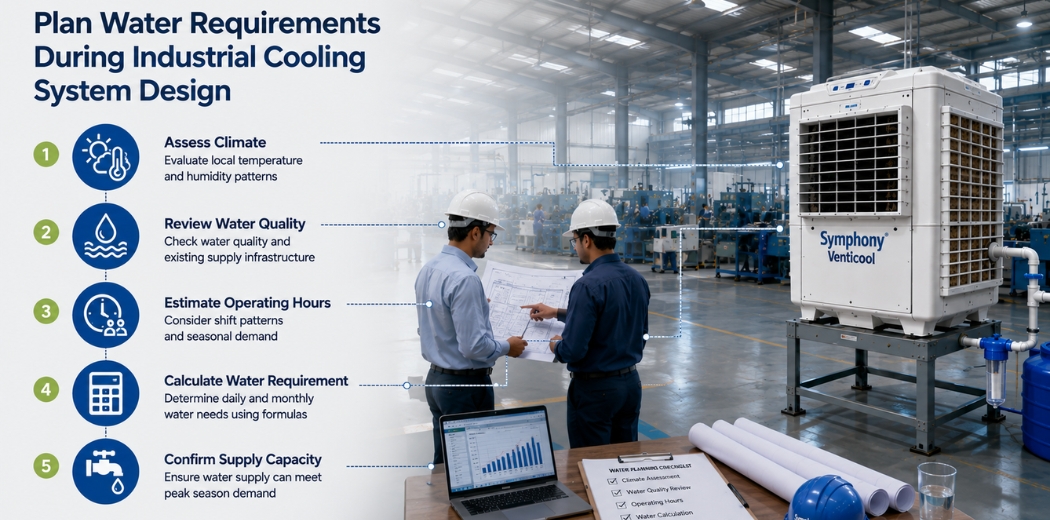
Businesses should plan water requirements during system design by evaluating climate, water quality, operating hours and cooling load together, rather than treating water planning as an afterthought once equipment selection is finalized. Early planning avoids costly surprises during commissioning and operation.
A practical planning approach includes:
- Assessing local climate data for temperature and humidity patterns
- Reviewing water quality and existing supply infrastructure
- Estimating operating hours based on shift patterns and seasonal demand
- Calculating expected daily and monthly water requirements using the formulas outlined above
- Confirming supply capacity can meet peak season demand
Following this sequence keeps water planning grounded in actual site data rather than a single estimate made late in the design process. Symphony Venticool works alongside plant planners and facility teams at this stage to align water requirements with the rest of the installation plan.
How to Select the Right Symphony Venti-Cool Configuration Based on Water Consumption Requirements
Selecting the right Symphony Venti-Cool configuration starts with matching the unit’s operating characteristics to the facility’s actual water availability, cooling load and operating schedule, rather than choosing based on cooling capacity alone. A configuration suited to a small warehouse with limited water supply may not fit a large facility with continuous multi shift operation, and the reverse is also true.
Key considerations when evaluating configurations include:
- Available water supply capacity at the site
- Local climate and typical humidity levels
- Facility size and cooling load requirements
- Water quality and bleed off management needs
Because these factors interact with one another, matching a configuration to a single variable, such as floor area alone, often creates a mismatch elsewhere in the system. Symphony Venticool works with factory owners, plant managers and facility consultants to weigh these conditions together and recommend a Symphony Venti-Cool configuration suited to the site’s actual water availability and cooling needs.
Conclusion
Estimating daily and monthly water consumption for an industrial evaporative cooler comes down to a consistent set of variables, evaporation, bleed off, water quality, ambient conditions and operating hours, run through the multiplication formulas covered above. These figures give plant teams a realistic basis for budgeting utility costs and sizing water supply during industrial cooling system design. Since no two facilities operate under identical conditions, the numbers should always be checked against actual site data. Symphony Venticool supports factory owners and plant planners in matching the right Symphony Venti-Cool configuration to those requirements.
Frequently Asked Questions About Industrial Evaporative Cooler Water Consumption
How to Estimate Daily and Monthly Water Consumption of an Industrial Evaporative Cooler
How is water consumption calculated for an industrial evaporative cooler?
Water consumption is calculated by multiplying the hourly water usage of the unit by the number of operating hours per day, then multiplying that daily figure by the number of operating days in a month. This gives an estimated monthly water requirement. Actual hourly usage depends on airflow, ambient conditions and bleed off frequency, so Symphony Venticool recommends confirming figures through a site specific assessment rather than relying on generic averages.
What factors affect the water consumption of an industrial air cooler?
The main factors are evaporation rate, bleed off frequency, water quality, ambient temperature, relative humidity, cooling load and daily operating hours. Hotter and drier conditions generally increase evaporation, while harder water increases bleed off frequency to prevent scale buildup. Because these factors vary by location and facility type, water consumption should always be assessed against real site conditions rather than assumed from a single fixed number.
How much water does an industrial evaporative cooling system use per day?
Daily water use depends on the cooler's hourly consumption multiplied by actual operating hours, so it varies from site to site based on climate, cooling load and shift patterns. There is no single universal daily figure that applies across all industrial facilities. Symphony Venticool works with plant teams to evaluate site conditions and estimate a realistic daily requirement for a specific Symphony Venti-Cool configuration.
Why do industrial evaporative coolers need bleed off?
Bleed off removes water with concentrated mineral content before it can cause scale buildup on cooling pads, pumps and other internal components. As water evaporates, the minerals left behind become more concentrated over time, and without periodic bleed off this can reduce cooling efficiency and shorten equipment life. Bleed off is a normal part of water management in any well maintained evaporative cooling system.
How does ambient temperature affect water usage in industrial cooling?
Higher ambient temperatures combined with low humidity typically increase evaporation, which raises water consumption because dry air can absorb more moisture during the cooling process. In cooler or more humid conditions, evaporation slows and water usage drops. This is why seasonal changes should be factored into any daily or monthly water requirement estimate for an industrial cooling solution.
Which factors should be considered when selecting an industrial evaporative cooler for a factory?
Facility size, cooling load, local climate, water quality and available water supply capacity should all be considered when selecting an industrial evaporative air cooler. Operating hours and shift patterns also affect the right configuration, since a facility running continuous multi shift production has different requirements than one with limited daily operation. Symphony Venticool helps evaluate these factors to recommend a suitable Symphony Venti-Cool configuration.
How many operating hours should be used when estimating monthly water consumption?
Operating hours should reflect actual production schedules, including shift patterns, seasonal extensions and any planned maintenance shutdowns, rather than a fixed assumption. Facilities that run extended hours during peak production months will have higher water requirements than those with standard single shift operation. Using real operating data instead of estimates produces a more accurate monthly water consumption figure.
Does water quality impact how much water an industrial cooler consumes?
Yes, water quality has a direct impact because harder water with higher mineral content requires more frequent bleed off cycles to prevent scale formation. Facilities working with poor quality water supply may also need additional water treatment as part of their industrial cooling project planning. Evaluating local water quality early helps avoid underestimating total consumption once the system is running.
Who should be involved in planning water requirements for an industrial cooling system?
Water requirement planning typically involves facility managers, plant engineers, utility planners and cooling system consultants working together to evaluate climate, water supply, cooling load and operating schedules. Involving these stakeholders early helps align the cooling system design with actual site infrastructure. Symphony Venticool works directly with these teams to support accurate water planning during system design and configuration selection.
Where can businesses get help estimating water requirements for industrial cooling installations?
Businesses can get help from cooling system manufacturers, facility consultants or engineering teams experienced in industrial water requirement planning. A proper estimate requires reviewing site specific conditions such as climate, water quality and cooling load rather than relying on generic figures found online. Symphony Venticool provides this kind of support to help factory owners and plant planners plan water needs before an industrial air cooling installation begins.
Conclusion
The cooling pad is the single component that determines how effectively an industrial evaporative cooler can lower temperature, and choosing the right type, thickness, and material has a direct impact on energy use, water consumption, and long term running cost. Honeycomb cellulose pads consistently outperform older wood wool designs, but even within honeycomb pads, matching thickness and cell size to the specific facility, water quality, and fan capacity is what determines real world performance.
Symphony Venticool supplies genuine honeycomb cooling pads engineered to match each model in its industrial ducting cooler range, along with guidance on selection and replacement timing suited to local water conditions. Reach out to Symphony Venticool for the correct replacement pad specification and to keep your industrial cooling system running at its rated efficiency.