




Table of Contents
Objective of the Evaporative Air Cooler Article
The primary objective of the article is to debunk 15 common and persistent myths and misconceptions surrounding modern evaporative air cooler technology.
The aim is to replace outdated perceptions – which often hinder the adoption of this cooling method – with factual, technical, and commercial evidence. The article seeks to establish the evaporative air cooler’s current status as a highly engineered, sustainable, cost-effective, and powerful cooling solution suitable for both commercial and industrial applications, especially when compared to energy-intensive traditional air conditioning (AC) systems.
Reality of High-Performance Evaporative Air Cooler
Misinformation often prevents businesses from adopting the most efficient cooling technology. Modern evaporative air coolers have overcome the limitations of their predecessors, debunking common myths and confirming their status as a high-performance, sustainable solution.
Myths Vs. Fact About Evaporative Cooling System Performance and Efficiency
Don't evaporative coolers stop working completely in humid climates?
Fact: While efficiency (the temperature drop) is highest in dry air, modern units still provide significant comfort in moderately humid regions. In fact, a quality unit provides powerful airflow and a substantial temperature drop even when the relative humidity is up to 70 percent, delivering far greater relief than a simple fan and at a fraction of the cost of AC. Strategic use of exhaust fans with the cooler ensures indoor humidity does not build up, maintaining effectiveness.
Aren't evaporative coolers just simple swamp coolers with poor cooling capacity?
Fact: The terms are often used interchangeably, but modern industrial evaporative coolers are highly engineered systems. They feature advanced honeycomb media, sophisticated pump systems, and high-efficiency fan designs, allowing them to deliver up to 50,000 CFM (Cubic Feet per Minute) of cooled air. This performance is a major upgrade from the basic aspen pad “swamp coolers” of the past.
Does the cooled air they produce feel sticky or uncomfortable?
Fact: The air feels slightly moistened, not “sticky,” when the system is installed correctly. Modern commercial units require adequate exhaust/ventilation (known as the air change rate). This ensures the slight moisture added is continuously exhausted and replaced with fresh, cooled air, maintaining a comfortable environment and preventing the air from feeling heavy or saturated.
Do evaporative air coolers make the room damp and encourage mold?
Fact: Modern systems are engineered to prevent oversaturation. They use high density, anti-microbial treated honeycomb cooling pads that distribute water uniformly and efficiently. With adequate ventilation, which is essential for their operation, the cooled, slightly moistened air is continuously pushed out, preventing stagnant, damp conditions and maintaining a healthy internal environment. Regular maintenance (cleaning pads and draining water) easily prevents mineral and microbial buildup.
Can evaporative coolers only achieve minor temperature drops?
Fact: The temperature drop is calculated based on the difference between the dry bulb and wet bulb temperatures (the wet bulb depression). In dry climates, modern systems can achieve cooling up to 20°F (11°C) below the ambient temperature. Even in moderate humidity, drops of 8°F to 12°F (4.5°C to 6.7°C) are typical, making a noticeable difference in comfort, especially in large, open environments where AC is impractical.
Do evaporative coolers only cool the air near the unit, not the whole space?
Fact: This depends on the unit size and installation. Industrial evaporative coolers are designed for whole-building or large-zone cooling. Units feature powerful direct-drive motors and aerodynamic fan blades that provide a long air throw (e.g., up to 20 meters), ensuring the conditioned air is distributed evenly across large warehouses, factory floors, or semi-open spaces.
Myths About Evaporative Air Cooling System Cost and Installation
Do evaporative coolers use an excessive amount of water?
Fact: While water is the cooling medium, modern units are highly water efficient. The total water consumption is small relative to the enormous amount of heat removed and the significant electrical savings achieved (typically 90% less energy than AC). Furthermore, the water usage is often far less impactful than the indirect water consumption associated with the electricity generation required to power a high capacity air conditioner (known as the water-energy nexus).
Read Our Article: Evaporative Air Cooler Benefits for Industry
Does the water usage make them environmentally unfriendly?
Fact: The opposite is true. Evaporative coolers are considered one of the most eco-friendly cooling methods. They consume electricity at a minimal rate (as low as a ceiling fan) and use no chemical refrigerants (CFCs or HFCs) that contribute to ozone depletion or global warming. The massive energy savings far outweigh the minor water consumption impact.
Myths About Evaporative Cooling Equipment Applications and Suitability
Are evaporative coolers just for small residential spaces?
Fact: This is fundamentally false. The greatest cost savings and most impressive applications of evaporative technology are found in large scale commercial and industrial cooling. Units with airflow capacities exceeding 50,000 CFM are routinely installed on rooftops of factories, event centers, and data centers, providing whole building cooling solutions that are energy efficient on a massive scale.
Can they be used in kitchens or areas with high heat loads?
Fact: Yes, they are highly effective in these settings, particularly when used for “make-up air”. They not only cool the space but also provide continuous ventilation, flushing out heat, smoke, and odours. This constant air exchange is often superior to closed-loop AC in environments with high internal heat or pollutant sources.
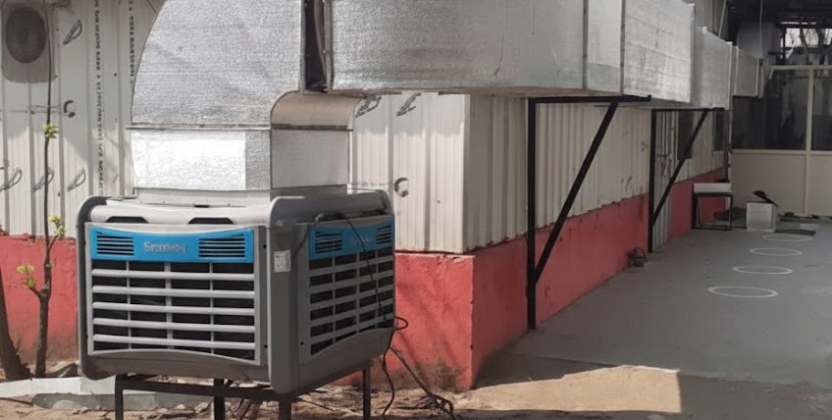
Do evaporative air coolers require complex ducting, just like a central AC unit?
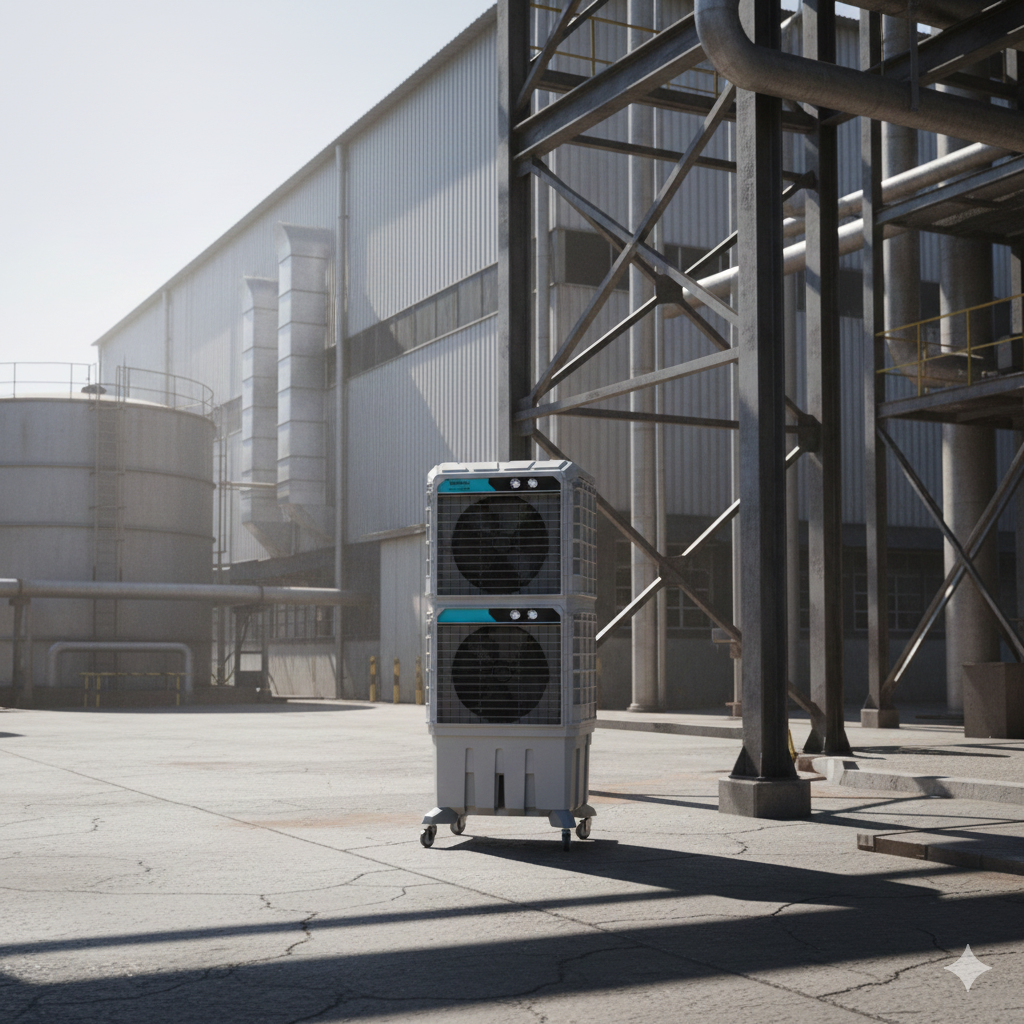
Fact: While they can be ducted for precise air distribution, industrial evaporative coolers are often used with minimal or no ducting. Portable commercial models (like the Movicool series) use directional louvers and powerful throw to cool zones without permanent installation, offering flexible, transportable climate control.
Myths About Evaporative Cooler Safety and Technology
Are evaporative coolers loud and disruptive to the workplace?
Fact: This myth stems from experience with older, poorly designed units. Modern commercial evaporative air coolers utilize advanced fan blade geometry and sophisticated, quiet direct drive motors to maximize air movement while minimizing noise. The sound profile is often a low-frequency sound similar to white noise, which is significantly less intrusive than the on/off cycling and high-frequency hum of a heavy-duty AC compressor unit.
Can Evaporative Coolers spread bacteria and contaminants through the building?
Fact: Modern commercial systems are designed to minimize this risk. They use UV light sterilization or chemical treatments in the water reservoir, and the honeycomb media itself is often treated with anti-microbial agents. Since the system relies on continuously bringing in fresh outside air and exhausting indoor air, it inherently promotes healthier air exchange than recirculation-based AC systems.
Are Evaporative Air Coolers prone to breaking down due to mineral scale buildup?
Fact: Older units were highly susceptible, but modern engineering addresses this with automatic purge or drain systems. These systems periodically dump a small amount of water (concentrated with mineral salts) and refill with fresh water. Furthermore, the use of UV-stabilized engineered plastic bodies prevents the rust and corrosion that plagued older metal casings due to constant water exposure.
Are evaporative air coolers a fire hazard?
Fact: Evaporative coolers are generally less of a fire hazard than compressor-based AC systems. They lack the high electrical demand and high-pressure refrigerant lines associated with AC compressors. Their construction uses durable, insulated plastics and metal components, which meet stringent commercial fire safety standards.
Replacing HVAC and Air Washers with Symphony LSV Evaporative Air Cooler
Symphony LSV Evaporative Air Coolers are engineered specifically for large commercial and industrial applications where traditional cooling methods like HVAC system and air washers become too expensive or inefficient. Instead of relying on heavy compressors and refrigerant gases, these industrial air coolers use advanced evaporative cooling to deliver powerful, continuous airflow, bringing fresh outside air into factories, warehouses, showrooms, workshops, and semi-open spaces. Compared to HVAC, Symphony LSV solutions consume significantly less power, are easier to install, and require lower maintenance, making them ideal for businesses focused on operational savings and sustainability. Unlike conventional air washers that mainly cool and wash air within limited ducted areas, Symphony’s LSV evaporative coolers are designed for large space venti cooling, improving ventilation, reducing heat stress, and maintaining comfortable working conditions even in harsh climates. This combination of high-volume cooling, energy efficiency, and healthier air circulation makes Symphony LSV Evaporative Air Coolers a smarter, more economical, and more scalable cooling solution for modern commercial and industrial environments.
Conclusion
The body of evidence presented confirms that modern evaporative air cooler technology has advanced far beyond the limitations of its simple predecessors. The myths concerning inefficiency, excessive water use, dampness, noise, and limited applicability are demonstrably false due to significant engineering innovations.
In summary:
- Performance: Modern units use advanced media and airflow design to provide substantial temperature drops-even in moderately humid climates-without creating a sticky environment, provided proper ventilation is maintained.
- Cost and Sustainability: The technology offers massive operational savings, consuming up to 90% less electricity than AC. While water is used, the energy savings far outweigh the cost, and the environmental benefit is significant due to the complete avoidance of harmful chemical refrigerants (HFCs/CFCs).
- Technology and Durability: Systems now feature high-density, anti-microbial treated pads, automatic purge systems for mineral control, quiet direct-drive motors, and corrosion-resistant UV-stabilized engineered plastic bodies.
- Application: Evaporative cooling is not limited to small, dry residential spaces but is a powerful, cost-effective solution for large-scale industrial and commercial applications that require both cooling and constant fresh air ventilation.
The contemporary evaporative air cooler is a technically advanced, durable, and ecologically sensible choice that stands as an indispensable option for businesses seeking affordable, high-efficiency thermal comfort.
FAQs About Evaporative Air Cooler Technology
Evaporative Air Cooler Technology: Top 15 Myths and Why They Aren’t True
What is an evaporative air cooler, and how does it work?
An evaporative air cooler works by cooling the air through the process of water evaporation. The cooler draws in warm air, passes it through water-soaked cooling pads, and releases cool air into the environment. This system is highly energy-efficient and environmentally friendly, making it ideal for commercial and industrial applications where large areas need to be cooled effectively without high energy consumption.
What are the benefits of using an evaporative air cooler for industrial spaces?
Evaporative air coolers offer many benefits for industrial environments:
- Energy-efficient: They use less electricity compared to traditional air conditioning units, which helps lower energy costs.
- Eco-friendly: They rely on natural cooling through water evaporation, avoiding harmful refrigerants.
- Cost-effective: Evaporative cooling systems are often more affordable to install and maintain than conventional AC systems.
- Ideal for large spaces: They can cool large, open spaces such as warehouses, factories, and event venues effectively.
How do evaporative coolers compare to traditional air conditioning systems?
Unlike traditional air conditioning systems, which use refrigerants to cool air, evaporative air coolers use water evaporation to reduce the temperature. This makes evaporative air coolers a more energy-efficient solution for areas that do not require precise temperature control. Additionally, industrial evaporative air coolers are less expensive to run and are ideal for spaces that require consistent, but not overly precise, cooling.
Are evaporative air coolers suitable for cooling large commercial areas?
Yes, evaporative air coolers are designed to cool both small and large spaces. For larger commercial areas such as open warehouses, factories, and large event venues, industrial evaporative air coolers provide an effective and energy-efficient cooling solution. Larger units are capable of cooling vast areas, offering comfort in environments that may not have access to centralized air conditioning.
Can evaporative air coolers be used in areas with high humidity?
Evaporative air coolers work most effectively in dry, low-humidity environments. In areas with high humidity, the cooling efficiency may decrease because the air is already saturated with moisture. However, some industrial evaporative air coolers are designed to perform even in moderately humid environments, though their cooling effect will be less pronounced in extremely high humidity.
What types of environments benefit most from evaporative cooling systems?
Evaporative cooling systems are ideal for:
- Commercial spaces: Retail stores, restaurants, and large conference rooms.
- Industrial applications: Warehouses, factories, and assembly lines that require cooling for large areas.
- Outdoor events: Temporary cooling solutions for festivals, markets, or construction sites.
These coolers are perfect for places where large-scale air conditioning would be impractical due to cost or installation limitations.
How much does an evaporative air cooler cost?
The price of an evaporative air cooler varies depending on its size and features. Portable industrial evaporative coolers are generally more affordable compared to traditional air conditioning systems. For larger spaces, industrial evaporative air coolers come in a range of sizes, and their prices can vary significantly depending on cooling capacity, airflow, and additional features. It's important to assess the space requirements and cooling needs to determine the right cooler and its price.
Are evaporative air coolers easy to maintain?
Yes, evaporative air coolers are relatively easy to maintain. Regular maintenance includes:
- Cleaning the water tank to prevent mold and bacteria growth.
- Replacing cooling pads to ensure optimal air cooling.
- Inspecting and cleaning the filters regularly to ensure good airflow.
- Checking the water levels to ensure the system operates efficiently.
Maintenance is minimal, making evaporative air coolers a convenient option for businesses.
Can I use an evaporative air cooler in outdoor areas?
Yes, evaporative air coolers are perfect for outdoor spaces. They are widely used in open-air settings such as patios, large event areas, and construction sites, providing cooling without the need for ductwork or extensive installation. Symphony evaporative coolers and other similar models are designed for both indoor and outdoor use, offering flexibility in cooling options for commercial and industrial environments.
What are the key features of Symphony evaporative cooling systems?
Symphony evaporative cooling systems are known for their advanced technology and efficiency. Some key features include:
- High cooling capacity: Ideal for large commercial and industrial spaces.
- Energy efficiency: Consumes less power than traditional air conditioning units.
- Eco-friendly: Uses water to cool the air, eliminating the need for refrigerants.
- Durability: Built to last with high-quality materials suitable for commercial and industrial applications.
How long do evaporative air coolers last?
With proper maintenance, evaporative air coolers can last for many years. The lifespan of these systems depends on factors like usage, maintenance, and environmental conditions. Regular cleaning and replacement of cooling pads help extend the life of the cooler and ensure its optimal performance. For industrial evaporative air coolers, proper upkeep is essential for long-term reliability.
What is the difference between ductable and non-ductable evaporative coolers?
Ductable evaporative coolers are designed to be connected to ductwork, allowing cooled air to be distributed throughout large, enclosed spaces. These are ideal for larger commercial or industrial areas that need consistent, widespread cooling. Non-ductable systems, such as portable industrial evaporative coolers, are more flexible and can be moved from one area to another. They are perfect for cooling specific areas or temporary setups.

Maulik Solanki is a seasoned B2B Product Marketing professional specializing in Industrial and Commercial Coolers in the LSV (Large Space Venticooling) segment. With 13+ years of experience, he drives brand building and audience engagement for Symphony’s LSV solutions through integrated offline and online strategies. Backed by an MBA in Marketing and earlier experience as a Regional Marketing Manager in banking, Maulik brings strong skills in sales, advertising, and events. He enjoys exploring new marketing ideas and cooling technologies and writes to help readers understand Symphony’s offerings.

Sourav Biswas is a senior marketing leader heading the LSV (Large Space Venticooling – B2B) marketing function at Symphony Limited. He shapes the brand’s strategic narrative, strengthens market leadership, and ensures excellence across all B2B cooling solutions. With deep expertise in Strategic Marketing, Brand Management, Advertising, and PR, he reviews content with analytical precision and alignment to Symphony’s vision. Passionate about mentoring and tracking B2B trends, Sourav ensures every content piece reflects accuracy, relevance, and strategic depth.