
Top discharge and side discharge industrial evaporative air coolers mainly differ in how they deliver airflow and where they are best used. Top discharge coolers push air vertically (often into ducts), making them ideal for centralized cooling and large spaces requiring uniform distribution, while side discharge coolers release air horizontally, making them more suitable for direct cooling in open or semi-open industrial areas. Side discharge systems are typically easier to install and maintain with efficient airflow across wide spaces, whereas top discharge units are preferred when ducting and structured airflow planning are required. Overall, the choice depends on installation layout, airflow direction needs, and the size and type of industrial space.
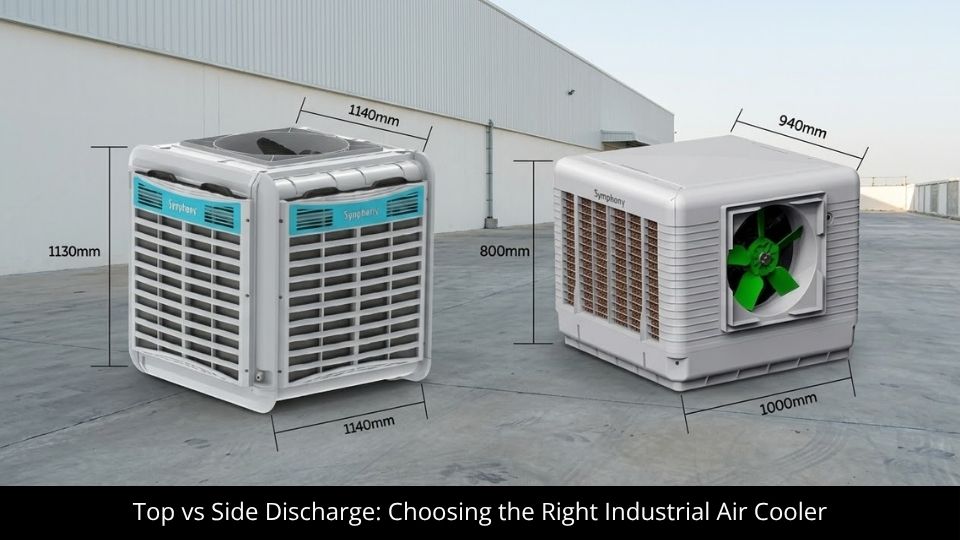




Table of Contents
Which Air Cooler is Better for Your Industry? - A Comprehensive Guide for Factory & Facility Managers
When it comes to industrial cooling solutions, facility managers and plant engineers across India and the world face a recurring and critically important decision: should they install a top discharge industrial air cooler or a side discharge industrial air cooler? On the surface, both types are evaporative air cooler industrial units that perform the same fundamental task: drawing in warm ambient air, passing it through water-saturated cooling pads, and circulating cooled, fresh air throughout the workspace. However, the direction in which cooled air is discharged — whether vertically upward through the top of the unit or horizontally outward from the side — has profound implications for how effectively the machine cools a given space, how well it suits a specific building layout, and how efficiently it performs in different industrial environments.
The difference between these two configurations is not merely technical — it is strategic. Choosing the wrong discharge type for your facility can result in uneven temperature distribution, poor airflow reach, energy waste, worker discomfort, and ultimately, a poor return on your industrial cooler investment. Conversely, selecting the right type — matched precisely to your building geometry, ceiling height, floor plan, and industry-specific cooling requirements — delivers dramatic improvements in comfort, productivity, and energy efficiency.
This comprehensive guide explores both configurations in depth, explains the engineering principles behind each, and — most importantly — provides industry-by-industry analysis of which type of industrial evaporative cooler delivers superior results and why. Whether you are searching for the best industrial cooling equipment for a warehouse, a textile mill, a food processing plant, a pharmaceutical facility, or a logistics hub, this guide will help you make the right decision. We will also cover key factors like industrial air cooler price in India, the role of industrial duct coolers, and what the top industrial cooler manufacturers in India recommend for different applications.
Understanding the Two Configurations
What Is a Top Discharge Industrial Air Cooler?
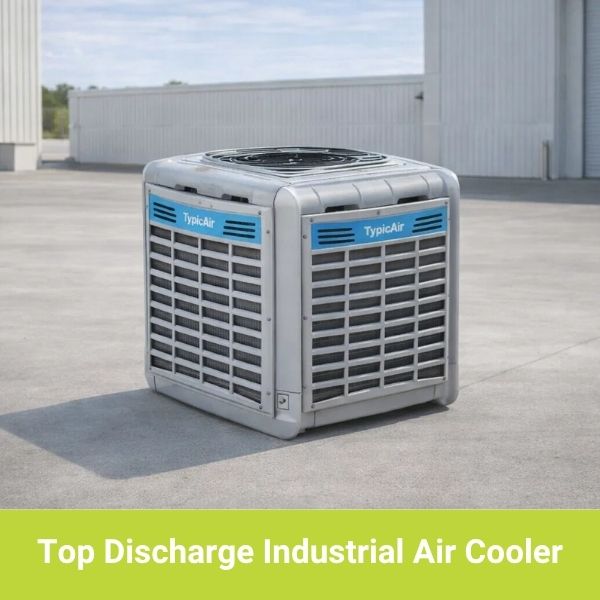
A top discharge industrial air cooler – sometimes called a top throw cooler or ceiling throw cooler – is designed so that the motor and fan assembly sits at the top of the unit and discharges cooled air vertically upward toward the ceiling. The warm ambient air is drawn in through the sides of the cooler where the evaporative cooling pads are located, passed through the water-wetted pads where evaporative cooling occurs, and then the cooled air is blown upward by the fan.
The cooled air rises to the ceiling, spreads horizontally across the ceiling plane, and then gradually descends as a cool air mass throughout the space. This top-down airflow pattern is sometimes called the ‘mushroom effect’ or ceiling distribution pattern. The result is a broad, even distribution of cool air across the entire floor area – particularly effective in large, open spaces with high ceilings.
Top discharge industrial evaporative coolers are typically larger, heavier units with high airflow capacity measured in CMH (Cubic Metres per Hour) or CFM (Cubic Feet per Minute). They are frequently used as the primary industrial cooling solution in factories, warehouses, and large open facilities where even floor-to-ceiling air distribution is the priority. Many top industrial cooler manufacturers in India, including those based in Ahmedabad, Coimbatore, and other manufacturing hubs, position top discharge units as their flagship industrial air cooling product for large-scale applications.
What Is a Side Discharge Industrial Air Cooler?
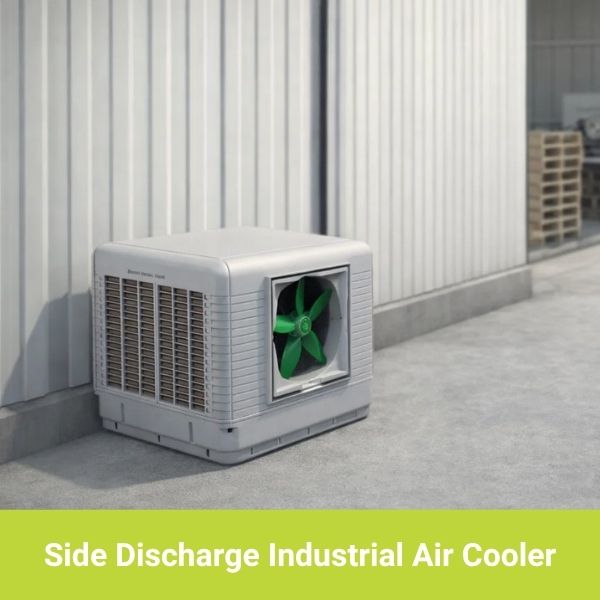
A side discharge industrial air cooler — also referred to as a front throw cooler or horizontal throw cooler — is configured so that the fan assembly is positioned on one side of the unit and discharges cooled air horizontally in a direct, focused stream. Warm air enters the unit through the cooling pad panels on the remaining three sides (or two sides in some configurations), is cooled through evaporation, and is then discharged as a powerful horizontal airflow by the fan.
The horizontal discharge pattern delivers a concentrated stream of cooled air that travels directly to the target zone — whether that is a workstation, a production line, a loading dock, or a specific section of a facility. Side discharge units are particularly effective in spaces with lower ceilings, narrow layouts, or when targeted spot-cooling is required rather than broad area coverage.
Industrial side discharge coolers are available in a wide range of sizes, from compact industrial ductless air cooler units suitable for smaller workshops and commercial spaces, to powerful large-capacity models used in mid-size factories and processing plants. Their flexibility, ease of positioning, and directional airflow control make them a versatile choice across many industrial and commercial settings. The industrial portable evaporative cooler — including industrial portable swamp coolers that can be relocated as needed — is most commonly a side discharge configuration.
Technical Comparison between Top Discharge Cooler and Side Discharge Cooler
Before diving into industry-specific recommendations, it is essential to understand how the two configurations compare across key technical and practical parameters. This comparison is critical for industrial cooler manufacturers, facility managers, and procurement teams evaluating industrial cooling units for their operations.
Parameter | Top Discharge Cooler | Side Discharge Cooler |
Airflow Direction | Vertically upward, then radially outward | Horizontally forward in direct stream |
Coverage Pattern | Broad 360° floor area coverage | Directional / zone-targeted coverage |
Ceiling Height Suitability | Best for high ceilings (14 ft+) | Suitable for low to medium ceilings (8–16 ft) |
Airflow Uniformity | Excellent — even temperature across floor | Good — concentrated in discharge direction |
Spot Cooling Capability | Limited — not ideal for spot cooling | Excellent — directed at specific zones |
Duct Compatibility | Can be connected to ducting on top | Can be connected to side discharge ducting |
Portability | Generally floor-mounted, less portable | Available in portable / mobile versions |
Installation Space | Compact floor footprint | Requires frontal clearance for discharge |
Maintenance Access | Side pads accessible; top motor accessible | Front/side pads accessible; front motor |
Typical Application Scale | Large factories, warehouses, hangars | Workshops, plants, commercial spaces |
Noise Profile | Moderate — fan at top, directed upward | Slightly higher — fan directed toward workers |
Energy Efficiency | High — minimal duct losses for open spaces | High — efficient for targeted zones |
Industrial Cooler Price | Generally higher (larger capacity) | Wide range — economy to premium |
Industry-by-Industry Analysis: Which Cooler Type Wins and Why?
Warehouses and Logistics & Distribution Centers
Recommended: Top Discharge Industrial Air Cooler
For warehouses and large logistics facilities, the top discharge industrial air cooler is the clear winner. The broad, even air distribution pattern makes it the ideal industrial cooling solution for these vast, open spaces.
Warehouses and distribution centers are among the most challenging environments to cool effectively. They typically feature very high ceilings — often 20 to 40 feet — enormous floor areas spanning tens of thousands of square feet, large rolling shutter doors that are frequently open for loading and unloading, and no internal partition walls. This combination of factors makes any industrial cooling equipment that relies on a sealed, recirculated air environment — such as an Industrial HVAC System or a traditional AHU unit — impractical and prohibitively expensive.
The top discharge industrial evaporative cooler is perfectly engineered for this environment. Positioned at regular intervals across the warehouse floor, top discharge units send cooled air upward to the ceiling, where it creates a cool air blanket that descends uniformly across the entire floor area. Workers at picking stations, packing lines, and loading docks all benefit from consistent cooling regardless of their position in the facility.
Multiple top discharge units can be deployed in a grid pattern to achieve complete coverage of even the largest warehouses. The fact that warehouse doors may be open periodically is also less of a concern with evaporative industrial air cooling — unlike air conditioning, evaporative coolers actually perform better with some air movement and fresh air intake. This makes them ideal for the semi-open environment of active logistics operations.
Top-rated industrial coolers for warehouse cooling from leading industrial cooler manufacturers in Ahmedabad and across India are specifically designed with high-CMH top discharge configurations for this application. When evaluating industrial air cooler price in India for warehouse applications, facility managers should calculate total coverage per unit and compare the operating cost advantage over Industrial HVAC alternatives.
- Very high ceilings enable optimal ceiling-bounce air distribution from top discharge units
- Even floor-level temperature across vast open floor areas without hotspots
- No sealed environment required — evaporative cooling thrives in semi-open warehouses
- Simple grid-pattern deployment across large floor areas
- Dramatically lower operating cost vs. Industrial HVAC System or central cooling
Our Other Product
Heavy Duty Industrial Cooler - Symphony Movicool XXLTextile Mills, Spinning Units, and Weaving Factories
Recommended: Top Discharge Industrial Air Cooler (with Ducting Option)
Textile mills and spinning units overwhelmingly prefer top discharge industrial evaporative coolers, often integrated with industrial duct cooler configurations, for their ability to maintain uniform temperature and humidity across large production floors.
The textile industry has uniquely demanding cooling requirements. In spinning, weaving, and yarn processing operations, consistent temperature and relative humidity are not merely comfort parameters — they directly affect product quality. Yarn breakages increase in overly dry or overly hot conditions; fabric dimensions and tension are affected by humidity fluctuations; and fiber processability changes with temperature variation. The industrial evaporative cooling system must therefore deliver even, consistent conditions across the entire production floor.
Top discharge industrial air coolers excel in this environment because their ceiling-level air distribution pattern creates a uniform thermal environment from wall to wall and row to row across the production floor. The evaporative cooling process also adds beneficial humidity to the air — a natural advantage in textile production where relative humidity between 55% and 65% is typically optimal for cotton spinning.
Large textile mills often deploy top discharge units in conjunction with an industrial duct cooler system, where the cooled air from the top discharge unit is distributed through a network of ducting to specific zones — carding rooms, draw frames, ring frames — requiring precise temperature and humidity control. This combination of evaporative air coolers industrial technology with ducted distribution represents the most advanced industrial cooling solution for textile applications.
Textile machinery generates significant radiant heat, and the ceiling-height placement of cooled air in the top discharge configuration means that fresh cool air continuously descends through the machinery environment, displacing the heat generated at machine level. This convective cooling effect is more efficient than direct horizontal discharge in a production floor where machinery fills most of the floor space.
- Uniform temperature and humidity across the entire production floor — critical for yarn and fabric quality
- Natural humidity addition through evaporative process benefits cotton and natural fiber processing
- Compatible with industrial duct cooler distribution for zone-specific control in large mills
- Ceiling-height air introduction displaces machinery radiant heat more effectively
- Lower operating cost vs. central AC or industrial air handling unit for the same coverage area
Food Processing Plants and Packaging Facilities
Recommended: Side Discharge Industrial Air Cooler (Non-Refrigerated Zones)
In food processing plants, side discharge industrial air coolers are preferred for non-refrigerated production and packaging zones where directed, controlled airflow to specific workstations is required while avoiding disruption to product handling areas.
Food processing facilities present a unique set of cooling challenges that make the discharge direction decision particularly important. These plants typically have a mix of temperature zones — cold storage and refrigerated processing areas (served by mechanical refrigeration), temperate processing zones for cutting, portioning, and preparation, and ambient packaging areas. The industrial cooler is primarily relevant for the temperate and ambient zones.
In food processing environments, uncontrolled or poorly directed airflow can be problematic. Strong top discharge air currents descending from ceiling level can potentially disturb open product on conveyor lines, create cross-contamination risks between different processing zones, or interfere with weighing and portion control equipment. Side discharge industrial air coolers, by contrast, can be positioned and directed precisely — angled to deliver cooled air to workers at processing stations without blowing directly over exposed product.
Side discharge units in food plants are often positioned along the perimeter of processing areas, directed inward toward worker zones. This configuration delivers effective worker-level cooling while maintaining controlled airflow that respects HACCP food safety protocols. The industrial ductless air cooler variant — a compact side discharge unit that operates without ducting — is particularly popular in smaller food processing and packaging facilities where flexibility and ease of cleaning are priorities.
For large food processing halls with high ceilings and open floor plans — such as flour mills, grain processing facilities, and large bakery operations — top discharge units may be appropriate in non-product-contact areas, but side discharge remains the preference for active product handling zones. Procurement teams evaluating industrial evaporative cooler price for food plant applications should factor in food-grade material requirements and ease-of-cleaning features.
- Precise directional control — cool workers without disturbing exposed product on lines
- Perimeter-mounted side discharge units maintain HACCP-compliant airflow patterns
- Industrial ductless air cooler variants ideal for smaller food plants and packaging areas
- Easier to isolate cooling zones — direct air to processing stations, not to adjacent cold zones
- Mobile industrial portable evaporative cooler units can be repositioned as production layout changes
Read Our Article
Evaporative Air Cooler Benefits for IndustryAutomobile and Auto Component Manufacturing Plants
Recommended: Top Discharge Industrial Air Cooler
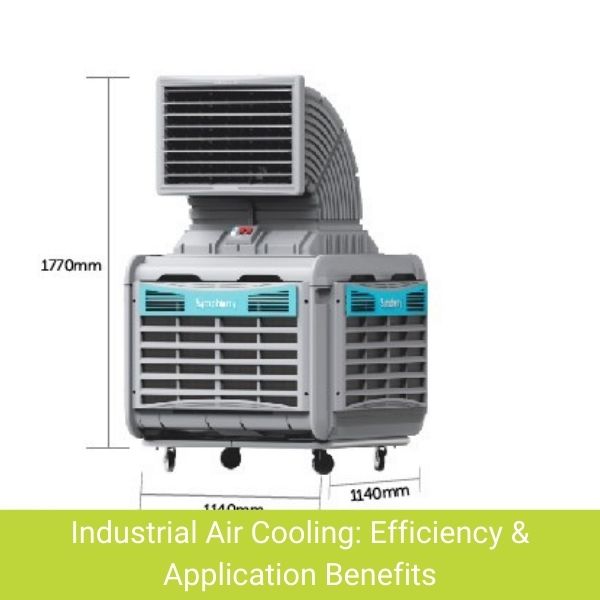
Automobile assembly plants and auto component manufacturing facilities strongly prefer top discharge industrial air coolers for their ability to deliver uniform cooling across very large, high-bay production floors without interfering with assembly line operations.
Automobile manufacturing plants represent some of the most demanding industrial cooling environments in the world. Assembly halls feature extremely high bay ceilings — typically 25 to 45 feet — enormous floor areas occupied by continuous assembly lines, heavy machinery and robotic equipment generating significant heat loads, and large vehicle access doors. Workers on the assembly line are often performing physically demanding tasks in high-heat conditions, making effective industrial air cooling critical for safety and productivity.
Top discharge industrial evaporative coolers are ideally suited to the automobile plant environment. Their high-ceiling air distribution creates a cool air envelope across the entire assembly hall floor — workers at every station along the assembly line receive consistent cooling regardless of their position. The large, open plan of assembly halls with high bays is exactly the environment where top discharge ceiling-bounce air distribution delivers its maximum benefit.
Auto component plants — pressed metal shops, machining centers, engine assembly units — similarly benefit from top discharge cooling. These facilities often have significant radiant heat from machining operations, welding stations, and heat treatment equipment. Top discharge units positioned above heat-generating workstations draw warm air upward (facilitated by the natural buoyancy of warm air) and continuously replace it with cool air descending from the ceiling zone.
The industrial air cooler price in India for large top discharge units suitable for automobile plants is significantly more favorable than equivalent Industrial HVAC System installations, both in capital cost and in ongoing energy consumption. Many automobile plants in India — including tier-1 and tier-2 supplier facilities — have adopted evaporative industrial air cooling as their primary cooling system, with notable improvements in worker comfort scores and production efficiency.
- High-bay ceiling heights in auto assembly halls perfectly match top discharge air distribution
- Continuous assembly line layouts benefit from uniform floor-level cooling without directional bias
- Radiant heat from welding and machining is displaced by continuous downward cool air movement
- No interference with overhead cranes, material handling systems, or assembly line structures
- Energy cost savings of 70–85% vs. Industrial HVAC System for equivalent coverage area
Pharmaceutical and Chemical Manufacturing Plants
Recommended: Side Discharge Industrial Air Cooler (with Filtration) or Industrial Duct Cooler
Pharmaceutical and chemical plants prefer side discharge industrial coolers or industrial duct cooler configurations, where airflow direction and filtration can be precisely controlled to meet GMP and safety compliance requirements.
Pharmaceutical manufacturing operates under strict regulatory frameworks — Good Manufacturing Practice (GMP) guidelines mandate precise control of temperature, humidity, air quality, and airflow patterns in production areas. These requirements make industrial air cooling system design a compliance issue as much as a comfort issue.
In pharma facilities, side discharge industrial air coolers or industrial duct cooler systems are preferred because they allow precise control of where cooled air goes and where it does not. Ductwork can be engineered to deliver filtered, cooled air to specific zones while maintaining cleanroom-level air management protocols. The directional nature of side discharge units makes it easier to design airflow patterns that do not cause cross-contamination between production zones or disturb sensitive processes.
Chemical plants similarly require controlled airflow to prevent the spread of chemical vapors, fumes, or dust to adjacent areas. A top discharge unit creating broad, turbulent ceiling-level circulation could inadvertently distribute airborne chemical particles throughout the facility — an unacceptable safety risk. Side discharge units, carefully positioned and directed, provide local cooling while maintaining zone isolation.
In non-critical utility and personnel areas of pharma and chemical plants — maintenance workshops, generator rooms, loading bays — top discharge units may be appropriate where compliance requirements are less stringent. But for active production areas, the controlled airflow of side discharge or ducted industrial cooling equipment is the standard recommendation from both regulators and experienced industrial cooler manufacturers.
- Directional airflow control supports GMP compliance and zone isolation requirements
- Industrial duct cooler configuration enables precisely engineered air distribution for each zone
- Avoids turbulent ceiling-circulation that could spread airborne particles or chemical vapors
- Filtration upgrades more easily integrated into side discharge or ducted systems
- Supports pharmaceutical cleanroom adjacent area cooling without compromising critical zones
Our Other Product
Ventilation Cooling System - Venti-Cool 11UPrinting, Packaging, and Paper Industries
Recommended: Side Discharge Industrial Air Cooler
Printing and paper industries prefer side discharge industrial evaporative coolers because of the need to control airflow direction carefully — preventing direct airflow over paper stock, printing substrates, and freshly printed materials.
The printing and packaging industry has a particular sensitivity to airflow management. Paper and printing substrates are highly sensitive to both temperature and humidity fluctuations — paper absorbs moisture from humid air and releases it in dry conditions, causing dimensional changes that affect print registration and cut accuracy. Freshly printed materials can be disturbed or contaminated by strong overhead airflow. Solvents and inks used in certain printing processes can create fire or health hazards if improperly ventilated.
Side discharge industrial air coolers are preferred in printing environments because their horizontal, directional airflow can be carefully aimed at worker areas and equipment heat sources while avoiding direct impingement on paper stock, ink trays, and printing substrates. The cooler can be positioned to cool the pressroom operators and the press heat without creating the turbulent ceiling-level circulation of a top discharge unit.
In large printing facilities — commercial printers, corrugated packaging plants, flexible packaging units — multiple side discharge units are deployed along the walls or between press lines, directed to cool the operational zones without creating cross-drafts that disturb fine print quality. Industrial ductless air cooler configurations are also popular in smaller print shops where a compact, easily repositioned cooling unit is preferred.
- Directional discharge avoids disturbing paper stock, substrates, and freshly printed materials
- Controlled horizontal airflow cools press operators and equipment without turbulent overhead circulation
- Prevents cross-drafts between printing zones that could cause registration errors
- Compatible with ventilation systems that exhaust solvent vapors without recirculation
- Industrial ductless air cooler variants ideal for small and mid-size print shops
Steel Plants, Foundries, and Metal Fabrication
Recommended: Top Discharge Industrial Air Cooler (High-Capacity)
Steel plants and metal fabrication facilities with very high bay areas and extreme heat loads prefer large, high-capacity top discharge industrial air coolers that can create meaningful cooling in the face of intense radiant and convective heat from metalworking operations.
Steel plants, rolling mills, foundries, and heavy metal fabrication shops represent the most extreme industrial cooling challenge — environments where ambient temperatures can reach 45–55°C or higher due to the radiant heat from furnaces, molten metal, and hot-rolling equipment. Conventional air conditioning or Industrial HVAC systems are completely impractical in these environments due to the impossibility of creating a sealed enclosure and the overwhelming heat loads involved.
High-capacity top discharge industrial air coolers — often the largest units available from industrial cooler manufacturers — are deployed in steel and foundry environments to provide meaningful heat stress relief for workers. The goal is not to air-condition the entire space to comfortable temperatures, but to create sufficient air movement and evaporative cooling effect to reduce apparent temperature at worker level, lowering heat stress risk and improving safety.
Top discharge units are preferred in these extreme environments because their high airflow volumes, directed upward, create maximum air movement across the entire facility floor. This air movement — even if the cooled air warms significantly before reaching worker level — dramatically reduces the perceived temperature through wind-chill and moisture evaporation effects. The ceiling-level distribution means that cooled air reaches workers approaching from all directions, not just from one side.
In some advanced steel plant cooling designs, top discharge industrial air coolers are supplemented by side discharge spot-cooling units positioned directly adjacent to particularly hot workstations — furnace charging areas, tap-out stations, roller entry zones — to provide localized relief at the highest heat exposure points.
- Maximum airflow volume from high-capacity top discharge units provides best heat stress relief in extreme heat environments
- Ceiling-level air distribution creates omnidirectional cooling effect at worker level
- Air movement wind-chill effect significantly lowers apparent temperature even in very high ambient conditions
- Works effectively in fully open or semi-open steel plant structures where sealed cooling is impossible
- Combination of top discharge area cooling + side discharge spot cooling for furnace-adjacent stations
Garment Manufacturing and Apparel Production
Recommended: Side Discharge Industrial Air Cooler
Garment factories and apparel manufacturing units prefer side discharge industrial air coolers because of their ability to deliver comfortable, even cooling at worker level along sewing lines, cutting tables, and finishing stations.
Garment manufacturing is a labor-intensive industry where worker comfort directly translates to productivity and quality. Sewing machine operators perform highly precise, repetitive tasks in close proximity to equipment that generates local heat. Cutting tables require flat, undisturbed fabric layouts. Finishing and pressing stations generate significant local heat from steam presses and ironing equipment.
Side discharge industrial air coolers are the preferred industrial cooling solution in garment factories because they deliver a controlled, horizontal airflow at worker level — cooling the operators at their sewing stations or cutting tables without creating the turbulent overhead circulation of top discharge units that could disturb lightweight fabric pieces, pattern paper, or interfere with pressing operations.
In typical garment factory layouts — long rows of sewing machines arranged in parallel production lines — side discharge units can be positioned at the ends of rows or along the side walls, directed to flow along the row, cooling operators as it passes. This directional cooling approach ensures that every worker along the line receives airflow. The relatively lower ceiling heights of most garment factory buildings (typically 12–18 feet) also make side discharge units more appropriate than top discharge configurations.
For very large garment factories with high-ceiling construction and very long sewing lines, a combination approach — top discharge units for overall temperature reduction combined with side discharge units for worker-level comfort — is increasingly adopted by garment exporters seeking to meet international buyer requirements for humane working conditions. Industrial air cooler suppliers across India offer both configurations for garment industry applications.
- Worker-level horizontal airflow perfectly suited to sewing line and cutting table cooling
- Controlled discharge avoids disturbing lightweight fabric pieces, patterns, and finished garments
- Suitable for the lower ceiling heights common in garment factory buildings
- Row-end positioning allows airflow along entire production lines
- Meets international buyer and compliance requirements for worker thermal comfort
Poultry Farms, Dairy Sheds, and Agricultural Buildings
Recommended: Side Discharge Industrial Evaporative Cooler + Exhaust Fans
Poultry and dairy facilities rely on side discharge evaporative coolers working in combination with exhaust fans to create a negative-pressure tunnel ventilation system — the most effective industrial cooling solution for livestock environments.
Poultry and livestock welfare are critically dependent on effective temperature control. In broiler poultry farms, temperatures above 30°C can cause significant heat stress, reducing feed conversion, lowering growth rates, and in extreme cases causing mass mortality. Dairy cattle produce substantially less milk in hot conditions. Effective industrial cooling is not just a comfort issue in these facilities — it is an economic necessity.
The gold standard for poultry and dairy cooling is tunnel ventilation — a system where side discharge evaporative coolers are installed at one end of the building (the air intake end) and high-volume exhaust fans are installed at the opposite end (the air exhaust end). The negative pressure created by the exhaust fans draws cooled, humidified air from the evaporative coolers through the entire length of the building at high velocity, creating a powerful wind-chill cooling effect throughout the animal housing area.
Side discharge industrial air coolers are essential to this system — the horizontal, directed discharge is precisely what is required to project cooled air into the tunnel ventilation flow. Top discharge units would be incompatible with tunnel ventilation because their vertical air discharge would not integrate into the horizontal airflow pattern required. Compact, high-efficiency side discharge evaporative air cooler industrial units — including industrial desert cooler variants adapted for agricultural use — are widely used in this application across Rajasthan, Gujarat, Maharashtra, and other hot-climate agricultural regions of India.
- Tunnel ventilation system requires horizontal discharge — side discharge units are essential
- High wind-chill effect from high-velocity horizontal airflow delivers powerful heat stress relief
- Consistent cooling along the entire length of poultry houses, regardless of building length
- Combined with exhaust fans — a complete, cost-effective industrial cooling system for agriculture
- Industrial evaporative cooler price in India for agricultural units is highly favorable vs. refrigerative alternatives
Commercial Spaces, Auditoriums, and Large Event Venues
Recommended: Top Discharge Industrial Air Cooler
Large commercial spaces, auditoriums, wedding halls, and event venues benefit most from top discharge industrial air coolers, which provide broad, even cooling across densely occupied floor areas — creating comfortable conditions for large gatherings.
Commercial large-space cooling presents a distinctive challenge: the space must be cooled effectively during peak occupancy — when body heat from hundreds or thousands of people creates significant thermal load — but the cooling system must not create disruptive airflows that interfere with the experience. Auditoriums, wedding halls, exhibition centers, and sports arenas need cooling that feels comfortable to everyone in the space, regardless of where they are seated or standing.
Top discharge industrial air coolers are ideal for this application. Positioned at strategic intervals across the venue floor or around the perimeter, top discharge units send cooled air to ceiling level, from where it descends uniformly across the entire occupied area. Guests experience a gentle, uniform cooling effect — the cool air descends without creating the strong directional draft that side discharge units can produce, making it more comfortable for formal events like weddings, conferences, and performances.
The industrial evaporative cooling approach is also particularly well-suited to venues with high ceilings — wedding halls, mandaps, and pavilions commonly feature decorative high ceilings or open-sided structures where Industrial HVAC would be impractical. Top discharge industrial air coolers can be deployed on a rental or permanent basis and provide impressive cooling performance at a fraction of the operational cost of equivalent air conditioning capacity.
Industrial air cooler for home applications and semi-commercial uses — such as large farmhouses, guest houses, and banquet spaces — increasingly feature top discharge configurations as homeowners and hospitality operators seek energy-efficient alternatives to central AC. The growing market for industrial air cooler for home use in India reflects widening awareness of evaporative cooling benefits.
- Gentle, uniform descent of cooled air from ceiling level — comfortable for all guests
- Broad coverage of entire venue floor area without directional drafts
- Ideal for open-sided or semi-open venues where HVAC is impractical
- Highly cost-effective vs. Industrial HVAC or Industrial HVAC System for occasional-use venues
- Portable top discharge models available for rental deployment at temporary event venues
Manufacturing Support Areas, Generator Rooms, and Utility Spaces
Recommended: Side Discharge Industrial Air Cooler or Industrial Duct Cooler
Utility areas, generator rooms, electrical substations, and manufacturing support spaces benefit from targeted side discharge cooling or industrial duct cooler configurations that direct cooling precisely where heat loads are concentrated.
Industrial facilities contain numerous support spaces — generator rooms, electrical rooms, compressor houses, transformer substations, maintenance workshops — that generate concentrated heat loads and require effective cooling to protect equipment and ensure safe working conditions for maintenance personnel. These spaces are typically smaller, more enclosed, and have specific heat sources that require targeted cooling rather than broad area coverage.
Side discharge industrial air coolers or industrial duct cooler systems are the preferred choice for these applications. A side discharge unit can be positioned to direct cooled air precisely toward the heat-generating equipment — generator sets, air compressors, electrical switchgear — providing both worker comfort and equipment heat protection. Industrial duct cooler configurations allow cooled air from a single evaporative unit to be distributed through a simple duct network to multiple equipment rooms within a utility area.
The industrial ductless air cooler — a self-contained side discharge unit that requires no duct installation — is particularly practical for existing utility areas where retro-fitting ducting would be complex or disruptive. These units can be installed quickly, directed at specific heat sources, and repositioned if equipment layouts change. Leading industrial cooler manufacturers in Ahmedabad and other Indian manufacturing centers offer a range of compact industrial cooling units specifically sized for utility and support space applications.
- Targeted side discharge directly toward heat-generating equipment — generators, compressors, switchgear
- Industrial duct cooler distribution to multiple utility rooms from a single evaporative unit
- Industrial ductless air cooler for quick installation in existing spaces with no duct retro-fit
- Compact industrial cooling units sized specifically for smaller support spaces
- Protects equipment from heat stress in addition to providing worker comfort
When to Combine Both: Hybrid Deployment Strategies
In many large industrial facilities, the optimal industrial cooling solution is not a choice between top discharge and side discharge — it is a strategic combination of both. Experienced industrial cooler manufacturers and cooling system designers often recommend hybrid deployment strategies that leverage the strengths of each configuration for different zones within the same facility.
Common Hybrid Deployment Scenarios
- Large Textile Mills: Top discharge units for general floor cooling across spinning and weaving halls + side discharge units at specific high-heat zones like ring frame sections and maintenance workshops
- Automobile Assembly Plants: Top discharge units for assembly floor + side discharge or industrial duct cooler for paint shop support zones and quality control areas
- Large Food Processing Plants: Top discharge units for dry goods warehousing areas + side discharge units for active processing and packaging lines
- Steel Plants: High-capacity top discharge units for general shop floor + side discharge spot coolers at individual furnace and welding stations
- Large Warehouses with Office Mezzanines: Top discharge units for the warehouse floor + side discharge or industrial ductless air cooler units for the office and mezzanine level
The hybrid approach requires careful airflow modeling and system design — ideally carried out by experienced cooling system designers from reputable industrial cooler manufacturers. When evaluating industrial air cooler suppliers for a large project, ask specifically whether the supplier’s engineering team can provide computational fluid dynamics (CFD) based airflow analysis for your facility, ensuring that the combination of top and side discharge units delivers optimal coverage without airflow conflicts.
Key Factors for Industrial Cooler Selection
For Top Discharge Industrial Air Coolers
Ceiling height: Minimum 14 feet for effective air distribution; optimal performance at 18–35 feet
- Airflow capacity (CMH): Calculate required CMH based on floor area × ceiling height × air changes per hour target (typically 20–40 ACH for industrial applications)
- Cooling pad area: Larger pad area = more evaporative cooling surface = lower discharge air temperature
- Motor power and fan design: Look for energy-efficient motors (IE2/IE3 rated) and aerodynamic fan blades that maximize CMH per watt
- Water distribution system: Uniform water distribution across the full pad area is critical — uneven distribution creates hot spots in the cooled air stream
- Number of units and placement: Use industrial cooler manufacturer’s coverage charts to determine optimal unit quantity and grid spacing for your floor area
For Side Discharge Industrial Air Coolers
- Discharge throw distance: Match the machine’s throw distance to the width or length of the zone being cooled — units are typically rated for 15m, 25m, or 40m throw
- Discharge angle adjustability: Louvered or adjustable discharge allows fine-tuning of airflow direction for precise zone targeting
- Portability requirements: If the unit needs to be relocated, consider an industrial portable evaporative cooler with castor wheels and a compact footprint
- Noise level: Side discharge units direct airflow toward occupants — lower noise models are important in office-adjacent or customer-facing environments
- Duct connection provision: If future ducting may be required, select a model with a duct collar provision on the discharge face
- Water tank capacity: Larger water tanks extend run time between top-ups, important in facilities where continuous water supply connection is not convenient
Our Other Products
Movicool L 65-S Commercial Cooler (65-litres)Industry-wise Quick Reference: Top vs. Side Discharge
Industry / Application | Preferred Type | Primary Reason |
Warehouses & Logistics | Top Discharge | High ceilings + broad even floor coverage |
Textile & Spinning Mills | Top Discharge | Uniform temp/humidity across production floor |
Food Processing Plants | Side Discharge | Controlled airflow, avoids product contamination |
Automobile Assembly | Top Discharge | High bay, continuous assembly line, radiant heat |
Pharma & Chemical Plants | Side / Duct | GMP compliance, zone isolation, filtration control |
Printing & Packaging | Side Discharge | Prevents paper/substrate disturbance, draft control |
Steel Plants & Foundries | Top Discharge | Max airflow volume for extreme heat environments |
Garment Manufacturing | Side Discharge | Worker-level cooling, avoids fabric disturbance |
Poultry & Dairy Farms | Side Discharge | Tunnel ventilation system requires horizontal flow |
Commercial Venues & Halls | Top Discharge | Gentle uniform cooling for dense occupancy |
Generator & Utility Rooms | Side / Duct | Targeted cooling at heat sources |
Construction Sites | Side Portable | Mobility, easy repositioning, no fixed installation |
Workshops & Small Factories | Side Discharge | Lower ceilings, defined work zones, cost-effective |
Conclusion
The choice between a top discharge and a side discharge industrial air cooler is one of the most consequential decisions in industrial cooling system design. As this guide demonstrates, neither configuration is universally superior — each excels in specific environments, building geometries, and industry applications. The key to making the right decision is understanding the airflow physics behind each type and matching those characteristics to the specific requirements of your facility.
Top discharge industrial evaporative coolers are the champions of large, high-bay, open-plan spaces — warehouses, automobile assembly halls, steel plants, textile mills, and commercial venues — where broad, even air distribution across vast floor areas is the primary requirement. Their ceiling-bounce distribution pattern creates comfortable, uniform conditions for workers across the entire space.
Side discharge industrial air coolers are the specialists of targeted, directional cooling — food plants, garment factories, printing units, poultry farms, and utility rooms — where controlled airflow direction is critical, space constraints limit ceiling height, or worker-level zone cooling is more important than broad area coverage. Their flexibility and portability in industrial portable evaporative cooler formats make them the most versatile member of the industrial cooling equipment family.
India’s industrial cooler manufacturers — particularly the top 10 industrial cooler manufacturers in India concentrated in Ahmedabad and other manufacturing centers — produce world-class industrial air cooling systems in both configurations. Whether you are looking for an industrial evaporative cooler for a new facility, replacing aging cooling units, or exploring industrial cooling solutions for an expansion project, the Indian industrial cooler manufacturer ecosystem offers options across every price point, capacity range, and technical specification.
The industrial air cooler price in India represents extraordinary value for money compared to Industrial HVAC systems or conventional air conditioning — delivering 70–90% lower operating costs with excellent cooling performance in the semi-open and open industrial environments where the majority of Indian manufacturing takes place. By selecting the right discharge configuration for your industry and facility, you ensure that your investment in industrial evaporative cooling delivers maximum return — in worker comfort, productivity, and energy efficiency — for years to come.
Frequently Asked Questions
Top Discharge vs. Side Discharge Industrial Evaporative Air Coolers
Can I use a top discharge industrial air cooler in a low-ceiling factory?
For ceilings below 12 feet, top discharge units are generally not recommended as the upward air throw has insufficient height to spread properly before descending. Side discharge or industrial ductless air cooler configurations are more appropriate for low-ceiling environments.
How do industrial air coolers compare to Industrial HVAC Systems on energy cost?
Industrial evaporative air coolers typically consume 70–90% less electricity than equivalent capacity Industrial HVAC or central air conditioning systems. A large industrial air cooler consuming 3–5 kW can cool a space that would require a 15–25 kW Industrial HVAC compressor system. This operating cost advantage is the primary driver of adoption across Indian industry.
Where can I find the top 10 industrial cooler manufacturers in India?
The highest concentration of top industrial cooler manufacturers and industrial air cooler suppliers is in Ahmedabad (Gujarat), followed by Coimbatore (Tamil Nadu), Rajkot (Gujarat), Mumbai (Maharashtra), and Surat (Gujarat). Industrial cooler manufacturer in Ahmedabad listings represent some of the most competitive and technically advanced producers in the country.

Maulik Solanki is a seasoned B2B Product Marketing professional specializing in Industrial and Commercial Coolers in the LSV (Large Space Venticooling) segment. With 13+ years of experience, he drives brand building and audience engagement for Symphony’s LSV solutions through integrated offline and online strategies. Backed by an MBA in Marketing and earlier experience as a Regional Marketing Manager in banking, Maulik brings strong skills in sales, advertising, and events. He enjoys exploring new marketing ideas and cooling technologies and writes to help readers understand Symphony’s offerings.

Sourav Biswas is a senior marketing leader heading the LSV (Large Space Venticooling – B2B) marketing function at Symphony Limited. He shapes the brand’s strategic narrative, strengthens market leadership, and ensures excellence across all B2B cooling solutions. With deep expertise in Strategic Marketing, Brand Management, Advertising, and PR, he reviews content with analytical precision and alignment to Symphony’s vision. Passionate about mentoring and tracking B2B trends, Sourav ensures every content piece reflects accuracy, relevance, and strategic depth.