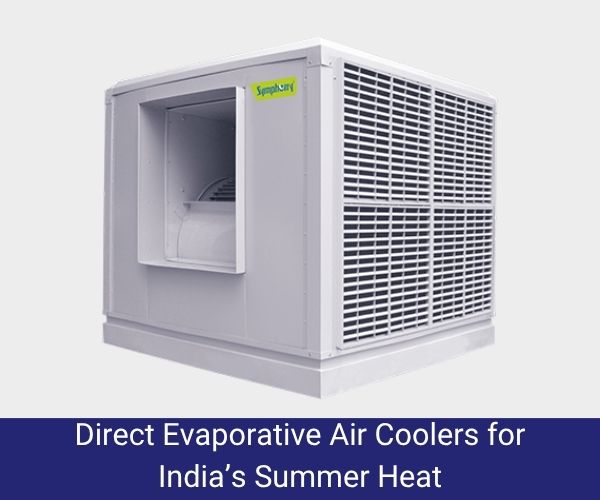
India’s hot and dry interior climate makes it a natural fit for evaporative cooling technology. This article examines the working principles of direct and indirect evaporative cooling, draws a clear technical comparison between the two and explains why the direct evaporative air cooling system is the more appropriate choice for India’s industrial and commercial sectors. It also covers how evaporative cooling equipment is applied across key Indian industries and what separates a capable evaporative air cooler manufacturer from the rest.
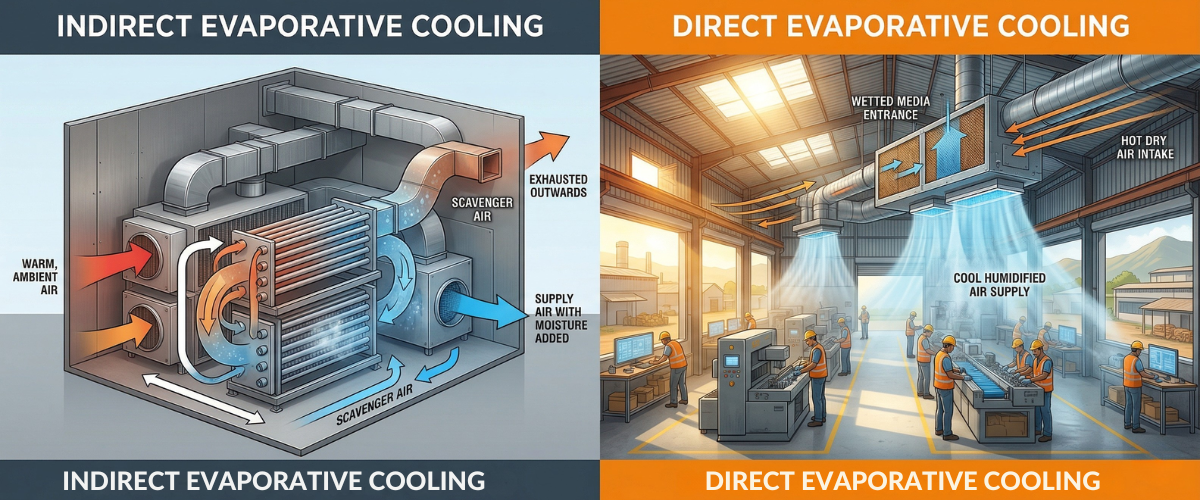
Table of Contents
How Direct Evaporative Air-Cooling Works?
In a direct evaporative air-cooling system, warm outdoor air is drawn through water-saturated porous pads. As air passes through the wet media, water evaporates directly into the airstream, simultaneously reducing the dry-bulb temperature and increasing relative humidity. The outlet air temperature approaches the wet-bulb temperature of the incoming air – modern high-efficiency pads achieve saturation efficiencies between 85% and 95%, delivering very close to the theoretical maximum cooling.
The system architecture is simple: a water pump, a distribution header, evaporative pads and a fan. This mechanical simplicity reduces failure points and keeps maintenance requirements low. High-volume evaporative air coolers built around this principle can deliver airflows from 10,000 to over 100,000 cubic metres per hour per unit, making them well-suited to large industrial spaces where air change rates are critical.
Evaporative Cooling System: How Indirect Cooling Works?
Indirect evaporative cooling applies the same evaporative principle but separates the working air and the supply air using a heat exchanger. The working air stream passes over a wet surface, evaporation cools the surface and this cooled surface reduces the temperature of the primary supply air flowing on the other side – without any moisture being added to it. The result is sensible cooling with no humidity increase in the delivered air.
The theoretical cooling limit for indirect systems is the dew point temperature, which is always lower than the wet-bulb temperature. However, reaching this limit demands high-effectiveness heat exchangers, which add system complexity, cost and maintenance requirements. Indirect evaporative cooling is used in environments where humidity addition is operationally problematic – pharmaceutical manufacturing, data centres and specific laboratory conditions.
Evaporative Coolers: Key Technical Differences
The primary distinction is moisture. Direct evaporative coolers add humidity to the supply air; indirect systems do not. In dry climates, the moisture added by direct systems actually improves occupant comfort by raising relative humidity from uncomfortably low levels into the recommended 40%–60% RH comfort range. In already-humid conditions, however, this becomes a limitation.
From an energy standpoint, direct evaporative cooling equipment consumes significantly less power – the load is limited to a fan motor and a small pump, with no compressor. Indirect systems require additional fan capacity for the working air stream and lose efficiency to heat exchanger thermal resistance. For equivalent airflow and cooling output under arid conditions, indirect systems consume more energy and involve greater capital expenditure.
Our Other Product
Industrial Ducting CoolerWhy Direct Evaporative Air Coolers Suits India Best?
India’s pre-monsoon summer months – March through June – bring dry-bulb temperatures exceeding 40°C with relative humidity often below 25% across Rajasthan, Gujarat, Maharashtra, Madhya Pradesh and much of the Deccan Plateau. The wet-bulb depression in these regions can reach 18°C to 22°C during peak summer. A direct evaporative air cooler operating at 90% saturation efficiency in these conditions can supply air at temperatures 16°C to 20°C below ambient – a substantial cooling effect achieved with a fraction of the electricity that mechanical refrigeration would consume.
Indirect evaporative cooling underperforms in this context for practical reasons. Its greater system complexity and cost are difficult to justify in the mid-market industrial segment that forms the core of India’s cooling demand. Additionally, during the monsoon when outdoor humidity rises sharply, indirect systems deliver near-zero cooling benefit. Direct evaporative air coolers, by contrast, continue to provide high-volume fresh air delivery and partial cooling even under elevated humidity – a critical advantage in facilities that operate year-round.
India’s large industrial base – textiles, automotive assembly, warehousing, food processing, fabrication – operates in high-bay facilities with large floor areas and continuous heat loads. Evaporative cooling equipment engineered for industrial use provides the airflow volumes these spaces require at operating costs that centralised refrigerant systems cannot match. For a facility running continuous shifts across tens of thousands of square metres, the energy consumption difference between evaporative and refrigerant-based cooling represents a significant cost advantage over the equipment lifetime.
Domestic manufacturing by an experienced evaporative air cooler manufacturer also supports India-specific customisation – pad configurations, water circuit designs suited to local water quality and ducting arrangements for specific building layouts. This local engineering capability, combined with accessible spare parts and service networks, gives direct evaporative cooling a practical edge that imported or complex systems cannot replicate at scale across India’s diverse industrial geography.
The sheer scale of India’s unmet cooling demand also reinforces the case for direct evaporative cooling. Millions of workers in factories, warehouses and processing facilities across India’s interior states spend long hours in environments where ambient summer temperatures without any cooling intervention would be physically hazardous. Direct evaporative air coolers provide an accessible, reliable and cost-effective means of addressing this gap – one that does not require the level of capital investment, grid infrastructure or technical expertise that centralised chilled-water systems demand.
Conclusion
Direct evaporative cooling is the most logically aligned cooling technology for India’s dominant climate conditions and industrial cooling requirements. Delivered through high-efficiency evaporative air coolers, it offers meaningful temperature reduction at low energy cost in precisely the dry, high-temperature conditions that characterise India’s peak demand months. While indirect evaporative cooling serves specific niche applications, the scale, geography and practical infrastructure of India’s cooling market consistently favour the direct approach – particularly when supported by a knowledgeable evaporative air cooler manufacturer with the capability to engineer for local conditions.
Frequently Asked Questions (FAQs)
What is Direct Evaporative Cooling & Indirect Evaporative Cooling? Why is the Direct Evaporative Cooler the Most Suitable for India?
What is the core difference between direct and indirect evaporative cooling?
Direct evaporative cooling adds moisture to the supply air as part of the cooling process. Indirect evaporative cooling cools the air through a heat exchanger without adding any moisture. Direct systems suit dry climates; indirect systems are preferred where humidity addition is unacceptable.
Why is a direct evaporative air-cooler system preferred for Indian industries?
India's dry summer climate creates large wet-bulb depressions that allow direct evaporative systems to achieve significant temperature reductions. Combined with lower energy consumption, simpler maintenance and the ability to deliver high airflow volumes, the direct evaporative air-cooling system is the practical choice for most Indian industrial applications.
What should one look for in an evaporative air cooler manufacturer?
Pad quality and saturation efficiency, water management system design, fan and motor specifications and the manufacturer's ability to customise installations for specific industrial layouts are the key parameters. After-sales service availability and familiarity with regional water quality conditions are equally important for long-term operational reliability.
Where is evaporative cooling equipment most widely used in India?
Evaporative cooling equipment is extensively used in textile mills, automotive plants, logistics warehouses, food processing units and fabrication facilities - particularly across Gujarat, Rajasthan, Maharashtra and Madhya Pradesh, where the hot and dry summer climate maximises system performance. These sectors share a common requirement for large-volume conditioned air delivery at manageable operating costs, which is precisely what industrial-grade evaporative cooling delivers.
How does an evaporative air cooler manufacturer support industrial installations in India?
A capable evaporative air cooler manufacturer provides engineering support from project design through commissioning - specifying the right airflow volumes, pad types, water circuit design and distribution layout for each facility. In India, where building layouts, water quality and operational requirements vary widely, this engineering expertise is what ensures the installed system performs as specified over its full operational life.

Maulik Solanki is a seasoned B2B Product Marketing professional specializing in Industrial and Commercial Coolers in the LSV (Large Space Venticooling) segment. With 13+ years of experience, he drives brand building and audience engagement for Symphony’s LSV solutions through integrated offline and online strategies. Backed by an MBA in Marketing and earlier experience as a Regional Marketing Manager in banking, Maulik brings strong skills in sales, advertising, and events. He enjoys exploring new marketing ideas and cooling technologies and writes to help readers understand Symphony’s offerings.

Sourav Biswas is a senior marketing leader heading the LSV (Large Space Venticooling – B2B) marketing function at Symphony Limited. He shapes the brand’s strategic narrative, strengthens market leadership, and ensures excellence across all B2B cooling solutions. With deep expertise in Strategic Marketing, Brand Management, Advertising, and PR, he reviews content with analytical precision and alignment to Symphony’s vision. Passionate about mentoring and tracking B2B trends, Sourav ensures every content piece reflects accuracy, relevance, and strategic depth.