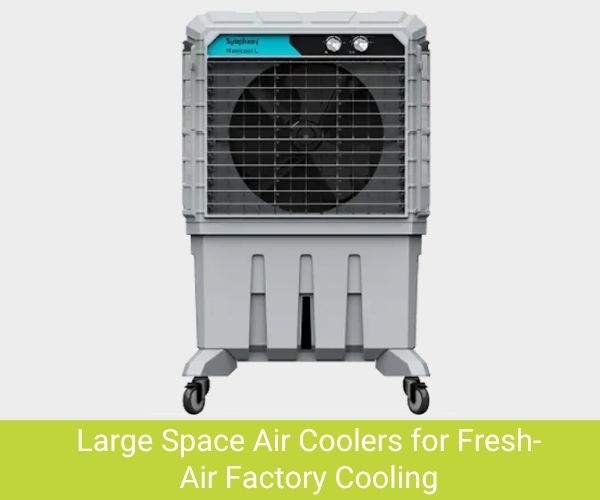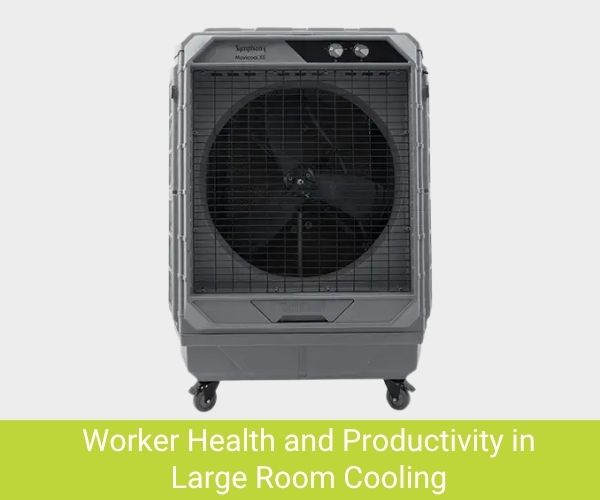
Symphony Venticool

Read AI-Generated Summary:

Plastic and injection moulding plants are among the most thermally demanding manufacturing environments, where continuous machine operation, heat-radiating hydraulic systems and compact facility layouts combine to push ambient temperatures well beyond comfortable or safe working limits. Conventional cooling approaches – ceiling fans, split air conditioners or open-door ventilation – consistently fall short of managing this heat load across large production floors. Symphony Large Space Venti Cooling addresses this industrial challenge through a purpose-built evaporative air cooling system that is specifically engineered for high-heat, high-volume manufacturing spaces. This article examines the unique thermal challenges of plastic and injection moulding facilities, the conditions that make conventional cooling ineffective and how large space coolers from Symphony have been deployed across real-world installations in India to create measurable improvements in worker comfort and production floor air quality.

0:00 / 0:00

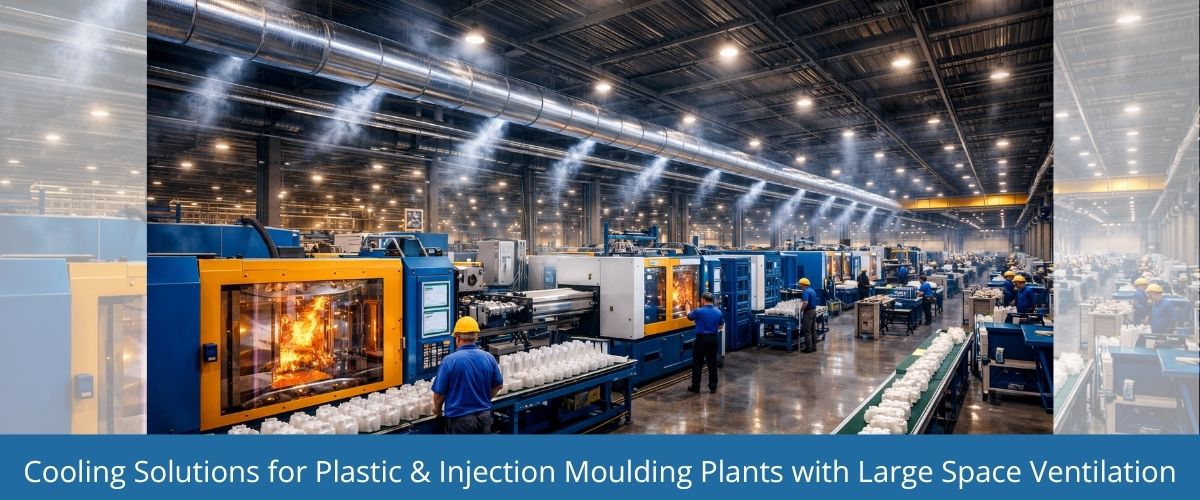
Injection moulding is a process that involves the repeated heating of raw polymer pellets to extreme temperatures, followed by high-pressure injection into metal moulds. Every machine on the production floor operates as a heat source – the barrel heaters, hydraulic power packs and mould cooling circuits all contribute to a cumulative thermal load that, in facilities running multiple machines simultaneously, can push floor-level temperatures to 40°C and above during Indian summers.

Unlike metal fabrication or warehousing, where heat tends to be localised, injection moulding plants generate distributed heat across the entire production area. Every active moulding machine adds to the ambient temperature. The closer the machines are to one another – as is common in high-throughput facilities – the more difficult it becomes to dissipate that heat through passive or low-volume ventilation. Workers stationed at these machines for extended shifts face not only physical discomfort but also reduced alertness, which directly impacts quality control and productivity.

This distributed, persistent heat generation is precisely the condition for which a well-designed evaporative cooling system becomes operationally critical rather than merely a comfort measure.

Need More Information?

Evaporative Air Cooler Deployment: Why Conventional Cooling Fails on Plastic Manufacturing Floors?

Standard split air conditioning units are sealed-loop systems designed for insulated rooms with limited occupancy. A typical injection moulding hall – with its metal roofing, open machine bays, loading dock access and continuous heat generation from processing equipment – creates conditions that render split ACs operationally and economically unworkable. The infrastructure cost of installing enough cooling capacity across a 10,000 to 35,000 square-foot facility, the energy consumption under continuous industrial load and the inability of closed-loop refrigerant systems to handle the fresh air volumes that industrial hygiene standards require, all point away from conventional air conditioning as a viable solution.

Industrial ceiling fans address air movement but offer no temperature reduction. They circulate hot air rather than cool it, providing minimal relief when ambient temperatures exceed the comfort threshold. During peak summer conditions, a ceiling fan above a running injection moulding machine merely redistributes the same hot air more evenly across the worker’s body – an outcome that offers no meaningful improvement in thermal comfort or workplace safety.

The large space air cooler operates on a fundamentally different principle. Rather than recycling indoor air, it draws fresh outdoor air through water-saturated cellulose pads, reduces its temperature through evaporative heat exchange and delivers cooled air into the production space – continuously replacing hot stagnant air with cooler, fresher air. For facilities where door openings, machine exhaust ports and roof penetrations mean the building is never truly sealed, an evaporative cooling system that thrives in semi-open conditions is inherently better matched to the operational reality.

Large Space Coolers: Ducted Distribution and Coverage across Multi-Machine Floors

One of the defining engineering requirements of cooling a large injection moulding floor is achieving uniform air distribution across all working zones – not just near the cooler unit itself. A single evaporative air cooler positioned at one end of a 12,000 or 35,000 square-foot facility will cool the immediate area effectively but leave distant machine stations untreated. This is where ducted distribution becomes the defining factor in a successful industrial cooling installation.

Symphony large space coolers are specifically designed to interface with ducting systems that extend cooled air deep into the production floor. The cooler units are mounted at ceiling level or on rooftop platforms, with insulated sheet metal ducts running the length of the building and terminating in direct grills at pre-determined intervals above the machine line. This approach ensures that every machine operator receives cooled air regardless of their position within the facility. It also allows a single large evaporative air cooler – or a coordinated network of units – to serve areas that would otherwise require prohibitively expensive centralised air conditioning.

The ducted delivery method is particularly effective in injection moulding environments because it can be directed precisely at the working height of machine operators, rather than at ceiling level where much of the heat accumulates. Targeted downward discharge into the occupied zone maximises the cooling effect per unit of airflow, making the system more responsive to the thermal conditions workers actually experience.

Evaporative Cooling Equipment Installation: Real-World from Bhakti Polymers, Ahmedabad

One of the most instructive real-world deployments of Symphony’s evaporative cooling equipment in an injection moulding context is the installation at Bhakti Polymers, Ahmedabad, completed in March 2021. This facility spans 12,000 square feet and operates a multi-machine injection moulding production line – a layout that presents the classic distributed heat generation challenge described above.

For this project, Symphony deployed 9 units of the PAC 25U – a ceiling-mounted, down-discharge large space cooler featuring four-side cooling pads for maximised evaporative surface area and superior air cooling performance. The PAC 25U units were installed at ceiling height and connected to 30-foot ducting with direct grills, ensuring that cooled air was delivered at the machine-operator level across the full length of the production floor. The four-side pad configuration of the PAC 25U is particularly well-suited to industrial environments like this one, as it maximises the volume of air that passes through wetted media per unit, producing a higher airflow volume of cooled air per installed unit compared to single-face configurations.

The use of a central evaporative cooler network with ducted distribution – rather than multiple standalone portable units – reflects Symphony’s approach to industrial cooling: engineer the system to match the geometry and operational pattern of the production space, rather than adapting the production space to the limitations of the cooling equipment. In the Bhakti Polymers installation, this meant ceiling-level mounting to keep the floor clear for material handling and machine maintenance and duct lengths calibrated to the machine row spacing. For more information, Visit this link:

This deployment pattern is representative of how Symphony large space coolers are applied across the injection moulding sector in India – installations engineered around the specific floor plan, machine layout and climate conditions of each facility, rather than off-the-shelf configurations.

We are Responsive

Energy-Efficient Industrial Coolers for Large Spaces: The Operating Economics of Plastic Plant Cooling

For plant owners and facility managers evaluating cooling options, the total cost of operation over a multi-year period is as important as the upfront investment. Energy-efficient industrial coolers for large spaces offer a fundamentally different operating cost structure compared to refrigerant-based cooling systems. Evaporative air coolers consume a fraction of the electrical power required by equivalent-capacity air conditioning installations – an important consideration for injection moulding plants that run multiple production shifts and operate cooling systems for eight or more hours per day throughout the summer months.

Because the evaporative cooling system does not use compressors or refrigerants, maintenance requirements are also lower. The primary consumable components are the cellulose cooling pads, which require periodic inspection and replacement and the water distribution system, which requires routine cleaning to prevent mineral deposits. For facilities that already have maintenance staff handling injection moulding machine servicing, adding evaporative cooler pad maintenance to the schedule represents a manageable additional workload – particularly compared to the specialised refrigerant handling that split AC maintenance requires.

When evaluating the total operational picture, the combination of lower running costs, lower maintenance complexity and the ability to cool large semi-open spaces that would be prohibitively expensive to condition with refrigerant-based systems positions the large space air cooling system as the economically rational choice for the injection moulding industry.

Large Space Cooler Selection: Matching Unit Capacity and Configuration for Different Facilities

Not all injection moulding facilities are the same and effective cooling requires matching the cooler capacity and discharge configuration to the specific geometry of each plant. Symphony’s industrial range offers down-discharge, side-discharge and bottom-discharge variants across multiple capacity classes – allowing integrators to select the configuration that best matches the building structure, roof type and internal layout of each facility.

For smaller injection moulding operations – such as a 6,000 square-foot facility like the Mungerkar Indian Industrial Company installation in Vasai, Thane, where 4 units of the PAC 10TC down-discharge cooler were deployed with 10-foot ducts and direct grills – the selection of a compact but capable unit with four-side cooling pads provides effective coverage without over-engineering the system. For more information, Visit this link

For mid-scale facilities in the 10,000-square-foot range, such as the Shaily Engineering Plastics plant in Baroda, the PAC 12TC bottom-discharge cooler – deployed in 8 units connected to 80-foot ducting with 10 outlets – delivers the extended reach needed to serve the full production floor from rooftop-mounted units. For more information, Visit this link

For larger plants of 35,000 square feet and above, such as the Kanpur Plastic Ltd. facility, 10 units of the SPS 09 side-discharge cooler connected to 90-foot ducts with 7 outlets provided the lateral air distribution coverage the wide floor plan required. Visit this link

The key engineering parameters in each case are the total floor area to be cooled, the ceiling height, the number and arrangement of heat-generating machines and the building’s natural ventilation characteristics. A qualified air cooler manufacturer will conduct a site assessment that addresses all of these parameters before specifying the number of units, the duct layout and the discharge direction.

Cooler for Large Room Environments: Addressing Worker Health and Productivity in Moulding Plants

Beyond the engineering and economic dimensions, there is a direct human case for industrial cooling in injection moulding plants. Workers operating in sustained temperatures above 36°C experience measurable declines in cognitive performance, manual dexterity and reaction time – all critical capabilities in a production environment where machine setups, quality inspections and material handling demand consistent attention and precision. Heat stress in industrial environments has also been linked to higher rates of workplace accidents, higher absenteeism and elevated staff turnover.

Installing a large space cooler that can bring working-zone temperatures down by 10°C to 15°C during peak summer conditions transforms the production floor from a heat-stressed environment into one where workers can maintain performance through an eight-hour shift. This improvement in thermal comfort translates into tangible operational outcomes: lower defect rates, fewer machine-related incidents and reduced pressure on human resources management from heat-related absenteeism.

From a regulatory standpoint, Indian occupational health standards are increasingly attentive to thermal working conditions in manufacturing environments. Proactively addressing plant cooling not only improves current operations but also positions facilities ahead of evolving compliance requirements.

Speak with an Expert

Conclusion

Plastic and injection moulding facilities face a cooling challenge that is both more persistent and more complex than most manufacturing environments – one that demands a solution specifically engineered for large industrial spaces, continuous heat loads and semi-open building structures. Symphony Large Space Venti Cooling, delivered through a purpose-designed evaporative air cooling system with ducted distribution, addresses these demands directly. The real-world deployments at Bhakti Polymers, Shaily Engineering Plastics, Kanpur Plastic Ltd. and Mungerkar Indian Industrial Company demonstrate that the system scales effectively from 6,000 to 35,000 square feet, adapts to different discharge configurations and duct geometries and consistently achieves the cooling coverage that moulding plant operators require. For facility managers seeking a thermally effective, operationally reliable and economically rational cooling solution for their production floors, the Symphony large space cooler range represents the industry-validated answer to one of Indian manufacturing’s most persistent challenges.

FAQs

Plastic & Injection Moulding Plant Cooling Requirements and How Symphony Large Space Venticooling Can Help this Industry?

Are large space coolers effective in the high-heat environment of injection moulding plants?

Yes. Injection moulding plants generate continuous, distributed heat from multiple machines operating simultaneously. A properly specified Symphony large space venti cooling system - with adequate unit capacity, duct distribution and fresh air intake - can reduce working-zone temperatures by 10°C to 15°C even in these high-heat conditions, significantly improving worker comfort and productivity.

Can evaporative air coolers work in semi-open or partially ventilated industrial buildings?

Evaporative air coolers are actually best suited to semi-open environments. Unlike sealed air conditioning systems that require an enclosed space to operate efficiently, an evaporative cooling system relies on a continuous supply of fresh outdoor air and performs optimally in buildings with natural ventilation, open loading bays or roof vents - conditions that are standard in most Indian injection moulding facilities.

How is the Symphony PAC 25U different from standard industrial coolers?

The PAC 25U features four-side cooling pads rather than the single-face design common in standard units. This configuration increases the volume of air passing through wetted media, resulting in higher airflow output and more consistent cooling performance. The unit is designed for down-discharge ceiling mounting with ducting integration, making it well-suited for large production floor installations like that at Bhakti Polymers, Ahmedabad.

What is the typical duct length used in injection moulding plant installations?

Duct lengths vary based on facility size and machine layout. In documented Symphony installations across injection moulding plants, duct lengths have ranged from 10 feet for compact 6,000 square-foot facilities to 90 feet for large 35,000 square-foot production floors. The number of outlets along each duct run is calibrated to the machine spacing and the required air volume at each workstation.

Is a central evaporative cooler better than multiple standalone units for a large moulding plant?

For facilities above 8,000 square feet with defined machine rows, a centrally ducted evaporative cooling system generally outperforms an equivalent number of standalone portable coolers. Ducted distribution delivers cooled air consistently across the full floor length, prevents hot spots between unit positions and simplifies water supply and maintenance access - all of which are operational advantages in a busy production environment.

How does large space cooler pricing compare to industrial air conditioning for a 12,000 sq ft plant?

While specific large cooler price comparisons depend on brand specifications and project scope, evaporative cooling systems consistently require lower capital investment for equivalent coverage area and have significantly lower ongoing operating costs due to reduced power consumption. For an industry like injection moulding - where cooling operates across long daily shifts and multiple months of summer - the cumulative energy savings over a three-to-five-year period typically represent a compelling financial case for evaporative cooling over refrigerant-based alternatives.

<< 1 >>


About the Author
About the Reviewer

Sourav Biswas is a senior marketing leader heading the LSV (Large Space Venticooling – B2B) marketing function at Symphony Limited. He shapes the brand’s strategic narrative, strengthens market leadership, and ensures excellence across all B2B cooling solutions. With deep expertise in Strategic Marketing, Brand Management, Advertising, and PR, he reviews content with analytical precision and alignment to Symphony’s vision. Passionate about mentoring and tracking B2B trends, Sourav ensures every content piece reflects accuracy, relevance, and strategic depth.


×
×
Index