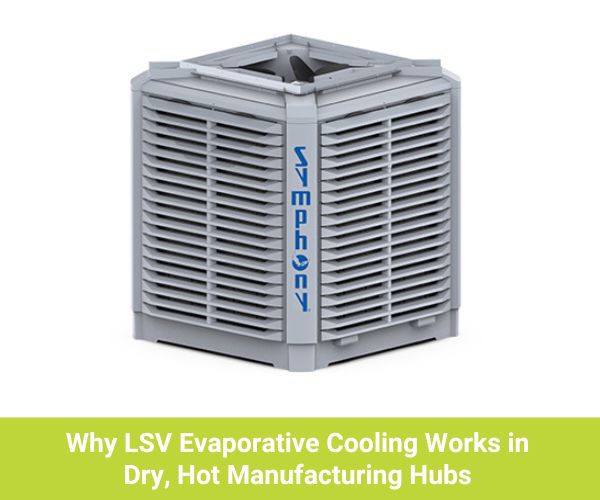
This article explains why conventional HVAC systems fail in India’s Tier-2 and Tier-3 industrial cities and how Symphony’s LSV evaporative cooling solution delivers better performance, lower energy consumption, easier maintenance, and faster ROI in the dry, high-temperature conditions typical of these fast-growing manufacturing hubs.
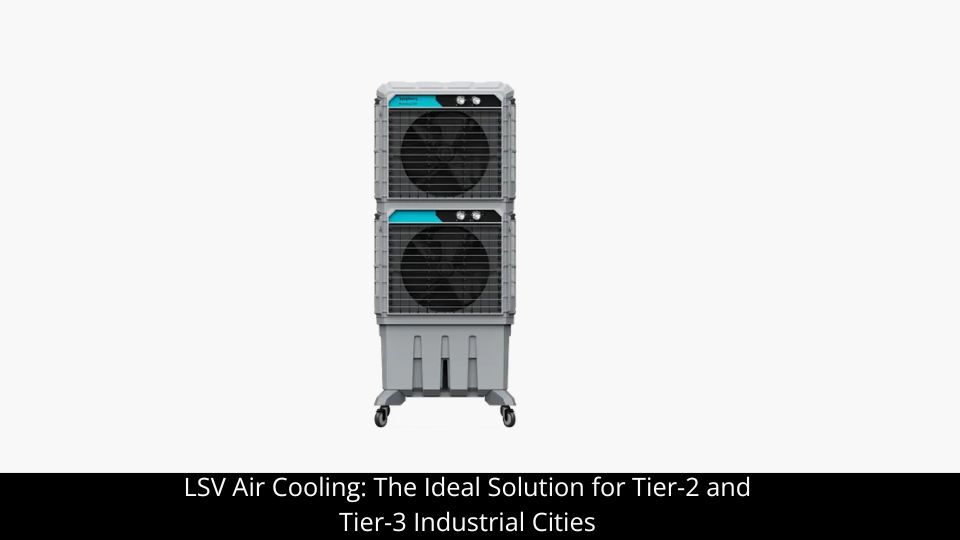
India’s industrial geography has changed dramatically in the last decade. As manufacturing investment disperses from metros into Tier-2 and Tier-3 cities — Surat, Coimbatore, Vadodara, Nashik, Kanpur, Ludhiana, Rajkot, Tiruppur, Bhiwandi, and Hapur — a new class of industrial facility owner is looking for air cooling solutions that fit the realities of these emerging manufacturing hubs.
These realities are specific: power supply that is less reliable than in metros, summer temperatures that regularly exceed 44°C, labour pools that are less expensive but more sensitive to working conditions, and capital budgets that require solutions with clear and fast return on investment. In these conditions, a standard HVAC system is often the wrong answer — and Symphony Venti-Cool’s LSV evaporative air cooling solution is increasingly the right one.
Table of Contents
Why AC Fails in Tier-2 and Tier-3 Industrial Cities
Air conditioning systems — whether split units, centralised chillers, or commercial HVAC installations — have three fundamental problems in the context of Tier-2 and Tier-3 Indian industrial facilities.
First, power demand. A HVAC system capable of cooling a 10,000 sq ft factory floor requires 80–120 kW of electrical load. In cities where industrial power supply is rated but unreliable — voltage fluctuations, load-shedding windows, and peak demand penalties are common — this level of electrical demand creates operational risk and cost unpredictability.
Second, commercial cooler price and capital cost. A centralised HVAC installation for a medium-sized factory in a Tier-2 city costs significantly more than an equivalent LSV evaporative cooling system — not just in equipment price but in civil work, refrigerant pipework, and specialist commissioning that may require technicians to travel from larger cities.
Third, maintenance infrastructure. HVAC systems require specialist refrigerant handling and compressor servicing. In cities where certified HVAC technicians are scarce, a breakdown in May means weeks without cooling. An industrial air cooler manufacturer like Symphony Venti-Cool has a service network that reaches Tier-2 and Tier-3 cities with standardised, non-specialist maintenance.
Why LSV Evaporative Cooling Works in These Markets
The industrial cities where LSV performs best are exactly the cities where Tier-2 and Tier-3 manufacturing is concentrated — dry, hot, inland cities where summer humidity remains below 50% for most of the critical April-to-June period.
Surat and Vadodara in Gujarat: temperatures regularly reaching 42–44°C with humidity below 35% in pre-monsoon months. Ideal evaporative cooling conditions.
Coimbatore and Tiruppur in Tamil Nadu: textile manufacturing hubs with 40–43°C peak temperatures and moderate humidity. Evaporative cooling delivers 8–12°C temperature drops.
Nashik and Aurangabad in Maharashtra: automobile and engineering components manufacturing with 40–43°C summer peaks.
Kanpur and Agra in Uttar Pradesh: leather and light manufacturing with 44–46°C summer peaks and low humidity — among the most ideal conditions for evaporative air cooling in India.
Ludhiana in Punjab: bicycle, hosiery, and engineering manufacturing with 42–45°C summer peaks.
In all these cities, LSV cooling delivers the temperature reduction that makes factory floors productive, at a commercial cooler price that fits emerging-market capital budgets, and with a maintenance requirement that local technicians can handle.
The Economics of LSV vs AC in Tier-2 Industrial Cities
Take a 12,000 sq ft garment factory in Tiruppur employing 150 workers. An air conditioning system covering this area would require 15–18 split units of 1.5-ton capacity each, drawing 30–36 kW of power, at an installation cost of ₹15–20 lakh. Monthly electricity: ₹2–3 lakh at industrial tariffs.
An LSV evaporative air cooling solution from Symphony Venti-Cool covering the same 12,000 sq ft would draw 8–12 kW, at an installation cost of ₹6–10 lakh. Monthly electricity: ₹60,000–90,000.
The capital saving alone pays for several years of operating costs. The monthly energy saving of ₹1–2 lakh means the LSV system pays for itself within 6–10 months relative to the HVAC alternative. For a factory owner in Tiruppur or Kanpur evaluating their cooling investment, this arithmetic is compelling.
The Right Air Cooling Solution for Different Tier-2 Industry Types
Different industries in Tier-2 and Tier-3 cities have specific cooling requirements that LSV addresses:
Textile and garment manufacturing: open floor plans with high worker density. Ducted LSV systems deliver uniform cooling across large weaving halls and stitching floors.
Engineering and components manufacturing: high heat loads from machines and presses. Heavy duty cooler units positioned near heat sources with supplementary ducted coverage of the main floor.
Food processing: hygiene requirements and temperature sensitivity. Symphony’s LSV systems deliver 100% fresh air — unlike recirculating HVAC — reducing contamination risk while maintaining comfortable temperatures.
Pharmaceutical manufacturing: temperature control with fresh air priority. AHU-based centralised systems with filtered fresh air delivery.
Frequently Asked Questions
Air Cooling Solution for Tier-2 and Tier-3 Industrial Cities: Why LSV Works Where AC Fails
Does Symphony Venti-Cool have dealer and service coverage in Tier-2 and Tier-3 cities?
Yes. Symphony Venti-Cool has an extensive dealer and service network covering major Tier-2 and Tier-3 industrial cities across India, including Surat, Vadodara, Coimbatore, Tiruppur, Nashik, Aurangabad, Kanpur, Ludhiana, Rajkot, and many others. Installation and after-sales service is available locally without requiring specialist travel from metros.
What is the typical commercial cooler price range for an LSV system suitable for a Tier-2 factory?
An LSV system for a 10,000–15,000 sq ft factory in a Tier-2 city typically ranges from ₹6–12 lakh installed, depending on system architecture, number of units, duct complexity, and city-specific logistics. This compares with ₹15–25 lakh for equivalent-area HVAC, plus significantly higher operating costs.
Does evaporative cooling work during monsoon in cities like Surat or Nashik?
During peak monsoon months (July–August), when outdoor humidity in these cities rises above 65–70%, the temperature drop from evaporative cooling reduces. Most factories in these regions switch to ventilation-only mode during monsoon — benefiting from fresh air circulation without the evaporative cooling function — and resume full cooling from September.
Can a small factory in a Tier-3 city get a site assessment from Symphony Venti-Cool?
Yes. Symphony Venti-Cool conducts site assessments for facilities of all sizes, including small and medium factories in Tier-3 cities. Contact your nearest Symphony Venti-Cool dealer or the corporate sales team to arrange a site visit and system recommendation.
Are there government subsidies or schemes for industrial cooling systems in Tier-2 cities?
Some state governments — particularly Gujarat and Maharashtra — have energy efficiency incentive schemes that cover industrial cooling upgrades meeting specified energy consumption benchmarks. Energy-efficient evaporative cooling systems often qualify. Your chartered engineer or factory consultant can advise on applicable schemes in your state.
Is LSV cooling suitable for outdoor or semi-outdoor factory areas in Tier-2 cities?
Yes. Symphony Venti-Cool's portable heavy duty cooler and outdoor-rated LSV units are suitable for semi-covered industrial areas, loading docks, shed-type factories, and outdoor assembly operations. The units are designed for Indian industrial environments, including the dust, humidity fluctuation, and power quality conditions typical of Tier-2 and Tier-3 industrial zones.

Maulik Solanki is a seasoned B2B Product Marketing professional specializing in Industrial and Commercial Coolers in the LSV (Large Space Venticooling) segment. With 13+ years of experience, he drives brand building and audience engagement for Symphony’s LSV solutions through integrated offline and online strategies. Backed by an MBA in Marketing and earlier experience as a Regional Marketing Manager in banking, Maulik brings strong skills in sales, advertising, and events. He enjoys exploring new marketing ideas and cooling technologies and writes to help readers understand Symphony’s offerings.

Sourav Biswas is a senior marketing leader heading the LSV (Large Space Venticooling – B2B) marketing function at Symphony Limited. He shapes the brand’s strategic narrative, strengthens market leadership, and ensures excellence across all B2B cooling solutions. With deep expertise in Strategic Marketing, Brand Management, Advertising, and PR, he reviews content with analytical precision and alignment to Symphony’s vision. Passionate about mentoring and tracking B2B trends, Sourav ensures every content piece reflects accuracy, relevance, and strategic depth.