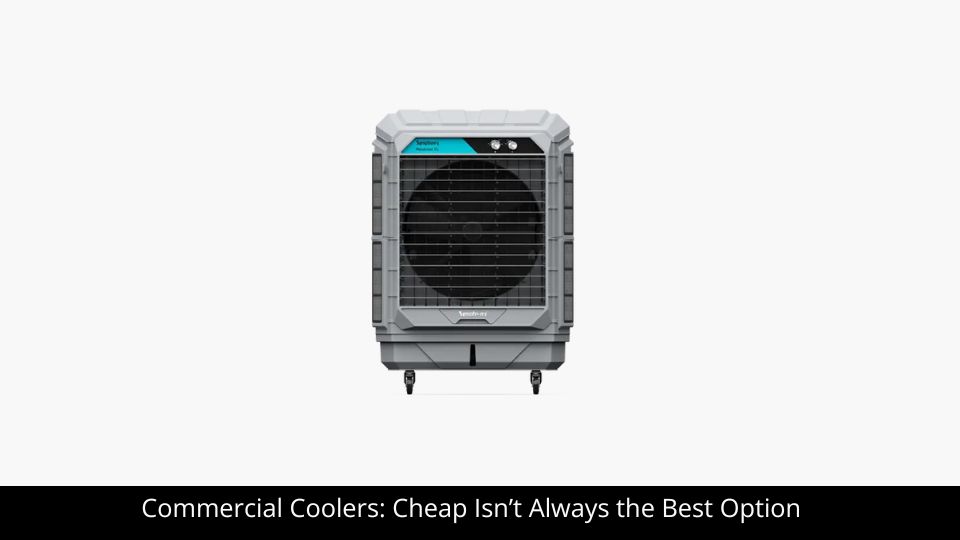
Symphony Venticool

Read AI-Generated Summary:

When a factory manager decides it is time to invest in a proper cooling system for factory operations, the first question is rarely “what brand?” — it is “what type?” The industrial cooling system market offers three fundamentally different architectural approaches

0:00 / 0:00

Every procurement manager in charge of sourcing an industrial or commercial cooling system faces the same temptation: take the lowest quote. The cheapest commercial cooler price wins the budget approval, the vendor gets the order, and the problems begin two summers later when the under-specified system is limping along, pads are disintegrating, the motor has been replaced twice, and the energy bills are 40% higher than expected.

Total Cost of Ownership (TCO) is the metric that separates informed buyers from expensive lesson-learners. This article builds the complete TCO framework for commercial and industrial cooling systems, so your next purchasing decision is based on what a system actually costs — not what it costs to buy.

Need More Information?

The quoted commercial cooler price from a vendor covers the equipment cost — the metal or plastic housing, the motor, the CELdek pads, the pump, and the controls. In most cases it does not cover installation, ductwork, electrical connection, water connection, commissioning, annual service, pad replacement, or motor maintenance over the system’s operational life.

For a central cooling system covering a 20,000 sq ft industrial facility, the equipment price might represent only 40–60% of the total five-year cost of ownership. The remaining 40–60% is energy, maintenance, consumables, and service — costs that vary dramatically between a premium industrial air cooler manufacturer whose products are built for Indian industrial conditions and a low-cost alternative built to a price point.

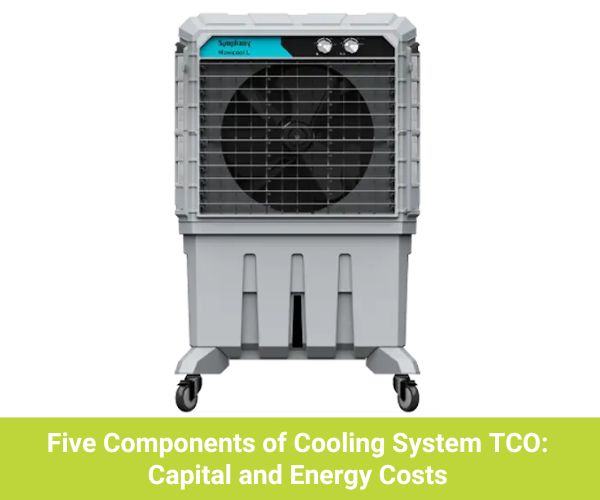
The Five Components of Cooling System TCO

Component 1 — Capital Cost: The purchase price of the units plus installation, ductwork, electrical connections, and commissioning. For a central cooling system, this is typically ₹8–20 lakh for a medium-sized industrial facility.

Component 2 — Energy Cost: The annual electricity consumption of the system. An evaporative air cooler operates at significantly lower energy consumption than a HVAC system of equivalent capacity. Over five years, the energy cost differential between a well-designed LSV system and a HVAC system can exceed the original capital cost of the LSV installation.

Component 3 — Maintenance Cost: Annual service visits, CELdek pad inspection and treatment, motor lubrication, belt tension checks, water distributor cleaning, and float valve maintenance. A well-built system from a quality industrial air cooler manufacturer requires predictable, low-cost annual maintenance. An underbuilt system has unpredictable repair costs.

Component 4 — Consumables: CELdek cooling pads typically require replacement every 2–5 years depending on water quality and usage intensity. Pad replacement cost varies by system size. Low-cost systems often use pads with shorter service lives that increase replacement frequency and cost.

Component 5 — Downtime Cost: Every day the cooling system is non-functional in peak summer is a day of reduced productivity, increased absenteeism, and potential compliance risk. Premium systems from established manufacturers have better parts availability and faster service response, reducing downtime duration and cost.

We are Fast in Response

Five-Year TCO Comparison: Budget Cooler vs Symphony LSV [The below costing is an example and tentative estimate. For actual pricing, you may contact Symphony Venti-Cool]

For a 15,000 sq ft factory requiring a central cooling system:

A budget commercial cooler from an unbranded manufacturer might be quoted at ₹4 lakh installed. But: higher energy consumption adds ₹60,000–80,000 per year vs Symphony LSV; pad replacement every 18–24 months adds ₹30,000–50,000 per cycle; two motor replacements over five years add ₹40,000–60,000; two major service events add ₹20,000–30,000; and one extended summer downtime event costs ₹2–5 lakh in lost productivity.

Five-year budget TCO: ₹4L capital + ₹4L energy premium + ₹1.5L pads + ₹1L motors + ₹2–5L downtime = ₹12.5–15.5 lakh.

A Symphony LSV system might be quoted at ₹9 lakh installed. But: lower energy cost, pad life of 3–5 years, negligible motor issues, annual service included, and near-zero summer downtime due to quality and service network.

Five-year Symphony TCO: ₹9L capital + ₹0 energy premium + ₹0.6L pads over 5 years + ₹0.3L service = ₹9.9 lakh.

The “cheaper” system costs 25–55% more over five years. This is the commercial cooler price reality that procurement decisions must incorporate.

How to Evaluate a Quote for True TCO

When receiving quotes for a commercial or industrial cooling system, ask each vendor: what is the rated energy consumption (kW) per unit? What is the expected pad life at your local water quality? What is the motor warranty and replacement cost? What is the annual service cost? What is the parts availability timeline if a component fails in June?

A vendor who cannot answer all five questions clearly is not qualified to sell you a critical infrastructure component for your facility.

Compare quotes not on commercial cooler price but on five-year TCO using the framework above. The right central cooling system from a credentialled industrial air cooler manufacturer will almost always win the TCO comparison, even if it loses the price comparison.

Frequently Asked Questions

Commercial Cooler Price vs Total Cost of Ownership: Why the Cheapest Quote Is Never the Cheapest Option

How long do CELdek cooling pads typically last in a Symphony LSV system?

CELdek pads in Symphony LSV systems last 3–5 years under normal operating conditions with good water quality. In areas with hard water (high mineral content), pad scaling can reduce life to 2–3 years without a water treatment protocol. Symphony recommends a water quality check at installation to determine appropriate pad maintenance intervals.

Is the energy cost of an evaporative commercial cooler significantly lower than HVAC?

Yes, substantially. An evaporative commercial cooler operates at approximately 1/8th to 1/5th of the electricity consumption of an equivalent-capacity HVAC system. For a central cooling system covering 15,000 sq ft, the annual electricity saving vs HVAC can be ₹2–4 lakh, which alone justifies the investment in a quality LSV system.

Does Symphony Venti-Cool offer Annual Maintenance Contracts?

Yes. Symphony Venti-Cool offers Annual Maintenance Contracts (AMC) for its LSV systems, covering scheduled service visits, pad inspection, motor checks, and priority response for breakdowns. An AMC provides predictable maintenance budgeting and ensures the system is serviced by trained Symphony technicians.

How does water quality affect the TCO of an evaporative cooling system?

Hard water with high TDS (Total Dissolved Solids) causes mineral scaling on CELdek pads and water distribution systems, reducing pad life and cooling efficiency. In regions with hard water — common across Rajasthan, Gujarat, and parts of Maharashtra — water treatment through a softener or TDS-reduction system adds a small capital cost but significantly extends pad life and reduces the long-term TCO.

What is the warranty on Symphony Venti-Cool industrial cooling systems?

Symphony Venti-Cool provides comprehensive product warranties on its LSV industrial systems. Warranty terms vary by product range — contact your nearest dealer or the Symphony Venti-Cool sales team for specific warranty details applicable to the system you are evaluating.

Can I calculate my own five-year TCO before buying?

Yes. Contact Symphony Venti-Cool with your facility size, current electricity tariff, and operating hours, and their technical team will produce a five-year TCO comparison between an LSV system and your current or alternative cooling approach. This is provided as a complimentary service as part of the quotation process.

<< 1 >>


About the Author
About the Reviewer

Sourav Biswas is a senior marketing leader heading the LSV (Large Space Venticooling – B2B) marketing function at Symphony Limited. He shapes the brand’s strategic narrative, strengthens market leadership, and ensures excellence across all B2B cooling solutions. With deep expertise in Strategic Marketing, Brand Management, Advertising, and PR, he reviews content with analytical precision and alignment to Symphony’s vision. Passionate about mentoring and tracking B2B trends, Sourav ensures every content piece reflects accuracy, relevance, and strategic depth.


×
×
Index