Symphony Venticool

Read AI-Generated Summary:

Factory ventilation strategy is one of the most impactful and least discussed decisions in industrial facility management. This article compares cross ventilation – the passive, wind-driven approach – with mechanical ventilation powered by industrial air coolers and LSV systems, across the dimensions that matter most to Indian factory managers: temperature reduction, air quality, worker health, energy cost, regulatory compliance, and scalability. Drawing on examples from textile units in Surat, auto plants in Pune, food processing facilities in Ludhiana, and pharmaceutical factories in Hyderabad, it explains when cross ventilation falls short and why mechanical ventilation with Symphony Venti-Cool’s industrial coolers is the superior strategy for most Indian factory environments. The article integrates key terms including ventilation cooling system, air cooler ventilation, industrial air cooler, HVAC, and cross ventilation cooler.

0:00 / 0:00

Walk into a poorly ventilated Indian factory in May or June and the impact is immediate – workers fatigued, machinery overheating, product quality compromised, and the constant risk of heat-related illness. Factory ventilation is not a comfort feature; it is a productivity, safety, and compliance infrastructure that directly affects a facility’s bottom line.

Despite its importance, ventilation strategy is often left to chance – relying on whatever openings the building happens to have. The result is inconsistent airflow, hot spots, dead zones, and inadequate temperature reduction. For factory managers in cities like Rajkot, Nagpur, Kanpur, Surat, and Coimbatore, where summer temperatures regularly exceed 40°C, an ad hoc ventilation approach is simply inadequate.

This article examines the two primary ventilation strategies available to Indian factory operators: passive cross ventilation and active mechanical ventilation with industrial air coolers, evaluating each against the practical requirements of large industrial spaces.

What Is Cross Ventilation and How Does It Work in a Factory?

Cross ventilation is a passive cooling strategy that uses the pressure difference created by wind to drive outdoor air through a building. In a factory, it typically relies on openings on opposite walls – windows, louvres, turbo vents, or open sides – to create an airflow path from the windward to the leeward side of the building.

When it works, cross ventilation is zero-cost, zero-energy, and simple. For single-storey sheds with large openings, favourable wind direction, and moderate outdoor temperatures, it can provide meaningful air movement and some degree of cooling through convective heat removal.

However, cross ventilation has fundamental limitations in real Indian factory conditions:

We are Available on Chat, Call, Email!

What Is Mechanical Ventilation with Industrial Air Coolers and How Is It Different?

Mechanical ventilation with industrial air coolers – specifically Symphony Venti-Cool’s LSV and ducting cooler range – is an active system that mechanically draws fresh outside air, cools it through evaporative cooling pads, and distributes it throughout the factory space via fans and ductwork.

Unlike cross ventilation, mechanical ventilation with air coolers:

Symphony Venti-Cool’s industrial ducting cooler range – including models delivering 8,000 to 25,000 CMH – can be configured in arrays to cover factory floors from 5,000 sq ft to over 1,00,000 sq ft. Multiple units are positioned at the supply end of the factory with exhaust openings at the opposite end, effectively combining mechanical ventilation with active cooling in a single system.

How Do Temperature Reduction Levels Compare Between Cross Ventilation and Mechanical Ventilation?

Temperature reduction is the most direct measure of cooling performance. The comparison in Indian conditions is stark:

Condition

Cross Ventilation Only

Mechanical Ventilation + Air Cooler

Outdoor temp: 44°C, 25% RH (Rajkot, June)

43–44°C inside (no reduction)

28–33°C inside (10–16°C drop)

Outdoor temp: 40°C, 40% RH (Pune, May)

39–40°C inside

30–35°C inside (8–12°C drop)

Outdoor temp: 38°C, 55% RH (Chennai, April)

37–38°C inside

32–36°C inside (4–6°C drop)

Outdoor temp: 46°C, 15% RH (Nagpur, June)

45–46°C inside

29–34°C inside (12–17°C drop)

The data is unambiguous: cross ventilation alone provides virtually no temperature reduction on peak summer days. Mechanical ventilation with evaporative air coolers delivers 8–17°C of temperature reduction – bringing factory floor temperatures to within BIS-recommended comfort ranges and dramatically improving worker performance and wellbeing.

Which Approach Better Supports Worker Health, Safety, and Productivity?

The human cost of inadequate factory cooling is measurable and significant. Studies by the National Institute of Occupational Health (NIOH) and international research consistently show that workers in environments above 34°C experience a 15–25% reduction in physical productivity, increased error rates, higher absenteeism, and elevated risk of heat exhaustion and heatstroke.

India’s Factories Act (Section 13) and the Building and Other Construction Workers Act (BOCW) mandate adequate ventilation and temperature control in factory workplaces. The Bureau of Indian Standards recommends a workplace temperature of 27°C ± 2°C for sedentary and light work. Cross ventilation cannot reliably meet this standard in most Indian industrial locations during summer months.

Mechanical ventilation with Symphony Venti-Cool’s industrial air coolers routinely achieves factory floor temperatures of 28–34°C even when outdoor temperatures are at 44–46°C – consistently meeting regulatory requirements and protecting worker health. The additional feature of positive pressure ventilation pushes out fumes, dust, and heat generated by machinery, further improving indoor air quality.

How Do Energy Costs and Infrastructure Requirements Compare?

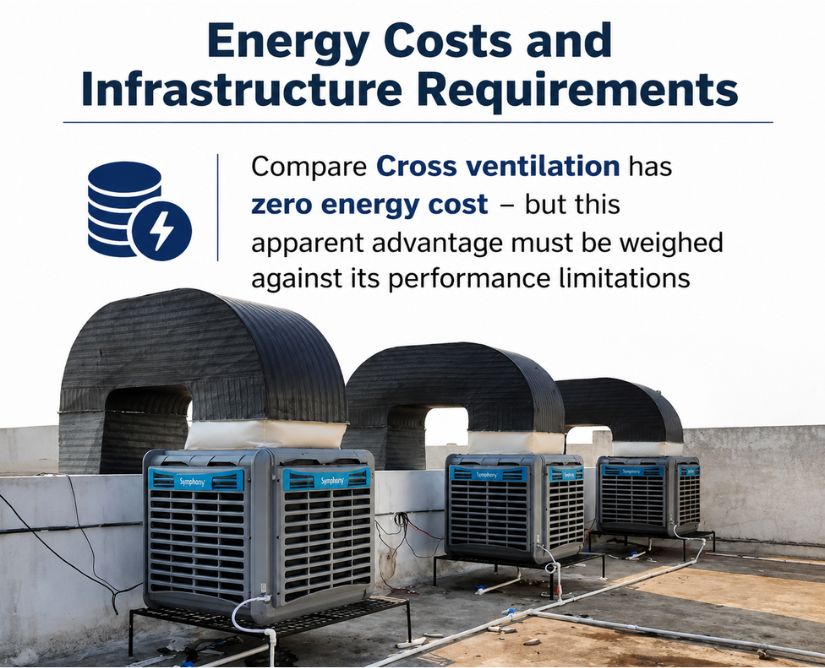
Cross ventilation has zero energy cost – but this apparent advantage must be weighed against its performance limitations. In a factory that relies on cross ventilation and then loses 25% worker productivity due to heat, the financial cost of that productivity loss far exceeds what a mechanical ventilation system would cost to run.

Symphony Venti-Cool’s industrial air coolers are among the most energy-efficient cooling systems available in India. A single LSV unit delivering 20,000 CMH of cooled air consumes just 1.1–1.5 kW – equivalent to a domestic ceiling fan. For a 50,000 sq ft factory requiring 10 LSV units, total power consumption is 11–15 kW – less than a single 5-ton split AC. Monthly electricity cost for this installation: ₹8,000–15,000 at ₹8/kWh, operating 10 hours per day.

Infrastructure requirements for mechanical ventilation with air coolers are modest – wall or rooftop mounting, simple galvanised sheet ductwork, and water connection. No electrical substation upgrades, no chiller room, no insulated pipework. Installation can be completed in 3–5 days for a typical factory.

In Which Factory Types Is Cross Ventilation Still Appropriate?

Cross ventilation retains value as a supplementary strategy in specific conditions:

However, for the vast majority of Indian factories – in hot dry climates of Gujarat, Rajasthan, and Madhya Pradesh; in the mixed-climate industrial belts of Maharashtra, Karnataka, and UP; and in humid-hot coastal states like Tamil Nadu and Andhra Pradesh – cross ventilation alone is insufficient and mechanical ventilation with industrial air coolers is necessary.

We’re Just a Call Away

What Is the Best Mechanical Ventilation Strategy for Different Types of Factories?

Textile and garment factories (Surat, Tiruppur, Ludhiana, Panipat): High worker density + heat from looms and sewing machines. Ducted LSV cooling with positive pressure ventilation, exhausting through roof vents. 15,000–25,000 CMH units positioned along the supply wall.

Auto assembly and engineering workshops (Pune, Gurgaon, Rajkot): High machinery heat loads, multiple work zones. Zoned ducted cooling with separate supply points for each assembly station. Heavy-duty air coolers with 20,000 CMH+ delivery.

Food processing plants (Ludhiana, Indore, Hyderabad, Pune): Temperature control + hygiene ventilation. Symphony LSV systems delivering fresh air to processing areas, with exhaust through dedicated food-safe ventilation openings.

Warehouses and logistics (Bhiwandi, Kundli, Nagpur): Very large floor areas. High-capacity portable and ducted coolers positioned to create airflow corridors through storage aisles. Roof exhaust fans combined with LSV supply.

Pharmaceutical factories (Hyderabad, Ahmedabad, Baddi): Non-clean-room areas benefit from fresh air LSV ventilation. Critical zones use separate HVAC. Hybrid approach widely deployed.

Conclusion: Mechanical Ventilation with Industrial Air Coolers Is the Industrial Standard

The comparison between cross ventilation and mechanical ventilation with industrial air coolers is not a close contest for most Indian factories. Cross ventilation is a passive, uncontrollable, and ultimately inadequate strategy for factory cooling in India’s hot climate. It provides air movement but no meaningful temperature reduction.

Mechanical ventilation with Symphony Venti-Cool’s industrial air coolers delivers consistent 10–18°C temperature reduction, regulatory compliance, improved air quality, worker health protection, and measurable productivity gains – at an energy cost lower than a handful of ceiling fans. For any factory manager serious about operational performance, compliance, and worker welfare, the choice is clear.

Contact Symphony Venti-Cool for a free ventilation and cooling assessment for your factory floor at symphonyventicool.com.

Frequently Asked Questions

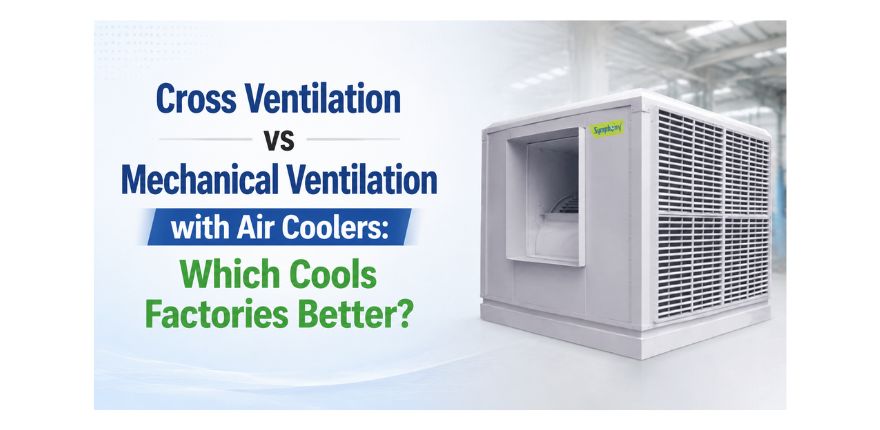
Cross Ventilation vs Mechanical Ventilation with Air Coolers: Which Cools Factories Better?

Can cross ventilation be enough for a factory in a hot climate like Gujarat or Rajasthan?

No. In cities like Ahmedabad, Rajkot, Jaipur, and Jodhpur where summer temperatures reach 44–48°C, cross ventilation provides no meaningful temperature reduction. Mechanical ventilation with evaporative air coolers is essential to achieve safe and productive working temperatures.

What is the airflow requirement for mechanical ventilation in an Indian factory?

Standard industrial ventilation guidelines recommend 20–40 air changes per hour for factory spaces. For a 50,000 sq ft factory with 5-metre ceiling height, this requires 1,00,000–2,00,000 CMH of supply airflow - achievable with 6–12 Symphony LSV units of 20,000 CMH each.

Does mechanical ventilation with an air cooler improve air quality inside a factory?

Yes. Symphony's LSV coolers create positive pressure inside the factory by supplying more cooled fresh air than exhaust. This pushes out fumes, dust, and heat generated by machinery through exhaust openings, significantly improving indoor air quality.

Is mechanical ventilation with air coolers compliant with the Factories Act?

Yes. Symphony Venti-Cool's LSV systems comply with Section 13 of the Indian Factories Act (ventilation and temperature) and align with BIS IS 3103 workplace temperature guidelines. The company can provide site-specific compliance documentation.

What is the industrial air cooler price for mechanical ventilation in a factory?

Symphony Venti-Cool's industrial air cooler prices range from ₹25,000 to ₹1,50,000 per unit depending on capacity and configuration. For a complete mechanical ventilation system covering 50,000 sq ft, total installed cost typically ranges from ₹10–25 lakhs including ductwork.

Can mechanical ventilation with air coolers work in a food or pharmaceutical factory?

Yes. Symphony LSV systems deliver fresh outside air continuously - making them suitable for food processing and non-clean-room pharmaceutical areas where fresh air ventilation is a compliance requirement.

Is it possible to combine cross ventilation and mechanical ventilation?

Yes. Symphony LSV systems are designed to work with building openings. Supply air from LSV units on one side of the factory, with cross-ventilation exhaust openings on the opposite side, creates an optimal combined natural and mechanical ventilation strategy.

What is the difference between a cross ventilation cooler and an LSV mechanical ventilation system?

A cross ventilation cooler (like a wall-mounted exhaust fan) simply moves air without cooling it. An LSV mechanical ventilation system from Symphony actively cools incoming air by 10–18°C through evaporative technology before distributing it - delivering both fresh air and temperature reduction simultaneously.

<< 1 >>


About the Author
About the Reviewer

Sourav Biswas is a senior marketing leader heading the LSV (Large Space Venticooling – B2B) marketing function at Symphony Limited. He shapes the brand’s strategic narrative, strengthens market leadership, and ensures excellence across all B2B cooling solutions. With deep expertise in Strategic Marketing, Brand Management, Advertising, and PR, he reviews content with analytical precision and alignment to Symphony’s vision. Passionate about mentoring and tracking B2B trends, Sourav ensures every content piece reflects accuracy, relevance, and strategic depth.


×
×
Index