Evaporative cooling pads are the core component that turns warm air into cool air inside an industrial air cooler, and honeycomb cellulose pads are now the standard choice over older wood wool designs for most industrial and commercial installations. Pad thickness, flute angle, and material quality directly affect cooling efficiency, water consumption, and airflow resistance, while pad lifespan depends heavily on water hardness, dust exposure, and cleaning frequency. This guide compares cooling pad types, explains how to select the right cooling pad for an industrial application, and outlines when replacement is needed, with guidance on Symphony Venticool honeycomb cooling pads used across its industrial ducting cooler range.
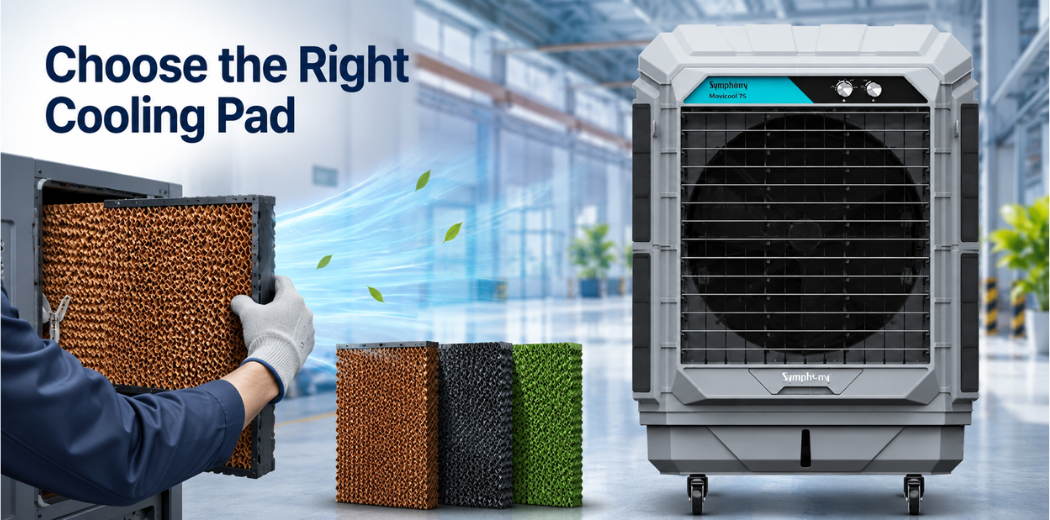
Table of Contents
Choosing the Right Evaporative Cooling Pad for Industrial Air Coolers
Choosing the right evaporative cooling pad has a bigger impact on cooling performance than most facility teams expect. Pad material, thickness, and cell structure determine how much water an industrial air cooler can evaporate per hour, which in turn decides how much temperature drop a factory, warehouse, or large commercial space actually experiences. This guide walks through cooling pad types, how they work, how to select the right pad for an industrial application, and how to judge when it is time for cooling pad replacement.
What Are Evaporative Cooling Pads?
Evaporative cooling pads are the wetted media inside an industrial air cooler through which warm air is drawn before entering the workspace. As air passes through the water saturated pad, some of the water evaporates, absorbing heat from the air in the process and lowering its temperature before it is pushed out through the fan and ducting. Industrial air cooler cooling pads are typically made from cellulose paper, treated wood fiber, or occasionally aspen wood wool, shaped to maximize the surface area in contact with both water and airflow.
How Cooling Pads Work?
Evaporative cooling relies on a simple principle described in building science references, including the United States Department of Energy, as adiabatic or wet bulb cooling. Water absorbs heat as it changes from liquid to vapor, and when warm, dry air is pulled through a wet pad, this evaporation process removes heat from the air itself, lowering its temperature while raising its moisture content slightly.
- A pump continuously circulates water from the tank to the top of the pad, keeping the surface evenly wetted.
- A fan draws outside air through the pad, where evaporation cools it before it enters the ducting or workspace.
- The corrugated or honeycomb structure of the pad increases surface area, allowing more water to evaporate per unit of airflow than a flat wetted surface would.
- Cooling effectiveness is strongest in hot, dry climates with low ambient humidity, since evaporation slows as the surrounding air approaches saturation.
Types of Evaporative Cooling Pads: Honeycomb Pads
Honeycomb cooling pads, also called cross corrugated cellulose pads, are the most widely used cooling media in modern industrial and commercial evaporative coolers. They are made from cellulose paper sheets treated with rigidifying resins and anti rot additives, then corrugated at alternating angles and bonded into a honeycomb like block.
- The crossed flute pattern forces air to change direction repeatedly as it passes through, increasing contact time with the wetted surface and improving evaporation efficiency.
- Common flute angles used in industrial pads balance water distribution against airflow resistance, since a steeper angle improves wetting but increases the static pressure the fan must overcome.
- Honeycomb pads are typically available in thicknesses ranging from around 50 mm for compact units up to 100 mm or more for large industrial ducting coolers, with thicker pads generally delivering higher cooling efficiency.
- Symphony Venticool uses honeycomb cellulose pads across its industrial ducting cooler range, with pad thickness varying by model to match the airflow and cooling efficiency target of each unit.
Cellulose vs Wood Wool Cooling Pads
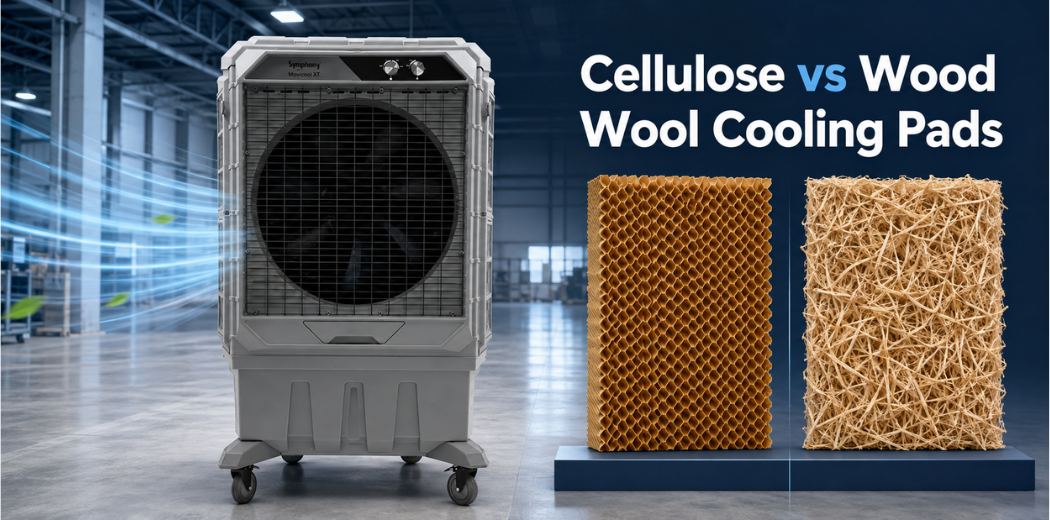
Wood wool pads, made from thin curled wood shavings such as aspen, were the traditional cooling media before cellulose honeycomb pads became widely available. While still used in some low cost or seasonal setups, they generally underperform honeycomb pads in industrial applications.
| Feature | Cellulose Honeycomb Pads | Wood Wool Pads |
| Cooling efficiency | Typically 75 to 90 percent depending on thickness | Generally lower, often 40 to 60 percent |
| Typical lifespan | One to three cooling seasons with proper care | Often needs replacement every single season |
| Water consumption | More efficient water use per degree of cooling | Higher water usage for similar cooling output |
| Airflow resistance | Engineered flute angles balance airflow and wetting | Uneven, can restrict airflow as fibers compact |
| Hygiene and mold resistance | Treated to resist rot and biological growth | More prone to mold and odor over time |
| Best suited for | Industrial, commercial, and continuous duty use | Light, seasonal, or budget constrained use |
How Pad Thickness and Cell Size Affect Cooling
Pad thickness and flute cell size are two of the most important specifications when comparing cooling pads for industrial air coolers, since both directly influence cooling efficiency and airflow resistance.
|
Pad Thickness |
Typical Cooling Efficiency |
Best Suited For |
50 to 60 mm | Around 70 to 75 percent | Compact ducted units and moderate cooling loads |
75 to 100 mm | Around 78 to 85 percent | Large industrial ducting coolers and factory floors |
100 mm and above | 85 percent and higher | High heat load industrial zones needing maximum cooling |
Smaller flute cell sizes increase the surface area available for evaporation, which improves cooling but also raises airflow resistance, meaning the fan and motor need to work harder to maintain the same air delivery volume. Larger cell sizes reduce resistance and are easier to clean but generally cool less effectively per unit of pad area. Selecting the right balance depends on the fan capacity, duct length, and cooling target of the specific installation.
How to Select Cooling Pads for Industrial Applications
Selecting the right cooling pad for an industrial air cooler depends on several site specific factors, not just the lowest cost option available.
- Assess the required airflow in cubic meters per hour and match pad thickness to the fan and motor capacity of the unit, since undersized pads restrict airflow and oversized pads add unnecessary resistance.
- Check local water hardness, since areas with hard water benefit from pads paired with a water treatment or scale inhibitor system to extend pad life.
- Consider ambient dust levels in the facility, as dustier environments call for pads with cell sizes that are easier to rinse clean without trapping particles deep in the flutes.
- Match pad thickness to the cooling target, choosing thicker honeycomb pads for zones with higher heat loads such as factory floors near machinery.
- Confirm the pad specification matches the original design of the installed cooler, since mismatched thickness or cell size can reduce both cooling efficiency and component life.
- Where possible, choose pads sourced from the original equipment manufacturer to ensure a precise fit and consistent water distribution across the full pad surface.
Factors Affecting Cooling Pad Life
- Water hardness: dissolved calcium and magnesium gradually deposit as scale inside the pad flutes, restricting water flow and stiffening the material over time.
- Dust and airborne particulate load: fine dust settles in the pad structure, clogging air paths and reducing evaporation surface area.
- Running hours and duty cycle: pads used continuously across long industrial shifts wear faster than those used intermittently.
- Cleaning frequency: infrequent cleaning allows scale, algae, and dust to compound, shortening usable pad life significantly.
- Sunlight and UV exposure: pads exposed to direct sunlight for extended periods can dry out unevenly and degrade faster than shielded installations.
- Water treatment quality: use of treated or softened water measurably extends pad life compared to untreated hard water in most industrial settings.
When Should Cooling Pads Be Replaced?
Most industrial honeycomb cooling pads last between one and three cooling seasons, depending on water quality, dust exposure, and maintenance consistency. Replacement, rather than continued cleaning, is recommended once any of the following signs appear.
- Persistent dry patches remain even after a thorough cleaning and rewetting cycle.
- Visible tearing, crumbling, or sagging of the honeycomb structure under normal water flow.
- A hardened, white scale crust that no longer softens with standard descaling methods.
- Noticeably reduced cooling output despite clean water supply and a functioning pump.
- A persistent musty odor that continues after cleaning, which can indicate biological growth embedded in the pad material.
Cooling Pad Cleaning and Maintenance
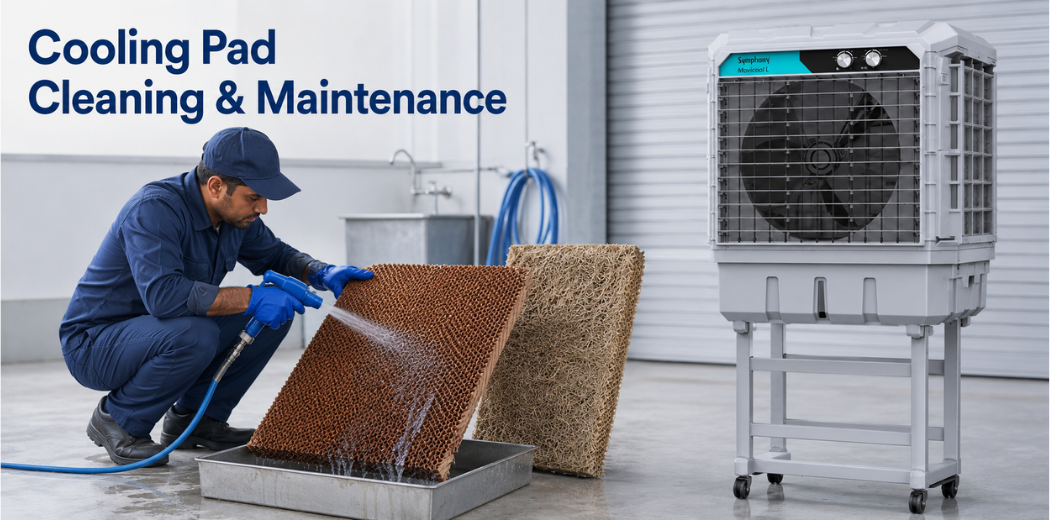
Routine cleaning extends pad life and protects cooling efficiency, though the right approach differs slightly by pad type. Cellulose honeycomb pads tolerate gentle rinsing and mild descaling solutions well, while wood wool pads are more fragile and tend to lose structure with repeated handling, which is one reason they often need full replacement rather than repeated cleaning.
- Rinse pads with low pressure water on a weekly to monthly basis depending on dust exposure, avoiding high pressure jets that can damage the flute structure.
- Address hard water scale early with a mild descaling rinse, since allowing scale to harden makes later cleaning far less effective.
- Keep the water tank and distribution troughs clean, since sediment and algae in the water supply reintroduce contamination to a freshly cleaned pad.
- Inspect pads during routine servicing for early signs of channeling or dry spots, which often signal uneven water distribution rather than a pad fault.
Common Cooling Pad Problems
| Problem | Likely Cause | Recommended Action |
| Channeling or dry streaks | Uneven water distribution across the pad top | Clean distribution troughs, check for blocked drip holes |
| White scale crust | Hard water mineral deposits | Descale gently, consider water treatment for hard water |
| Musty odor | Algae or biological growth in pad or tank | Clean tank and pad thoroughly, improve water turnover |
| Sagging or collapsing structure | Prolonged saturation or structural aging | Inspect for replacement, avoid continued heavy wetting |
| Reduced airflow through pad | Dust or scale clogging flute cells | Rinse pad, check for cell size suited to dust levels |
| Brittle or crumbling edges | Pad has reached end of usable life | Replace pad rather than continue repeated cleaning |
Frequently Asked Questions on Cooling Pads
Cooling Pad Types, Selection, Life and Replacement for Industrial and Commercial Evaporative Coolers
Which cooling pad is best for an industrial air cooler?
For most industrial applications, cellulose honeycomb pads are the better choice over wood wool, since they offer higher cooling efficiency, longer lifespan, and more consistent water distribution across continuous duty cycles. The ideal thickness and cell size still depend on the specific fan capacity and cooling target of the installed unit.
How long do evaporative cooling pads last?
Honeycomb cellulose pads typically last between one and three cooling seasons under industrial use, depending on water hardness, dust exposure, and cleaning frequency, while wood wool pads often need replacement every single season.
How often should cooling pads be replaced?
Replacement is generally needed once a season or two under heavy industrial use, but the real signal is performance rather than a fixed timeline, so pads should be replaced whenever cleaning no longer restores even wetting, airflow, or cooling output.
Are honeycomb pads better than wood wool pads?
Yes, for industrial and commercial evaporative coolers, honeycomb cellulose pads generally outperform wood wool pads in cooling efficiency, water use, lifespan, and resistance to mold, which is why most modern industrial ducting coolers are designed around honeycomb pad technology.
Do cooling pads affect electricity consumption?
Yes, indirectly. A pad that is scaled, clogged, or poorly matched to the fan increases airflow resistance, forcing the motor to work harder and consume more electricity for the same cooling output, so well maintained pads support the low energy consumption evaporative coolers are known for.
How does hard water affect cooling pads?
Hard water leaves calcium and magnesium scale deposits inside the pad flutes as water evaporates, gradually restricting water flow and airflow through the pad. Over time this reduces cooling efficiency and shortens pad lifespan, making water treatment worthwhile in regions with high water hardness.
What are honeycomb cooling pads made of?
Honeycomb cooling pads are made from specially treated cellulose paper, corrugated at alternating angles and bonded together, then treated with rigidifying resins and anti rot additives to withstand continuous exposure to water.
How do honeycomb cooling pads work in evaporative coolers?
Water is continuously distributed across the top of the honeycomb pad while a fan draws warm air through its crossed flute structure. The large wetted surface area allows significant evaporation to occur as air passes through, cooling the air before it exits into the workspace.
How do honeycomb cooling pads improve air cooler efficiency?
Their crossed flute design increases the surface area of contact between air and water compared to flat or loosely packed media, allowing more evaporation per unit of airflow, which translates into a greater temperature drop for the same fan power.
What is the best source for honeycomb cooling pads for industrial use in India?
The most reliable option is to source pads matched to the original specification of the installed cooler, since thickness, cell size, and frame fit vary by model. Symphony Venticool supplies genuine honeycomb cooling pads engineered specifically for its own industrial ducting cooler range, ensuring the correct fit and rated cooling efficiency for each model.
What should offices look for in honeycomb cooling pads for their air coolers?
Offices generally benefit from honeycomb pads with efficient airflow characteristics and good hygiene resistance, since office environments often run coolers for long daytime hours. Pads that are correctly sized for the unit and cleaned on a regular schedule will maintain consistent cooling without excessive noise or airflow resistance.
How does the lifespan of honeycomb pads compare to wood wool pads?
Honeycomb cellulose pads generally last two to three times longer than wood wool pads under similar conditions, since their treated cellulose structure resists rot and compaction far better than untreated wood fiber.
What are the benefits of honeycomb cooling pads compared to traditional pads?
Honeycomb pads offer higher cooling efficiency, better structural durability, more even water distribution, and greater resistance to mold and odor compared to traditional wood wool or aspen pads, which is why they have become the standard choice for industrial and commercial evaporative cooling.
Conclusion
The cooling pad is the single component that determines how effectively an industrial evaporative cooler can lower temperature, and choosing the right type, thickness, and material has a direct impact on energy use, water consumption, and long term running cost. Honeycomb cellulose pads consistently outperform older wood wool designs, but even within honeycomb pads, matching thickness and cell size to the specific facility, water quality, and fan capacity is what determines real world performance.
Symphony Venticool supplies genuine honeycomb cooling pads engineered to match each model in its industrial ducting cooler range, along with guidance on selection and replacement timing suited to local water conditions. Reach out to Symphony Venticool for the correct replacement pad specification and to keep your industrial cooling system running at its rated efficiency.

Maulik Solanki is a seasoned B2B Product Marketing professional specializing in Industrial and Commercial Coolers in the LSV (Large Space Venticooling) segment. With 13+ years of experience, he drives brand building and audience engagement for Symphony’s LSV solutions through integrated offline and online strategies. Backed by an MBA in Marketing and earlier experience as a Regional Marketing Manager in banking, Maulik brings strong skills in sales, advertising, and events. He enjoys exploring new marketing ideas and cooling technologies and writes to help readers understand Symphony’s offerings.

Sourav Biswas is a senior marketing leader heading the LSV (Large Space Venticooling – B2B) marketing function at Symphony Limited. He shapes the brand’s strategic narrative, strengthens market leadership, and ensures excellence across all B2B cooling solutions. With deep expertise in Strategic Marketing, Brand Management, Advertising, and PR, he reviews content with analytical precision and alignment to Symphony’s vision. Passionate about mentoring and tracking B2B trends, Sourav ensures every content piece reflects accuracy, relevance, and strategic depth.