





Table of Contents
AI Summary
For 80% of India’s industrial and semi-open commercial spaces, Big-Size (Industrial) Evaporative Air Coolers offer a significantly lower Total Cost of Ownership (TCO) than Centralized Air Conditioning. Our analysis shows that businesses in Textiles, Manufacturing, and Logistics can save ₹25–40 Lakhs over 5 years per 5,000 sq. ft. area by choosing industrial coolers.
- Winner: Big Air Coolers for Warehouses, Factory Floors, Textile Mills, Open-Air Events, and Commercial Kitchens due to 80-90% lower OPEX and “fresh air” ventilation benefits.
Objective & Scope of Big Cooler Vs. Air Conditioner
This article analyzes the financial and operational viability of installing Centralized Air Conditioning (VRF/Packaged) versus Industrial Evaporative Air Coolers (often called “Desert Coolers” or “Ductable Coolers” or “Big Coolers”).
Scope of Analysis:
- Timeframe: 5 Years (Standard depreciation cycle).
- Focus: Operational Expenditure (OPEX) dominates the decision-making process in India due to high industrial electricity tariffs.
- Geography: Pan-India, with specific adjustments for humid coastal zones (Mumbai/Chennai) vs. dry manufacturing hubs (Delhi/Ahmedabad/Pune).
Methodology: The TCO Costing Model for Big Size Cooler
To provide a fair comparison, we modeled the cooling of a 5,000 sq. ft. industrial floor (e.g., a garment finishing floor or auto-ancillary unit) with a ceiling height of 15 ft.
The Formulas Used
- CAPEX (Capital Expenditure): Cost of equipment + Installation (Ducting, Electricals).
- Energy Cost: (Total kW Load) × (Running Hours) × (Electricity Rate ₹/kWh).
- Water Cost (for Coolers): (Liters/hour) × (Running Hours) × (Cost ₹/Liter).
- Maintenance: AMC (Annual Maintenance Contracts) + Consumables (Filters/Pads).
Baseline Input Assumptions (2025 Market Rates)
| Parameter | Central AC (Packaged / VRF) | Industrial Big Air Cooler | Source / Notes |
|---|---|---|---|
| Cooling Requirement | ~35–40 Tons (150 sq.ft/ton) | ~3 Units (18,000 CFM each) | Standard heat load sizing |
| Power Consumption | 45 kW (approx. 1.2 kW/ton) | 3.3 kW (1.1 kW per unit) | AC includes compressor load |
| Daily Operation | 12 Hours | 12 Hours | Single shift scenario |
| Avg. Electricity Rate | ₹9.00 / kWh | ₹9.00 / kWh | Avg. industrial tariff (India) |
| Water Consumption | Negligible | ~100 Liters/hr (Total) | @ ₹0.10/Liter (Tanker/Municipal mix) |
| Initial CAPEX | ₹18,00,000 | ₹4,50,000 | Includes ducting basics |
Industry-by-Industry Analysis for Big Cooler & AC
Cooling for Textiles (Spinning, Weaving, Dyeing)
Hubs: Surat, Tirupur, Ludhiana, Coimbatore.
- Cooling Need: High heat load from machinery. Crucially, humidity is required. Dry air (from ACs) causes yarn breakage and static electricity, which ruins fabric quality.
- Recommended System: Big-Size Air Coolers.
- Why Big Coolers? : Textile processes require 60-65% Relative Humidity (RH). ACs dehumidify the air (bad for yarn), while Coolers add moisture (good for yarn).
5-Year Air Conditioner and Big Cooler Cost Comparison (Textile Unit – 5,000 sq. ft.)
| Cost Head | Central AC | Industrial Big Size Coolers | Savings with Big Coolers |
|---|---|---|---|
| Initial CAPEX | ₹18,00,000 | ₹4,50,000 | ₹13,50,000 |
| 5-Year Electricity | ₹88,00,000 | ₹6,50,000 | ₹81,50,000 |
| 5-Year Water | ₹0 | ₹2,16,000 | -₹2,16,000 |
| 5-Year Maintenance | ₹9,00,000 | ₹2,50,000 | ₹6,50,000 |
| Total 5-Year TCO | ₹1.15 Crores | ₹15.6 Lakhs | ~₹1 Crore |
Verdict: Using AC in textiles is technically detrimental and financially disastrous. Industrial Big Coolers are the standard for a reason.
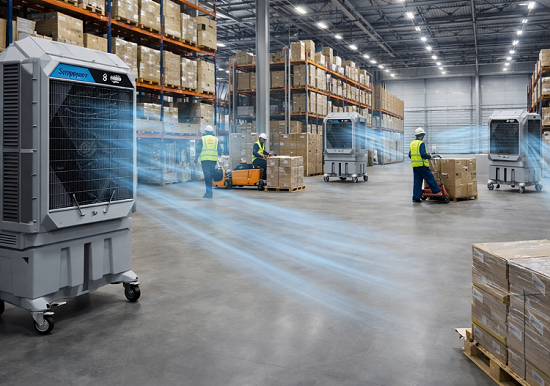
Why Big Size Cooler for Warehouses & Logistics Hubs Cooling
Hubs:Bhiwandi, NCR, Bangalore.
- Cooling Need: Worker comfort to prevent heat exhaustion. Spaces are massive with high ceilings.
- Operational Profile: Loading docks are frequently opened.
- Recommended System: Big-Size Air Coolers.
- Why Big Air Coolers? : ACs require a sealed environment. Every time a shutter opens, you lose thousands of rupees of chilled air. Coolers operate on Positive Pressure—they push cool air in, forcing hot air out. Opening doors actually helps coolers work better.
Manufacturing Cooling (Automotive, Engineering, Workshops)
Hubs: Pune, Chennai, Manesar, Jamshedpur.
- Cooling Need: Spot cooling for workers near furnaces, welding stations, or CNC machines.
- Recommended System: Ducted Industrial Coolers (Spot Cooling).
- Why Ducted Industrial Coolers? : You cannot cool a factory floor with a furnace running. However, you can direct a cool breeze (jet) onto the worker.
- Cost Impact: AC is impossible to size for open factory floors. Coolers provide a “wind chill” effect that improves productivity without trying to cool the entire building volume.
Big Size Cooler for Restaurants’ Kitchen Cooling
- Cooling Need: Kitchen heat.
- Recommended System: Hybrid.
- Kitchen: Big Coolers are mandatory.
- Why Big Size Coolers? : Kitchens have massive exhaust fans. If you put AC in a kitchen, the exhaust pulls the chilled air out immediately. A Big Cooler provides Make-up Air (fresh air) to replace what the exhaust pulls out, keeping the kitchen bearable for chefs without wasting energy.
Regional Strategies to Curtail Cooling Costs in India
Climate dictates performance. An AC works the same everywhere, but a Cooler’s efficiency depends on the “Wet Bulb Depression” (dryness of air).
-
North & Central India (Delhi, Rajasthan, MP):
- Climate: Hot & Dry (March–June).
- Strategy: 100% Air Coolers. The dry heat allows coolers to drop temperature by 10-15°C easily.
-
Western India (Gujarat Maharashtra):
- Climate: Hot & Dry (March–June).
- Strategy: 100% Air Coolers. The dry heat allows coolers to drop temperature by 10-15°C easily.
-
South India (Bangalore, Hyderabad, Chennai):
- Climate: Moderate to Humid.
- Strategy: Stage-Cooling. Bangalore is dry enough for coolers most of the year. Chennai requires high-velocity ducts (Spot Cooling) rather than general space cooling.
Sensitivity Analysis: When does the math change?
We tested the model against three scenarios:
-
Conservative (Low Usage): 8 hours/day, ₹7/unit electricity.
- Result: Coolers still save ~60% TCO. Payback period on CapEx difference is <6 months.
-
Typical (Industry Standard): 12 hours/day, ₹9/unit.
- Result: Coolers save ~85% TCO.
- Aggressive (24×7 Ops): 24 hours/day, ₹12/unit (Maharashtra Industrial Tariff).
Result: The electricity savings from Coolers become massive. AC becomes financially unviable for low-margin industries (like weaving or packaging). The savings in Year 1 alone cover the entire cost of the Cooler setup.
Environmental & Regulatory Considerations
- Refrigerant Phase-out: Indian regulations are tightening on HCFCs (R-22). New ACs use R-32 or R-410A, which are expensive. Coolers use Water (R-718), which is future-proof.
- ESG Goals: Companies reporting ESG (Environmental, Social, and Governance) scores benefit from Coolers due to significantly lower Carbon Footprint (Scope 2 emissions).
- Water Usage: In water-scarce regions (Rajasthan), coolers must be equipped with water recovery systems or treated STP (Sewage Treatment Plant) water to remain compliant.
Thus Choose Big-Size Air Coolers If:
- You have large open doors or high ceilings (Warehouses).
- Your process generates dust/fumes (Coolers flush air; ACs recycle it).
- You are in Textiles, Heavy Manufacturing, or Logistics.
- Budget is priority: You want to save ~80% on electricity bills.
Why are outdoor cooling systems now considered crucial public health infrastructure?
The increasing frequency and intensity of heatwaves have driven a fundamental social and governmental shift: viewing outdoor cooling not as a luxury, but as a crucial component of public health infrastructure and climate justice. The implementation of smart cooling systems in public spaces reflects this realization, transforming how cities protect vulnerable populations and maintain social and economic activity during extreme thermal events.
FAQs About Big Coolers & ACs
Big Size Cooler Vs. AC for Different Industries: A 5-Year Operational Cost Comparison
Which is cheaper - centralized AC or industrial evaporative coolers for textile mills?
Industrial evaporative coolers are vastly cheaper (approx. 1/8th the running cost) and are technically superior for textile mills because they maintain the humidity required to prevent yarn breakage.
Can industrial air coolers work effectively in Mumbai’s high humidity?
During the humid months (July-Sept), their efficiency drops. However, for industrial setups in Mumbai, high-velocity ductable coolers are still used for "Spot Cooling" (wind chill effect) combined with heavy exhaust systems, as AC is often too expensive for open factory floors.
What is the water consumption of a large industrial air cooler per hour?
A standard 18,000 CFM industrial cooler typically consumes 20–40 liters of water per hour depending on the dryness of the outside air.
Do big air coolers require a lot of maintenance compared to AC?
No. Coolers are simpler (Fan + Pump). Maintenance involves cleaning pads and draining the tank (often automated). ACs require specialized compressor servicing, gas top-ups, and expensive coil cleaning.
Is 3-phase electricity required for industrial air coolers?
Yes, most large industrial coolers (above 1.1 kW motor power) run more efficiently on 3-phase power, though single-phase options exist for smaller units.
How many industrial air coolers do I need for a 10,000 sq ft warehouse?
Roughly, you need about 5–6 units of 18,000 CFM capacity. The rule of thumb is 1 CFM per sq. ft. for warehouses, adjusted for ceiling height and heat load.
What is the price difference between ductable AC and ductable coolers?
A Ductable AC setup costs roughly ₹2,500–₹3,500 per sq. ft. (CapEx), whereas a Ductable Cooler setup costs roughly ₹400–₹600 per sq. ft.
Do industrial coolers spread bacteria or Legionella?
Modern industrial coolers have "Auto-Drain" and "Clean Cycle" features that prevent water stagnation, eliminating the risk of bacterial growth or smells.

Maulik Solanki is a seasoned B2B Product Marketing professional specializing in Industrial and Commercial Coolers in the LSV (Large Space Venticooling) segment. With 13+ years of experience, he drives brand building and audience engagement for Symphony’s LSV solutions through integrated offline and online strategies. Backed by an MBA in Marketing and earlier experience as a Regional Marketing Manager in banking, Maulik brings strong skills in sales, advertising, and events. He enjoys exploring new marketing ideas and cooling technologies and writes to help readers understand Symphony’s offerings.

Sourav Biswas is a senior marketing leader heading the LSV (Large Space Venticooling – B2B) marketing function at Symphony Limited. He shapes the brand’s strategic narrative, strengthens market leadership, and ensures excellence across all B2B cooling solutions. With deep expertise in Strategic Marketing, Brand Management, Advertising, and PR, he reviews content with analytical precision and alignment to Symphony’s vision. Passionate about mentoring and tracking B2B trends, Sourav ensures every content piece reflects accuracy, relevance, and strategic depth.