





Table of Contents
AI Summary
The comparison between Big Size Coolers, such as Symphony’s Large Space Venti-Cooling (LSV), and Central Cooling Systems (HVAC) highlights a fundamental shift toward energy-efficient industrial infrastructure in 2026. While Central HVAC systems provide precise temperature and humidity control essential for sealed, high-precision environments, they demand a significantly higher CAPEX for complex chiller plants and a massive OPEX due to energy-intensive compressors. In contrast, Big Size Coolers offer a modular, low-cost installation that is 25-40% cheaper upfront and consumes up to 90% less electricity by leveraging the natural power of evaporative cooling. This makes the Big Size Cooler an ideal solution for large, open, or semi-open industrial spaces, providing superior ventilation and fresh air while ensuring an aggressive ROI within just 7 to 12 months, effectively balancing worker comfort with long-term fiscal sustainability.
Introduction
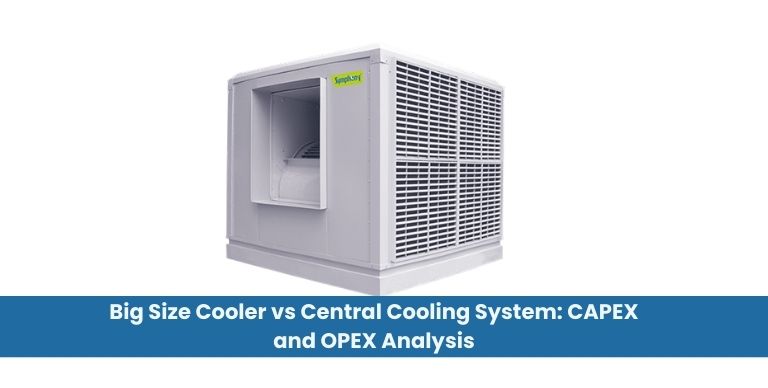
When designing the cooling infrastructure for massive industrial or commercial spaces in 2026, the decision typically boils down to two heavyweights: the Big Size Cooler (Industrial Evaporative Cooling) and the Central Cooling System (Chilled Water HVAC).
While both aim to lower indoor temperatures, they differ fundamentally in physics, infrastructure, and financial impact. This article provides a data-driven comparison of the Capital Expenditure (CAPEX) and Operating Expenditure (OPEX) to help facility managers make an informed choice.
Technical Overview: Different Philosophies of Cooling
The Big Size Cooler (Evaporative Venti-Cooling)
These units, such as the Symphony Large Space Venti-Cooling(LSV), operate on the principle of evaporative cooling. Hot outside air is pulled through water-saturated honeycomb pads, causing the water to evaporate and the air temperature to drop.
- Key Feature: It requires a constant flow of fresh air and works best in open or semi-open environments.
- Mechanism: It provides 100% fresh, filtered air while displacing stale, hot air.
The Central Cooling System (HVAC)
A traditional central HVAC system uses a refrigeration cycle (compressor, condenser, and refrigerant) to chill water or air.
- Key Feature: It operates in a “closed-loop” environment where air is recirculated and chilled.
- Mechanism: It offers precise control over temperature and humidity but requires the space to be completely sealed.
CAPEX Comparison: The Cost of Getting Started
Capital Expenditure includes the purchase price, ducting, electrical infrastructure, and installation labor.
Big Size Cooler (The Lean Option)
- Modular Setup: These units are modular and can be installed in stages. You don’t need a massive central plant room.
- Simplified Infrastructure: It requires standard electrical points and a water connection. There are no high-pressure refrigerant lines or complex chillers.
- Cost Factor: Generally, the CAPEX for a Big Size Cooler system is 25% to 40% lower than a central HVAC system for the same floor area.
Central Cooling System (The Heavy Investment)
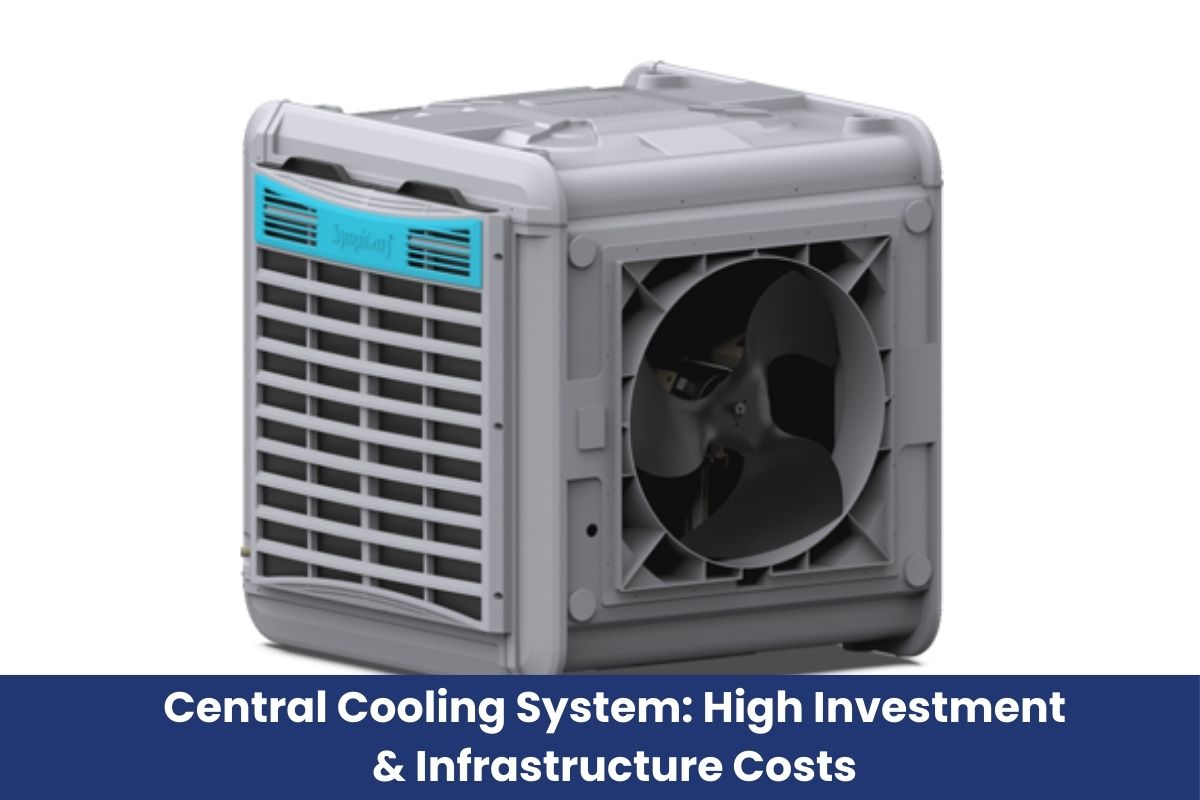
- High Infrastructure Needs: Requires a dedicated plant room, cooling towers, heavy-duty pumps, and extensive insulated ducting.
- Regulatory & Safety Costs: Handling refrigerants often requires specialized certifications and safety compliance measures.
- Cost Factor: The upfront investment is high due to the complexity of the compressor-based machinery and the precision of the control systems.
Our Other Product
Ventilation Cooling System - Venti-Cool 11UOPEX Comparison: The Reality of Running Costs for Big Size Cooler & Central Cooling System
Operating Expenditure is where the “Big Size Cooler” truly shines, particularly in the current energy landscape.
Expense Category | Big Size Cooler (Evaporative) | Central Cooling (HVAC) |
Electricity Consumption | Uses 90% less electricity than HVAC. | High; compressors are energy-intensive. |
Water Usage | Higher (required for evaporation). | Low (closed loop, minimal evaporation). |
Maintenance | Minimal; cleaning pads and pumps. | High; refrigerant top-ups, compressor service. |
Labor Costs | Can be maintained by site staff. | Requires specialized HVAC technicians. |
The Power Multiplier
In a factory setup of 20,000 sq. ft., a central HVAC system might cost ₹5.00 to ₹7.00 per sq. ft. per month to operate. A Symphony LSV system can achieve similar comfort levels (ambient cooling) at less than ₹1.00 per sq. ft. per month.
Big Size Cooler & Central Cooling System Performance in Industrial Contexts
Humidity and Ventilation
- Big Size Coolers add a controlled amount of humidity, which is beneficial in dry climates and industries like textiles or woodworking. More importantly, they provide ventilation, which removes fumes, dust, and odors.
- Central Cooling removes humidity. While ideal for electronics or pharmaceuticals, the lack of fresh air in a “sealed” factory can lead to poor air quality and worker fatigue.
Scalability and ROI
The Return on Investment (ROI) for Big Size Coolers is remarkably fast. Due to the massive energy savings (90% reduction), many industrial units recover their entire CAPEX in 7 to 12 months. A central HVAC system, due to higher OPEX, may take 5 to 7 years to reach a similar break-even point.
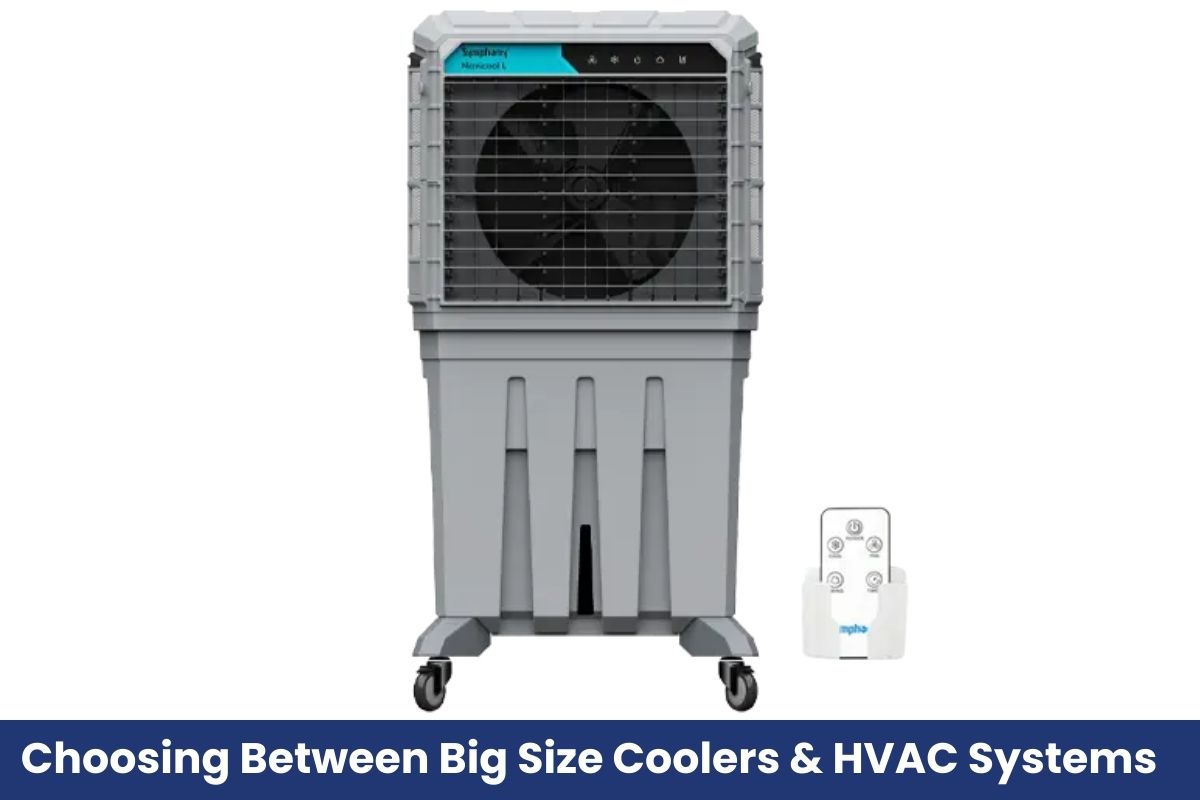
Which Should You Choose? Big Cooler or HVAC System?
Choose Big Size Coolers If:
- You have a large open or semi-open factory, warehouse, or banquet hall.
- Your primary goals are worker comfort and ventilation.
- You want to slash electricity bills and achieve a fast ROI.
- You are operating in a hot and dry or semi-arid climate.
Choose Central Cooling If:
- You require precise temperature control (e.g., constant 22°C).
- You are in a high-precision industry like semiconductor manufacturing or surgery.
- Your space must be hermetically sealed from the outside environment.
Estimated Monthly Saving for Specific Facility Floor Area
These calculations compare a Big Size Cooler (specifically the Symphony LSV/Venti-Cool series) against a traditional Central HVAC (Chilled Water/VRF) system.
The 2026 Savings Matrix (Monthly OPEX)
The calculations are based on an average industrial electricity tariff in India of ₹9.00/unit, assuming 12 hours of daily operation.
Facility Floor Area (Sq. Ft.) | Central HVAC Cost (Est. Monthly) | Big Size Cooler Cost (Est. Monthly) | Monthly Savings with Big Size Cooler |
2,500 (Small Workshop/Cafe) | ₹15,000 – ₹17,500 | ₹2,500 – ₹5,000 | ₹12,500+ |
5,000 (Banquet/Textile Unit) | ₹35,000 – ₹45,000 | ₹5,000 – ₹10,000 | ₹30,000+ |
10,000 (Showroom/Packaging) | ₹75,000 – ₹90,000 | ₹10,000 – ₹20,000 | ₹65,000+ |
25,000 (Large Warehouse) | ₹1,85,000 – ₹2,25,000 | ₹25,000 – ₹50,000 | ₹1,60,000+ |
50,000 (Automobile Factory) | ₹3,75,000 – ₹4,50,000 | ₹50,000 – ₹1,00,000 | ₹3,25,000+ |
Key Data Assumptions for 2026
- Operational Cost Efficiency: A Symphony LSV unit consumes roughly 1/10th the power of a central HVAC system. While HVAC uses 1.5 to 3 units/hour, these industrial coolers consume only 0.2 to 0.5 units/hour.
- Per Sq. Ft. Metric: Running costs for the Big Size Cooler are consistently reported at less than ₹2 per sq. ft. per month, whereas Central AC costs often exceed ₹7 to ₹9 per sq. ft. in industrial settings.
- Water Usage: Unlike AC, coolers require water (approx. 20–40 liters/hour per unit). Even with water costs factored in, the total OPEX remains 80–90% lower than electricity-heavy AC systems.
Our Other Product
Industrial Ducting Cooler - Heavy Duty Movicool XXLReturn on Investment (ROI)
Because the CAPEX (Installation Cost) of a Big Size Cooler is about 25% to 40% of a Central HVAC system, the “Payback Period” is exceptionally fast:
- Typical ROI: Within 7 months of installation.
- 5-Year TCO: For a 5,000 sq. ft. area, you can save roughly ₹1 Crore over 5 years by choosing a Big Size Cooler over Central AC.
Why the Savings are Massive in 2026
In 2026, as electricity tariffs in states like Gujarat, Maharashtra and other Indian States continue to rise for commercial slabs, the “Power Multiplier” effect of evaporative cooling becomes your biggest financial advantage. For any space that is semi-open or involves high worker movement, Central AC loses its chilled air instantly, leading to “energy leakage” that doesn’t happen with the Venti-Cooling philosophy.
Conclusion
In 2026, as sustainability and “Green Factory” mandates become the norm, the Big Size Cooler is the clear winner for general industrial and large-scale commercial applications. It offers a “Customer-Friendly” and “Worker-Friendly” environment at a fraction of the cost, making it the most sensible financial and environmental choice for the modern entrepreneur.
FAQs: Big Size Cooler vs. Central Cooling System
Big Size Cooler vs Central Cooling System: CAPEX and OPEX Comparison
What is the primary difference in CAPEX between a Big Size Cooler and a Central HVAC system?
The Capital Expenditure (CAPEX) for a Big Size Cooler (like the Symphony LSV) is typically 25% to 40% lower than a central HVAC system. This is because Big Size Coolers are modular and do not require expensive central chiller plants, heavy-duty pumps, or complex refrigerant piping, making the initial setup much more affordable for large facilities.
How much can I save on OPEX by switching from a Central Cooling System to a Big Size Cooler?
The Operating Expenditure (OPEX) is where the most significant savings occur. Big Size Coolers consume up to 90% less electricity than compressor-based HVAC systems. For example, while a central AC might cost ₹7–₹9 per sq. ft. to run monthly, a Big Size Cooler operates at less than ₹1–₹2 per sq. ft., drastically reducing monthly utility bills.
Big Size Cooler or HVAC? Which system is better for air quality and worker health in an industrial environment?
The Big Size Cooler is superior for ventilation. It provides 100% fresh, filtered air and constantly displaces stale air, odors, and dust. Traditional Central Cooling Systems often recirculate the same air in a sealed environment, which can lead to poor indoor air quality and the buildup of pollutants unless expensive filtration upgrades are added.
What is the typical Return on Investment (ROI) period for a Big Size Cooler?
Due to the combination of lower installation costs and massive electricity savings, most industrial facilities achieve a full ROI within 7 to 12 months. In contrast, a Central Cooling System often takes 5 to 7 years to break even due to its high power consumption and intensive maintenance requirements.

Maulik Solanki is a seasoned B2B Product Marketing professional specializing in Industrial and Commercial Coolers in the LSV (Large Space Venticooling) segment. With 13+ years of experience, he drives brand building and audience engagement for Symphony’s LSV solutions through integrated offline and online strategies. Backed by an MBA in Marketing and earlier experience as a Regional Marketing Manager in banking, Maulik brings strong skills in sales, advertising, and events. He enjoys exploring new marketing ideas and cooling technologies and writes to help readers understand Symphony’s offerings.

Sourav Biswas is a senior marketing leader heading the LSV (Large Space Venticooling – B2B) marketing function at Symphony Limited. He shapes the brand’s strategic narrative, strengthens market leadership, and ensures excellence across all B2B cooling solutions. With deep expertise in Strategic Marketing, Brand Management, Advertising, and PR, he reviews content with analytical precision and alignment to Symphony’s vision. Passionate about mentoring and tracking B2B trends, Sourav ensures every content piece reflects accuracy, relevance, and strategic depth.