





Symphony Venticool

0:00 / 0:00

A centralised air cooling system is only as good as its duct design. A cooling system, poorly connected to a badly routed duct network, will deliver uneven temperatures across a facility – some zones sweltering while others are adequately cooled. The design of the duct layout is the engineering work that determines whether a central cooling system delivers its designed performance.

This guide explains the principles of duct routing design for maximum temperature uniformity in large industrial and commercial facilities – the technical foundation behind every centralised Air Handling System installation.

Quick Response Guaranteed

The objective of duct layout design is to deliver the designed CFM volume to every discharge grille in the system, regardless of the distance from the AHU. This is called airflow balance – and achieving it requires careful management of duct size, length, bends, and branch splits.

Air, like water, takes the path of least resistance. Without deliberate design, more air will flow to the nearest, shortest duct branches and less to the longer, more distant ones. The result is a central air cooling system that cools well near the AHU and poorly at the far end of the facility – exactly the opposite of what “centralised” cooling should mean.

Balanced distribution is achieved through: correct duct sizing (larger ducts for longer runs), dampers at branch junctions to adjust flow resistance, appropriately sized discharge grilles, and commissioning with airflow measurement and damper adjustment at every point.

Duct Routing Approaches: Trunk-and-Branch vs Ring Main

Two main duct routing architectures are used in industrial Air Handling Systems:

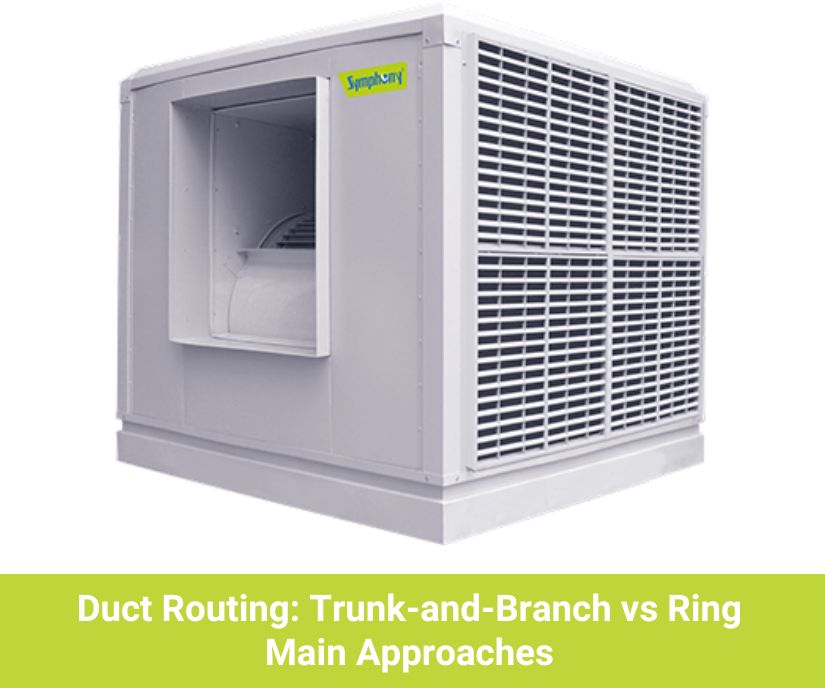
The trunk-and-branch approach uses a large main duct (the trunk) running the length of the facility, with smaller branch ducts splitting off at regular intervals to reach discharge grilles. This is the most common design for rectangular industrial buildings and is straightforward to install and balance.

The ring main approach uses a duct loop that runs around the perimeter of the facility, with drop ducts descending to discharge grilles at regular intervals along the loop. This approach provides more inherently even pressure distribution and is preferred for very large facilities or those with irregular shapes where a single trunk creates excessively long branch runs.

For facilities with multiple wings, mezzanines, or separate processing zones, a hybrid approach is used – multiple trunk-and-branch sub-systems fed from a centralised AHU manifold.

Discharge Grille Placement: Where the Air Meets the Workers

The position and angle of discharge grilles determines where cooled air is directed and how it mixes with the room air. Poor grille placement is one of the most common causes of uneven cooling in industrial Air Handling Systems.

Grilles should be positioned to direct air across the occupied zone – not into walls, not directly downward from ceiling height, and not aimed at machinery in ways that could interfere with processes. For factories with benches or workstations arranged in rows, discharge grilles positioned along the centreline of the row and aimed along the row direction provide the most effective coverage.

The spacing between discharge grilles depends on the throw distance of each grille – the distance over which it maintains adequate air velocity. For a factory with 18-foot ceilings, a grille with 12-metre throw distance should be placed at 10–11 metre intervals to ensure overlapping coverage without gaps.

We’re Just a Call Away

AHU Positioning: Where the Central Cooling System Lives

The AHU position determines the maximum duct run length and, therefore, the complexity of the duct network. In large facilities, positioning AHU units at the geometric centre of their served zone – rather than at the perimeter – minimises maximum duct run length and improves balance.

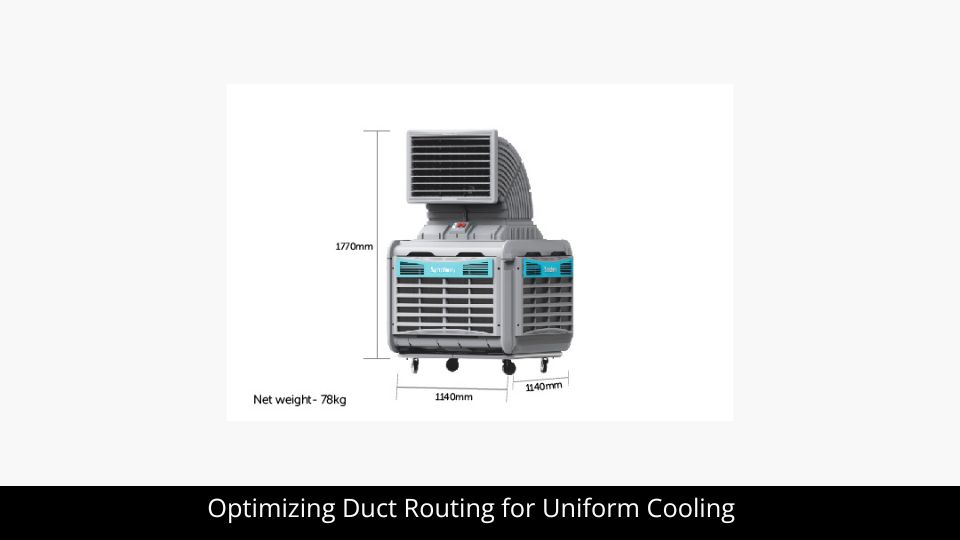
For facilities with rooftop mounting capability, roof-mounted AHU units feed vertical drop ducts that enter the building near the centre, dramatically reducing horizontal duct runs and simplifying installation. For facilities where roof mounting is not feasible, external wall mounting with penetration through the building shell is used.

Multiple AHU units in a large central cooling system should be positioned to serve distinct, non-overlapping zones – preventing interference between duct networks and allowing zone-by-zone control.

Frequently Asked Questions

Central Air Cooling System Layout: How to Design Duct Routing for Maximum Uniformity in Large Facilities

How do I know if my existing central cooling system has poor duct design?

Signs of poor duct design include: significant temperature variation between areas of the facility (more than 3–4°C between the coolest and warmest zones), high noise from discharge grilles (indicating air velocity problems), low air velocity at distant discharge points, and AHU units running continuously at maximum capacity without achieving designed temperatures. Symphony Venti-Cool can audit existing systems and recommend redesign.

What duct material is recommended for industrial central cooling systems?

Galvanised steel sheet metal is the standard duct material for industrial Air Handling Systems in India - it is durable, dimensionally stable, and resistant to the humidity and temperature fluctuations of industrial environments. Insulation is recommended for duct runs passing through uncooled zones or exposed to direct sunlight to prevent heat gain in the duct before air reaches the discharge grille.

How long does a duct routing design take to complete for a large facility?

A full duct routing design for a facility of 20,000–50,000 sq ft typically takes 5–10 working days from receipt of floor plans and zone mapping data. For very large or complex facilities - multi-bay warehouses, multi-wing factories - the design process may take 2–3 weeks. Symphony Venti-Cool's engineering team provides complete design documentation as part of the system supply process.

Can duct routing be modified after installation if the initial design is not performing correctly?

Yes, but modifications after installation are more costly than getting the design right before installation. Adding dampers, resizing duct sections, or repositioning discharge grilles is possible but requires additional materials and labour. This is why commissioning with airflow measurement at every grille is essential - and why working with an experienced supplier like Symphony Venti-Cool from the design stage saves significant cost.

Does the central cooling system design account for future factory layout changes?

A well-designed system includes provision for future duct extensions - blanked-off tee connections at key points along the trunk duct that can be opened and extended when new zones are added. Communicating planned future layout changes to your system designer at the outset is important for designing this flexibility in from the start.

What is the maximum distance a duct can run from an AHU before CFM delivery is significantly reduced?

With correctly sized ductwork, effective CFM delivery can be maintained over runs of 40–60 metres from the AHU. Beyond this distance, duct diameter needs to increase significantly, or a secondary AHU unit should be positioned closer to the far zone. Symphony's duct design service calculates the optimal AHU positioning and duct sizing for every specific facility.

<< 1 >>


About the Author
About the Reviewer

Sourav Biswas is a senior marketing leader heading the LSV (Large Space Venticooling – B2B) marketing function at Symphony Limited. He shapes the brand’s strategic narrative, strengthens market leadership, and ensures excellence across all B2B cooling solutions. With deep expertise in Strategic Marketing, Brand Management, Advertising, and PR, he reviews content with analytical precision and alignment to Symphony’s vision. Passionate about mentoring and tracking B2B trends, Sourav ensures every content piece reflects accuracy, relevance, and strategic depth.


×
×
Index