Symphony Venticool

Read AI-Generated Summary:

This comprehensive guide explains how a central cooling system works in multi-floor commercial buildings – from shopping malls and corporate offices to hospitals, hotels, and mixed-use complexes across Indian cities like Mumbai, Delhi, Bengaluru, Hyderabad, and Ahmedabad. It covers the key types of central cooling systems, including chiller-based HVAC, central evaporative cooling (LSV), and hybrid approaches, along with a detailed cost breakdown for Indian buyers. Symphony Venti-Cool’s Large Space Venti-Cooling solutions are highlighted as an energy-efficient, cost-effective alternative to conventional Commercial HVAC for large commercial spaces. The article addresses system design, airflow requirements, AHU configuration, installation timelines, operating costs, and selection criteria – making it an essential reference for architects, facility managers, property developers, and procurement teams.

0:00 / 0:00

India is experiencing a commercial real estate boom of historic proportions. From IT parks in Bengaluru and Hyderabad to shopping malls in Mumbai and Delhi, from multi-storey hospitals in Chennai and Pune to corporate headquarters in Gurugram and Noida – the demand for reliable, energy-efficient central cooling systems for large commercial buildings has never been higher.

Yet cooling remains one of the largest operational expenditures for commercial building owners and facility managers. In a typical Indian commercial building, HVAC and cooling can account for 40–60% of total electricity consumption. For multi-floor commercial properties, selecting the right centralized cooling system at the design stage – or upgrading to the right system during retrofitting – determines operational profitability for the next 15–20 years.

This guide explains exactly how central cooling systems work in multi-floor commercial buildings, what the key system types are, how much they cost to install and operate in India, and when Symphony Venti-Cool’s central evaporative cooling approach delivers superior value.

We’re Ready to Help!

What Is a Central Cooling System for a Multi-Floor Commercial Building?

A central cooling system is a unified infrastructure that generates cooling capacity at one central location and distributes it throughout a building via a network of ducts, pipes, and air handling units. In a multi-floor commercial building, this typically means:

The key advantage of a centralized cooling system over individual split ACs or portable coolers is efficiency at scale – a single central plant serving 50,000 sq ft is far more efficient and manageable than 50 individual 1-ton split ACs.

What Are the Main Types of Central Cooling Systems Available in India?

Chiller-Based Commercial HVAC System

The most common approach in premium Indian commercial buildings. A water-cooled or air-cooled chiller produces chilled water at 6–12°C, which is pumped to AHUs or FCUs across all floors. The Commercial HVAC System can achieve very precise temperature (18–24°C) and humidity control. It is the standard for IT parks, hospitals, five-star hotels, and premium offices in cities like Mumbai, Bengaluru, and Delhi NCR. Capital cost is high (₹400–1,000 per sq ft installed), and operating costs are substantial.

Central Evaporative Cooling System (LSV)

Symphony Venti-Cool’s Large Space Venti-Cooling (LSV) system is India’s leading central evaporative cooling solution for large commercial and industrial buildings. Modular AHUs using direct evaporative cooling technology cool fresh outside air and distribute it through ductwork. Multiple LSV units are configured per floor, controlled centrally. CapEx is 5–8x lower than chiller-based systems; operating costs are 80–90% lower. Ideal for commercial spaces in dry-heat climates and for semi-open or naturally ventilated buildings.

Hybrid Cooling System

An increasingly popular approach in Indian commercial buildings – using LSV evaporative cooling for large open areas (lobbies, factories, retail floors, warehouses) while deploying precision cooling (split AC or small chillers) only for zones requiring low temperatures (server rooms, laboratories, conference rooms). This hybrid approach minimises overall system cost while meeting the specific needs of each zone.

Variable Air Volume (VAV) HVAC System

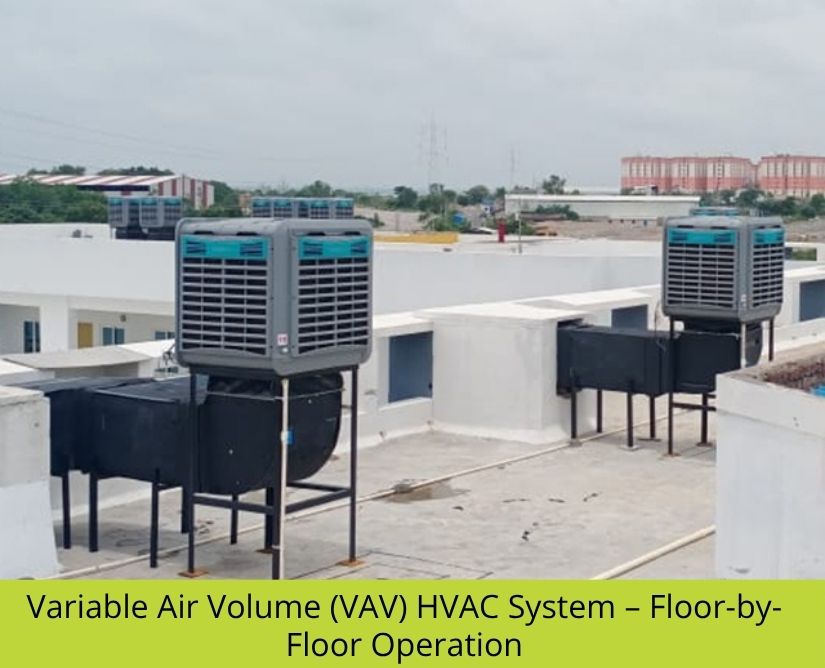
A sophisticated variation of the chiller-based system where airflow to each zone varies based on real-time demand. VAV HVAC systems are popular in premium multi-tenant office buildings in Gurugram, Mumbai BKC, and Bengaluru’s IT corridors. They offer better energy efficiency than constant-volume systems but require higher upfront investment and skilled commissioning.

How Does a Central Cooling System Work Floor by Floor in a Multi-Storey Building?

Understanding the floor-by-floor configuration is essential for architects, MEP consultants, and facility managers planning a multi-floor commercial building cooling system:

Basement / Ground Floor – Central Plant: Houses the primary cooling equipment – chillers, cooling towers (for chiller systems) or large central LSV AHUs (for evaporative systems). This is the heart of the central cooling system.

Mechanical Floors (every 8–12 floors): For tall buildings, intermediate mechanical floors house secondary AHUs and distribution equipment. In LSV evaporative systems, modular AHU units can be installed at each floor level without dedicated mechanical floors, reducing construction cost.

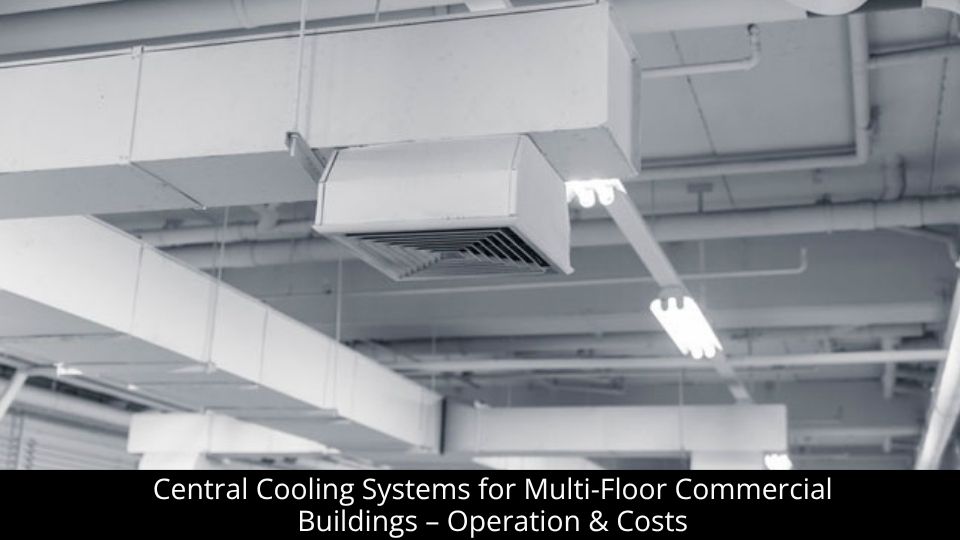
Floor-Level Distribution: Chilled water pipes (HVAC) or supply air ducts (LSV evaporative) run horizontally on each floor to distribute conditioned air. Supply air diffusers, grilles, and return air paths are designed by MEP engineers to achieve uniform airflow.

Zone Controls: BMS or zone thermostats allow each floor or zone to be controlled independently. Symphony Venti-Cool’s LSV systems are BMS-compatible, allowing centralised monitoring and scheduling.

What Is the Cost of a Central Cooling System for a Multi-Floor Commercial Building in India?

Cost is the most critical factor in central cooling system selection. The following benchmarks are based on typical Indian commercial projects as of 2026:

Building Type & Size

Chiller-Based HVAC (₹)

Symphony LSV Evaporative (₹)

Small commercial (10,000 sq ft, 3 floors)

₹40–80 lakhs

₹8–15 lakhs

Medium mall/office (50,000 sq ft)

₹2–4 crores

₹30–60 lakhs

Large mall/hospital (2,00,000 sq ft)

₹8–18 crores

₹1.2–2.5 crores

Annual operating cost (50,000 sq ft)

₹72 lakhs–1.5 crores

₹8–15 lakhs

Simple payback vs AC system

Baseline

1–2 years

*This table parameters and values are tentative and may vary based on various other factors.

The central cooling system cost in India varies significantly based on building height, occupancy type, climate zone, and required temperature precision. For commercial buildings in Tier 2 cities like Indore, Nagpur, Jaipur, and Surat where cooling is required primarily during the hot season (8–9 months), the operating cost advantage of Symphony’s LSV system is even more pronounced.

What Are the Key Design Considerations for Multi-Floor Commercial Building Cooling?

What Are the Operating and Maintenance Costs for Commercial Building Cooling Systems?

For a 50,000 sq ft multi-floor commercial building operating 10 hours per day, 300 days per year in a city like Ahmedabad, Hyderabad, or Nagpur:

Symphony LSV Central Evaporative System – Monthly Operating Cost: ₹60,000–1,20,000 in electricity, plus ₹5,000–10,000 in water and consumables. Annual maintenance contract: ₹1–2 lakhs.

Chiller-Based Commercial HVAC – Monthly Operating Cost: ₹5,00,000–12,00,000 in electricity. Annual AMC including refrigerant servicing and compressor maintenance: ₹5–15 lakhs.

Note: This pricing parameters and values are tentative and may vary based on various other factors.

Over a 10-year building lifecycle, the operating cost differential alone can be ₹5–12 crores for a medium-sized commercial building – a compelling financial case for choosing Symphony Venti-Cool’s central evaporative cooling approach wherever the application allows.

Speak with an Expert

Which Commercial Buildings Are Best Suited for LSV Central Cooling?

Conclusion: Making the Right Central Cooling Investment for Your Commercial Building

Central cooling for a multi-floor commercial building is a long-term capital decision that shapes operational economics for the lifetime of the building. The evidence is clear: for the majority of Indian commercial buildings – especially those in non-premium segments, semi-open configurations, industrial-commercial hybrids, or Tier 2 and Tier 3 city locations – Symphony Venti-Cool’s central evaporative cooling system delivers the optimal combination of performance, cost, and sustainability.

For premium air-conditioned environments requiring precise temperature and humidity control, chiller-based HVAC remains the appropriate choice – but even in these buildings, a hybrid approach using Symphony LSV for large common areas, lobbies, and peripheral zones can cut overall HVAC costs by 40–60%.

To design the right central cooling system for your commercial building, consult Symphony Venti-Cool’s expert team for a free site assessment and customised system design at symphonyventicool.com.

Frequently Asked Questions

Central Cooling System for Multi-Floor Commercial Buildings: How It Works and What It Costs

What is the central cooling system cost in India for a commercial building?

A Symphony LSV central evaporative cooling system for a 50,000 sq ft commercial building costs are very less as compared to HVAC. A chiller-based HVAC system for the same building would cost higher roughly 5–8x more.

Can a central evaporative cooling system be used in a multi-floor office building?

Yes. Symphony's modular LSV AHUs can be configured for each floor independently, connected to a central monitoring and control system - making them fully viable for multi-floor commercial and office buildings.

What is a VAV HVAC system and is it better than central evaporative cooling?

A VAV (Variable Air Volume) HVAC system varies airflow to each zone based on demand, improving efficiency over constant-volume systems. However, it is still refrigerant-based and costs significantly more than LSV evaporative cooling. For most Indian commercial buildings, LSV is more cost-effective.

How much fresh air does a central cooling system deliver per person?

Symphony LSV systems deliver 100% fresh outside air, providing airflow of 15–30 CMH per person depending on configuration - meeting NBC and ASHRAE fresh air requirements for commercial occupancies.

Is Symphony Venti-Cool's LSV system suitable for hospitals and healthcare buildings?

LSV systems are suitable for waiting areas, OPDs, administrative wings, and corridors. Critical zones such as operation theatres and ICUs require chiller-based AC with humidity control. A hybrid approach using LSV for non-critical areas is widely adopted.

How long does it take to install a central cooling system for a commercial building?

Symphony LSV installation for a multi-floor commercial building typically takes 1–3 weeks depending on scale. Chiller-based HVAC installation takes 6–12 weeks for equivalent projects.

What is the energy rating of Symphony Venti-Cool's central cooling system?

Symphony LSV systems consume 90% less electricity than central AC systems and inherently comply with BEE ECBC energy performance standards for commercial buildings.

Can the central cooling system be expanded as the building grows?

Yes. Symphony's modular LSV design allows incremental expansion - new units can be added as additional floors or wings are occupied without redesigning the entire system.

<< 1 >>


About the Author
About the Reviewer

Sourav Biswas is a senior marketing leader heading the LSV (Large Space Venticooling – B2B) marketing function at Symphony Limited. He shapes the brand’s strategic narrative, strengthens market leadership, and ensures excellence across all B2B cooling solutions. With deep expertise in Strategic Marketing, Brand Management, Advertising, and PR, he reviews content with analytical precision and alignment to Symphony’s vision. Passionate about mentoring and tracking B2B trends, Sourav ensures every content piece reflects accuracy, relevance, and strategic depth.


×
×
Index