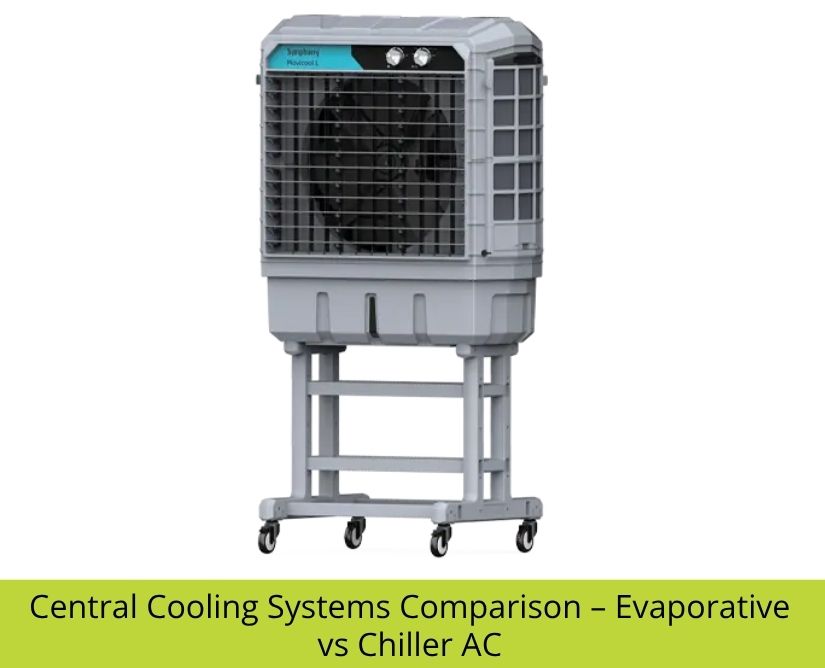
Choosing between a central evaporative cooling system and a chiller-based central AC is one of the most consequential decisions for Indian industrial and commercial facility managers. This article delivers a comprehensive cost and performance comparison of both systems across capital expenditure, operating cost, energy efficiency, maintenance, environmental impact, and suitability for Indian climate conditions. It explains how Symphony Venti-Cool’s Large Space Venti-Cooling (LSV) evaporative systems offer up to 90% lower power consumption than central AC, with far lower installation and lifecycle costs. Key sectors – textiles, pharma, auto, food processing, warehouses – and cities including Ahmedabad, Surat, Pune, Ludhiana, and Nagpur are referenced. Buyers seeking the best industrial cooling solution for large spaces in India will find clear, data-backed guidance here.
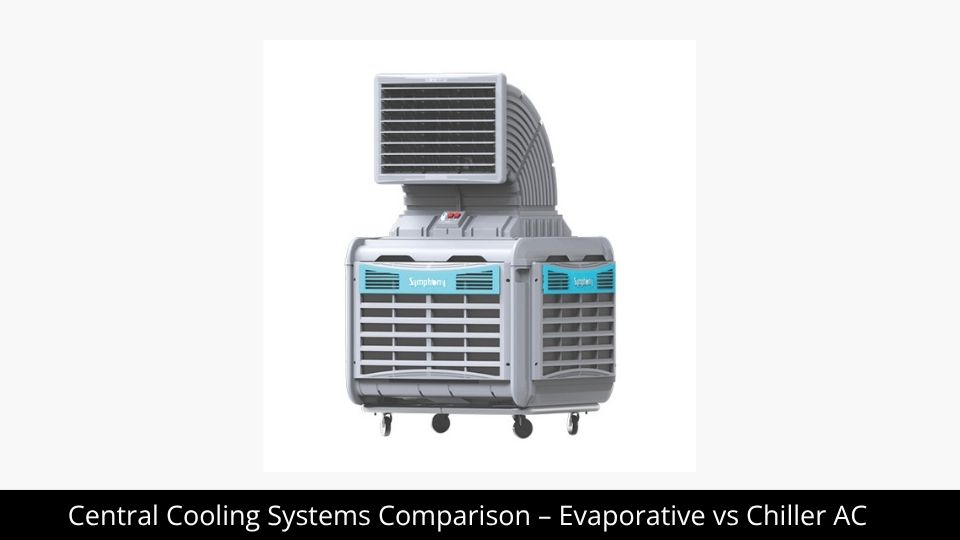
Table of Contents
Introduction: Why the Right Central Cooling Choice Matters for Indian Industry
India’s industrial and commercial real estate is expanding at a pace that is stretching cooling infrastructure to its limits. From multi-storey garment factories in Surat to pharmaceutical plants in Hyderabad, from sprawling auto assembly halls in Gurgaon to logistics warehouses in Bhiwandi, the need for a reliable, energy-efficient, and cost-effective central cooling system has never been more urgent.
Yet the choice of cooling technology is rarely straightforward. Facility managers, plant heads, and procurement teams are regularly forced to evaluate two fundamentally different approaches: the traditional chiller-based central AC system and the emerging category of central evaporative cooling systems, best represented in India by Symphony Venti-Cool’s Large Space Venti-Cooling (LSV) solutions.
The stakes are high. A wrong cooling infrastructure decision can cost crores in wasted CapEx, inflate electricity bills by lakhs every month, and ultimately compromise the productivity, safety, and comfort of hundreds of workers. This article provides an objective, data-driven breakdown of both technologies so you can make an informed decision.
What Is a Central Evaporative Cooling System and How Does It Work?
A central evaporative cooling system uses the natural process of water evaporation to reduce ambient air temperature. In direct evaporative cooling – the technology behind Symphony Venti-Cool’s LSV range – hot outside air is drawn through water-saturated cellulose honeycomb cooling pads. As water evaporates, it absorbs heat from the air, reducing its temperature by 10–15°C before distributing it through ducts or directly into the space.
Symphony’s LSV solutions use modular industrial air handling units (AHUs) delivering airflows between 8,000 and 25,000 CMH per unit, powered by motors ranging from 0.37 kW to 1.5 kW. Multiple units can be centrally configured to cool spaces from 5,000 sq ft to over 1,00,000 sq ft – making LSV a genuine central cooling system for large industrial and commercial buildings.
Unlike conventional desert coolers or portable coolers, LSV evaporative systems are designed for continuous industrial operation, with UV-stabilised engineering plastic bodies, professional ductwork integration, and smart controls compatible with Building Management Systems (BMS).
What Is a Chiller-Based Central AC System and How Does It Work?
A chiller-based central AC system uses vapour compression refrigeration technology. A central chiller unit cools water (or a water-glycol mixture), which is then circulated through air handling units (AHUs) or fan coil units (FCUs) distributed across the building. The AHU pulls warm room air over the chilled water coil, cools it, and recirculates it. A cooling tower or condenser rejects the heat outside.
Chiller-based HVAC systems are the dominant commercial cooling technology in India’s premium office buildings, shopping malls, hospitals, and star hotels. They can cool to very low temperatures (18–22°C) regardless of outside humidity and can maintain precise temperature and humidity control. However, they come with substantial cost and energy implications – especially for semi-open or naturally ventilated industrial environments.
How Do the Capital Costs Compare Between Central Evaporative Cooling and Central AC?
Capital expenditure is typically the first filter in any cooling system evaluation. The differences between the two technologies are stark:
Cost Parameter | Central Evaporative Cooling | Chiller-Based Central AC |
Installation cost per 1,000 sq ft | ₹15,000 – ₹40,000 | ₹1,50,000 – ₹4,00,000 |
Civil works & AHU room | Minimal / none required | Dedicated chiller room + AHU shafts |
Ductwork complexity | Simple galvanised ducts | Insulated chilled-water piping + ducts |
Commissioning time | 3–7 days | 3–6 weeks |
Typical 50,000 sq ft factory | ₹20–40 lakhs | ₹1.5–3 crores |
*This table parameters and values are tentative and may vary based on various other factors.
For a 50,000 sq ft factory in Pune, Ludhiana, or Ahmedabad, the CapEx saving from choosing an LSV evaporative system over chiller-based AC can be ₹1–2.5 crores – capital that can be reinvested in production equipment, raw materials, or working capital.
What Are the Operating Costs and Energy Consumption Differences?
Operating cost – primarily electricity – is where the difference between the two systems is most dramatic over time. Symphony Venti-Cool’s LSV systems consume 90% less power than equivalent air conditioning systems. A practical comparison for a 1,00,000 sq ft industrial facility:
Operating Parameter | Central Evaporative Cooler | Chiller-Based Central AC |
Power consumption (kW) | 40–80 kW | 500–900 kW |
Monthly electricity cost (8 hrs/day) | ₹50,000–1,00,000 | ₹6,00,000–12,00,000 |
Annual operating cost | ₹6–12 lakhs | ₹72–1.44 crores |
COP / EER | 15–25 (COP equivalent) | 3–4 (EER) |
CO₂ emissions (annual) | Very low | Very high (refrigerant risk too) |
*This table parameters and values are tentative and may vary based on various other factors.
For industries operating across 10–12 hours a day in states like Gujarat, Maharashtra, and Rajasthan, the annual energy saving from evaporative cooling can fund the entire system CapEx within 6–18 months – a payback period no chiller-based system can match.
How Do Both Systems Perform in Indian Climate Conditions?
India’s climate is deeply varied – and this is where the nuanced performance comparison matters most. The central evaporative cooling system thrives in India’s dominant climatic conditions: hot and dry summers (April–June) in cities like Ahmedabad, Jaipur, Nagpur, Raipur, Kanpur, and Ludhiana, where outside air temperatures reach 42–48°C and relative humidity is below 40%.
In these conditions, direct evaporative cooling achieves temperature drops of 12–18°C, delivering comfortable indoor temperatures of 28–34°C – well within the Bureau of Indian Standards (BIS) guideline of 27°C for workplace thermal comfort. This is sufficient for virtually all industrial and commercial applications including textile factories, auto assembly plants, warehouses, showrooms, and food processing units.
In coastal and humid climates – Mumbai, Kochi, Chennai, Kolkata – the evaporative cooling efficiency reduces, but Symphony’s LSV systems still deliver 6–10°C of cooling in these conditions, which combined with ventilation, maintains productivity and comfort. Chiller-based AC maintains performance regardless of humidity but at dramatically higher energy cost.
Which Industries Benefit Most from Central Evaporative Cooling vs Central AC?
Central evaporative cooling (LSV) is the superior choice for:
- Textile factories, garment units, and weaving mills (Surat, Tiruppur, Ludhiana, Panipat) where large, semi-open factory floors make refrigerant-based cooling impractical
- Auto assembly plants and engineering workshops (Pune, Gurgaon, Rajkot, Coimbatore) with high heat loads from machinery and human activity
- Warehouses and logistics hubs (Bhiwandi, Kundli, Nagpur) where air circulation and worker comfort are priorities over precise temperature control
- Food processing and FMCG factories where fresh air ventilation is a compliance requirement
- Pharmaceutical manufacturing areas (non-clean room zones) where energy efficiency and GMP-compatible ventilation are needed
- Retail showrooms, malls, and commercial spaces in Tier 2 and Tier 3 cities where AC running costs are prohibitive
Chiller-based central AC remains appropriate for:
- Clean rooms, operation theatres, data centres, and precision manufacturing where temperature control below 22°C and humidity control are mandatory
- Premium hotels, corporate offices, and hospitals where occupant expectations require air conditioning
- Areas with year-round high humidity where evaporative cooling efficiency is consistently limited
What Are the Maintenance Requirements and Lifecycle Costs?
Maintenance is a frequently underestimated component of total cost of ownership. Chiller-based central AC systems require qualified HVAC engineers for preventive maintenance, refrigerant handling (with associated regulatory compliance under the Montreal Protocol), and periodic replacement of compressors, heat exchangers, and control systems.
Symphony Venti-Cool’s LSV evaporative systems, by contrast, require simple maintenance: periodic cleaning of honeycomb cooling pads, water tank cleaning, and motor inspection – tasks that facility maintenance staff can perform without specialist contractors. Cooling pads typically last 3–5 years; motors are rated for long industrial duty cycles.
Over a 10-year lifecycle, the total cost of ownership for an LSV evaporative system is typically 20–30% of an equivalent chiller-based central AC system – even accounting for pad replacements and water costs.
How Does the Environmental Impact Compare?
Sustainability is an increasingly important factor in cooling system selection, driven by corporate ESG commitments, GRIHA and LEED green building ratings, and India’s national energy efficiency targets under the Bureau of Energy Efficiency (BEE).
Central evaporative cooling systems have a dramatically lower carbon footprint than chiller-based AC. They use no refrigerants (zero ODP/GWP risk), consume 80–90% less electricity, and the only consumable is water – typically 15–40 litres per hour per unit, depending on capacity and climate. For factories targeting ISO 14001 environmental certification or seeking to publish sustainability reports, LSV cooling is a compelling choice.
Symphony Venti-Cool’s eco-friendly cooler range is designed to align with WHO and ISHRAE health guidelines, delivering fresh outside air continuously rather than recirculating indoor air – a critical advantage for post-pandemic workplace health protocols.
Conclusion: Which Central Cooling System Should You Choose?
For the vast majority of Indian industrial and commercial facilities – factories, warehouses, manufacturing plants, large retail spaces, educational institutions, and event venues – the central evaporative cooling system delivered by Symphony Venti-Cool’s LSV range is the clear, evidence-based choice. It offers 90% lower energy consumption, 5–10x lower capital investment, faster deployment, easier maintenance, zero refrigerant risk, and a payback period of under 18 months in most cases.
Chiller-based central AC remains relevant for environments requiring precise low-temperature and humidity control – clean rooms, data centres, premium hospitality, and critical healthcare spaces. But for the 80% of Indian industrial floor space that simply needs comfortable, fresh, cost-effective cooling, Symphony Venti-Cool’s central evaporative cooling system is the smart investment.
To assess your specific facility, request a free site inspection from Symphony Venti-Cool at symphonyventicool.com – India’s most trusted name in large-space industrial cooling.
Frequently Asked Questions
Central Evaporative Cooling System vs Chiller-Based Central AC: A Cost & Performance Breakdown
Does an evaporative cooling system work in humid cities like Mumbai or Kolkata?
Evaporative cooling is less efficient in high-humidity conditions. However, Symphony LSV systems still deliver 6–10°C of cooling plus ventilation in humid cities, making them valuable for factories and warehouses where any temperature reduction improves worker comfort and productivity.
What is the power consumption of Symphony Venti-Cool's central evaporative cooling system?
Symphony LSV units consume 0.37 kW to 1.5 kW per unit, delivering 8,000 to 25,000 CMH airflow. A central system for 1,00,000 sq ft typically uses 40–80 kW total - compared to 500–900 kW for equivalent chiller-based AC.
Can a central evaporative cooling system be used in a pharma or food processing factory?
Yes. Symphony LSV systems deliver continuous fresh air ventilation, making them suitable for food processing, FMCG, and non-clean-room pharmaceutical areas. They comply with ventilation requirements under the Factories Act and GMP guidelines for these sectors.
What is the maintenance requirement for a central evaporative cooling system?
Maintenance is simple - periodic cleaning of cooling pads, water tank, and motor inspection. No specialist contractors or refrigerant handling is required. Cooling pads typically last 3–5 years.
Is an LSV central evaporative cooling system suitable for a multi-floor building?
Yes. Symphony's modular LSV AHUs can be configured floor by floor, with centralized controls, making them suitable for multi-floor industrial and commercial buildings.
How quickly can a central evaporative cooling system be installed?
A typical LSV installation for a 50,000 sq ft factory can be completed in 3–7 days, compared to 3–6 weeks for a chiller-based central AC installation.
What is the payback period for choosing evaporative cooling over central AC?
Given the lower CapEx and 90% lower operating cost, the payback period for an LSV central evaporative cooling system versus central AC is typically 6–18 months depending on operating hours and local electricity tariffs.

Maulik Solanki is a seasoned B2B Product Marketing professional specializing in Industrial and Commercial Coolers in the LSV (Large Space Venticooling) segment. With 13+ years of experience, he drives brand building and audience engagement for Symphony’s LSV solutions through integrated offline and online strategies. Backed by an MBA in Marketing and earlier experience as a Regional Marketing Manager in banking, Maulik brings strong skills in sales, advertising, and events. He enjoys exploring new marketing ideas and cooling technologies and writes to help readers understand Symphony’s offerings.

Sourav Biswas is a senior marketing leader heading the LSV (Large Space Venticooling – B2B) marketing function at Symphony Limited. He shapes the brand’s strategic narrative, strengthens market leadership, and ensures excellence across all B2B cooling solutions. With deep expertise in Strategic Marketing, Brand Management, Advertising, and PR, he reviews content with analytical precision and alignment to Symphony’s vision. Passionate about mentoring and tracking B2B trends, Sourav ensures every content piece reflects accuracy, relevance, and strategic depth.