





Symphony Venticool

The Comprehensive Guide to Industrial Ducting Coolers
0:00 / 0:00

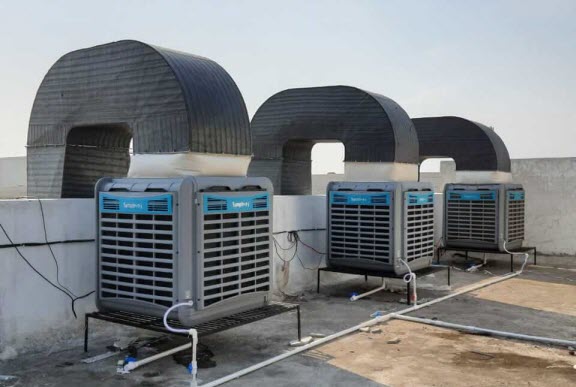
Industrial ducting coolers are a vital component in maintaining optimal temperatures within large industrial spaces. These coolers operate on the principle of evaporative cooling, which is both energy-efficient and environmentally friendly. Designed to cool extensive areas effectively, industrial ducting coolers ensure a comfortable and productive working environment, enhancing the overall efficiency of industrial operations.


Benefits of Using Industrial Ducting Coolers

Industrial ducting coolers offer numerous benefits. They are remarkably energy efficient, consuming significantly less power than other cooling systems, leading to substantial savings on electricity bills. Additionally, these coolers are cost-effective and eco-friendly, utilizing water for cooling and reducing the overall carbon footprint. Furthermore, they improve air quality by introducing fresh air, enhancing ventilation, and reducing the concentration of indoor pollutants.

Technical Specifications of Industrial Ducting Coolers

Understanding the technical specifications is crucial for selecting the right unit for specific needs. Industrial ducting coolers offer various discharge options including bottom, side, top, or down. The nominal air delivery capacity ranges from 8,000 CMH to 25,000 CMH, effectively cooling areas from 500 to 1,600 square feet.

The net weight of these units varies between 47 kg and 78 kg, with operating weights ranging from 70 kg to 140 kg depending on the model. The power supply requirement is generally 230V/50Hz/1Ph, with motor power ranging from 0.37 kW to 1.5 kW. The outside dimensions differ among models, with examples including 1000 x 940 x 800 mm, 1140 x 1140 x 850 mm, and 1140 x 1140 x 1770 mm. Air outlet dimensions also vary, such as 450 x 450 mm, 670 x 670 mm, and 645 x 440 mm.

Made from UV stabilized engineering plastic, these coolers have tank capacities from 23 liters to 70 liters. The air is moved by fans with diameters ranging from 425 mm to 620 mm. The cooling media consists of honeycomb pads with thicknesses of 60 mm to 100 mm, providing minimum cooling efficiencies between 75% and 80%. Duct lengths can extend up to 24 meters, with up to 12 air outlet grills per unit. Each 40HQ container can hold between 48 and 108 units in SKD form.

Key Features of Industrial Ducting Coolers

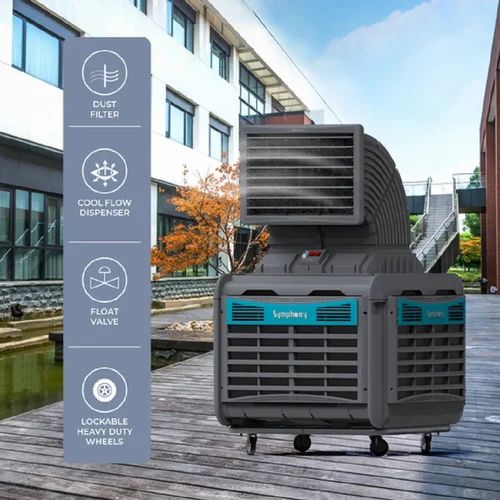
Key features of industrial ducting coolers include their modular design, making them suitable for any area and allowing for future expansion. The motors ensure powerful air delivery with varying capacities, while the weather-resistant UV stabilized engineering plastic bodies enhance durability. Superior cooling is achieved through three or four-side cooling pads, and the inclusion of Symphony accessories ensures easy and quick installation.


Applications and Use Cases of Industrial Ducting Coolers

Industrial ducting coolers are versatile and find applications across various settings, including factories, manufacturing plants, warehouses, large commercial spaces, agricultural environments like greenhouses, and event venues. Their efficiency and flexibility make them a preferred choice for maintaining optimal temperatures in diverse environments.

Installation and Maintenance of Industrial Ducting Coolers

Installing and maintaining industrial ducting coolers is relatively straightforward. The installation process can be completed in a few hours using Symphony accessories. Regular maintenance involves checking and cleaning the cooling pads, ensuring the water tank is free from debris, and inspecting the fan and motor for any signs of wear and tear. Proper maintenance is essential to ensure the longevity and efficiency of the coolers.

Comparing Industrial Ducting Coolers with Other Cooling Systems

When compared to traditional HVAC systems, industrial ducting coolers stand out due to their lower energy consumption, cost-effectiveness, better ventilation capabilities, and ease of maintenance. While traditional systems may provide precise temperature control, industrial ducting coolers offer a more sustainable and economical solution, especially for large spaces.

Common Challenges and Solutions for Industrial Ducting Coolers

Despite their benefits, industrial ducting coolers may face certain challenges. These include ensuring a consistent water supply, regular maintenance to keep the cooling pads and tank clean, and adequate space for installation and ducting. Addressing these challenges is crucial for optimal performance and longevity of the coolers.

Future Trends in Industrial Cooling Technology

Future trends in industrial cooling technology include the integration of smart cooling systems that leverage the Internet of Things (IoT) for enhanced control and monitoring. Advanced materials are being developed to improve the efficiency of cooling media, and there is a growing focus on sustainable solutions to minimize environmental impact. These advancements are expected to further enhance the performance and appeal of industrial ducting coolers.


FAQs About Industrial Ducting Coolers

The Comprehensive Guide to Industrial Ducting Coolers

How does an industrial ducting cooler work?

Industrial ducting coolers use the principle of evaporative cooling, where hot air is passed through water-soaked pads, causing the water to evaporate and cool the air, which is then circulated into the space.

What are the key benefits of using an industrial ducting cooler?

The key benefits include energy efficiency, cost-effectiveness, eco-friendliness, and improved air quality through better ventilation.

Can an industrial ducting cooler be used in humid climates?

While industrial ducting coolers are most effective in dry climates, they can still provide cooling in humid climates, although the efficiency might be slightly reduced.

What maintenance is required for an industrial ducting cooler?

Regular maintenance involves cleaning the cooling pads, ensuring the water tank is clean, and inspecting the fan and motor for any wear and tear.

How do I choose the right size of an industrial ducting cooler for my space?

The size should be based on the area that needs cooling. For example, a cooler with a capacity of 20,000 CMH can cool up to 1,200 square feet effectively.

What materials are used in the construction of industrial ducting coolers?

They are typically made from UV-stabilized engineering plastic, which is durable and weather-resistant.

Are industrial ducting coolers environmentally friendly?

Yes, they use water for cooling and consume less electricity compared to traditional HVAC systems, reducing the overall carbon footprint.

Can the duct length of an industrial ducting cooler be extended?

Yes, the duct length can be extended up to 24 meters, allowing installation flexibility.

What are the common applications of industrial ducting coolers?

They are commonly used in factories, warehouses, large commercial spaces, agricultural settings, and event venues.

What future trends can we expect in industrial cooling technology?

Future trends include smart cooling systems with IoT integration, advanced cooling materials for higher efficiency, and sustainable solutions to minimize environmental impact.

<< 1 >>


About the Author
About the Reviewer

Sourav Biswas is a senior marketing leader heading the LSV (Large Space Venticooling – B2B) marketing function at Symphony Limited. He shapes the brand’s strategic narrative, strengthens market leadership, and ensures excellence across all B2B cooling solutions. With deep expertise in Strategic Marketing, Brand Management, Advertising, and PR, he reviews content with analytical precision and alignment to Symphony’s vision. Passionate about mentoring and tracking B2B trends, Sourav ensures every content piece reflects accuracy, relevance, and strategic depth.


×
×
Index