Symphony Venticool

Read AI-Generated Summary:

India’s Global Capability Centre (GCC) sector has grown to over 1,700 campuses in 2026, with large-format facilities in Pune, Hyderabad, Bangalore, Chennai, and NCR housing thousands of employees round the clock. These campuses come with a cooling challenge that conventional air conditioning handles poorly: massive semi-open common areas, lobbies, cafeterias, and transit zones that cannot be sealed. Symphony Venti-Cool’s Large Space Venti-Cooling (LSV) system solves this precisely, delivering energy-efficient, fresh-air cooling across large open-plan areas at a fraction of central AC costs. This article explains what GCC facilities need, why evaporative LSV cooling is the right solution for their non-sealed zones, how to size the system, and what the cost comparison looks like over five years.
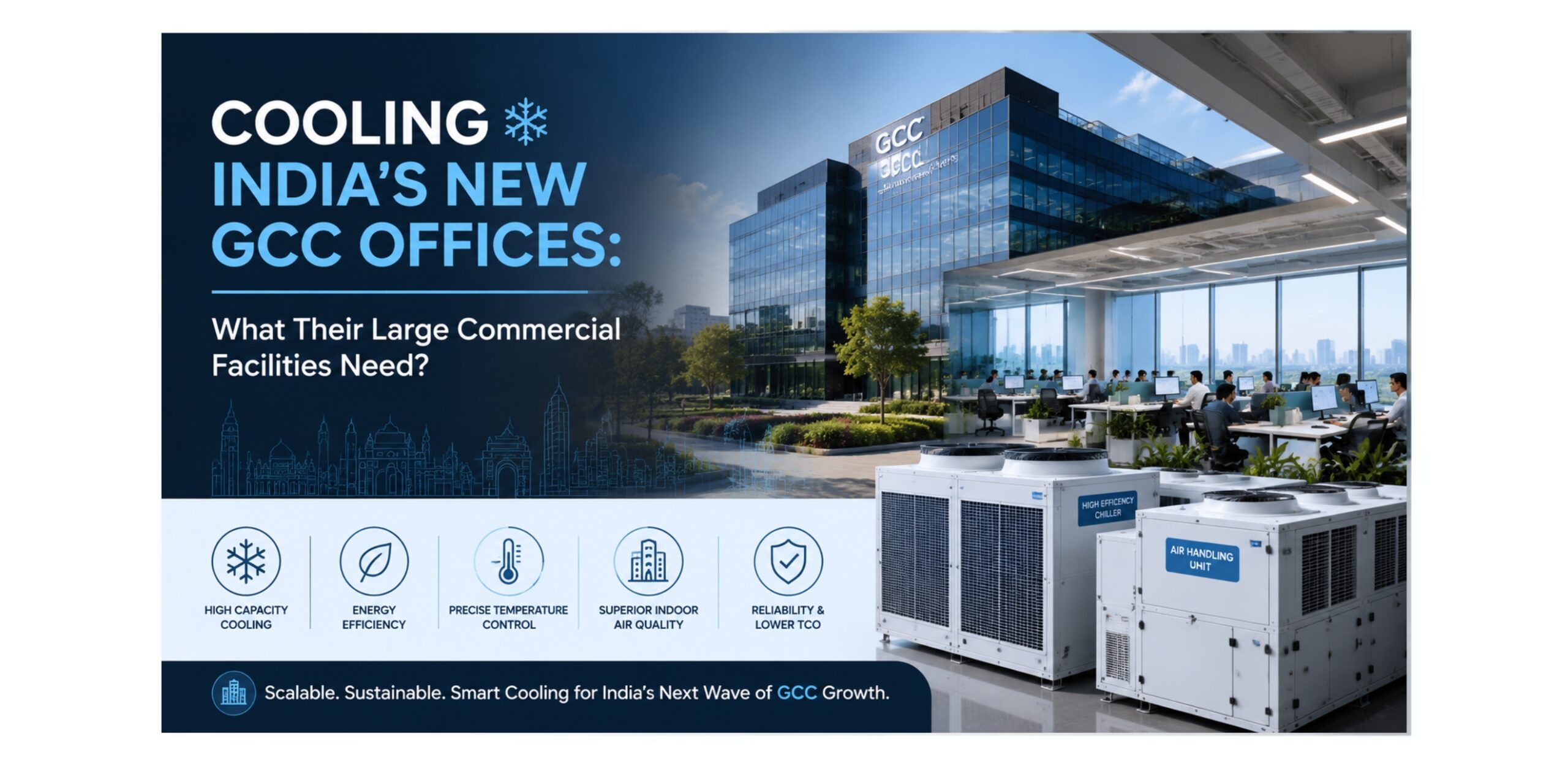

Cooling India’s New GCC Offices: What Their Large Commercial Facilities Need?
0:00 / 0:00

A Global Capability Centre is a captive offshore unit set up by a multinational company to handle technology, operations, analytics, or finance functions from India. In 2026, more than 1,700 such centres are operational across Indian cities, employing upwards of 1.6 million professionals, and the number is projected to reach 2,500 by 2030.

The reasons are well understood: deep engineering and technology talent, competitive operational costs, a large English-speaking workforce, and time zone coverage that works well for European and American headquarters. Pune’s Hinjewadi, Hyderabad’s HITEC City, Bangalore’s Electronic City and Whitefield, Chennai’s OMR corridor, and the NCR’s Gurugram and Noida belts have become the primary GCC hubs.

Each of these campuses is a significant real estate investment. A mid-size GCC facility typically spans 100,000 to 300,000 square feet across open-plan workspaces, large cafeterias, multi-purpose halls, atriums, and server corridors. It operates three shifts a day, five to seven days a week. The cumulative cooling load is substantial, and the energy cost of that cooling directly affects the facility’s operating budget and its parent company’s sustainability scorecard.

What Are the Cooling Challenges Specific to GCC Campuses in India?

GCC campuses present a cooling challenge that is more complex than a standard office building or a factory floor. Several factors combine to make it demanding:

  • Open-plan floors of 20,000 to 80,000 square feet per level generate high heat loads from dense workstations, multiple monitors, and server closets distributed across the floor plate.
  • Atriums, lobbies, cafeterias, and transition corridors are large, high-ceiling spaces that are difficult and expensive to cool with refrigerant-based air conditioning systems.
  • Round-the-clock operations mean cooling systems must perform continuously, making energy efficiency a financial priority rather than just an environmental one.
  • Global headquarters increasingly mandate Scope 2 emission reporting and expect facilities to demonstrate measurable progress against energy reduction targets.
  • LEED and GRIHA green building certifications, which many new GCC campuses target, require documented energy performance and fresh air ventilation standards.

The core problem is that most GCC campuses are not uniform sealed boxes. They combine fully enclosed, centrally air-conditioned workspaces with semi-open or high-ceiling zones that behave more like commercial large spaces than conventional offices. Treating every square foot of a GCC campus with chiller-based AC is technically inefficient and commercially wasteful.

Speak with an Expert

What Cooling Solutions Are Used in Large GCC Campuses Today?

Facilities teams at large campuses typically use a layered approach:

Chiller plants with AHU distribution serve enclosed workspaces and meeting rooms where occupancy is predictable and the building envelope can be reasonably sealed.

VRF or VRV split systems are used for smaller enclosed zones where individual control matters, such as executive offices and IT server rooms.

Symphony LSV evaporative cooling systems serve the large semi-open zones: cafeterias, ground-floor lobbies, atriums, multi-purpose halls, and loading areas. These zones are where conventional cooling is most expensive and least effective.

The hybrid model is the standard in well-designed GCC facilities. Each technology is used where it is appropriate, and LSV evaporative cooling occupies a critical role in covering the large-volume, semi-open portions of the campus that central AC cannot justify.

How Does an Air Handling Unit Work in a Large Office Facility?

An Air Handling Unit (AHU) is the central component of any ducted air distribution system. It takes return air from the space, filters it, conditions it through a cooling coil, and supplies it back to the space via ductwork. In a GCC office building, AHUs typically operate as part of a central chilled water system, where a chiller plant cools the water that flows through the AHU cooling coil.

Symphony’s evaporative industrial cooler operates on a different principle. Instead of passing air across a chilled water coil, it passes air through water-saturated CELdek evaporative pads. Evaporation absorbs heat from the air, dropping its temperature by 8 to 12 degrees Celsius before the fan delivers it into the space. This process uses no refrigerants, consumes no compressor energy, and delivers 100 percent fresh outdoor air rather than recirculated internal air.

The result is an AHU that performs very well in semi-open, high-ceiling zones and costs a fraction of a chilled water AHU to install and operate.

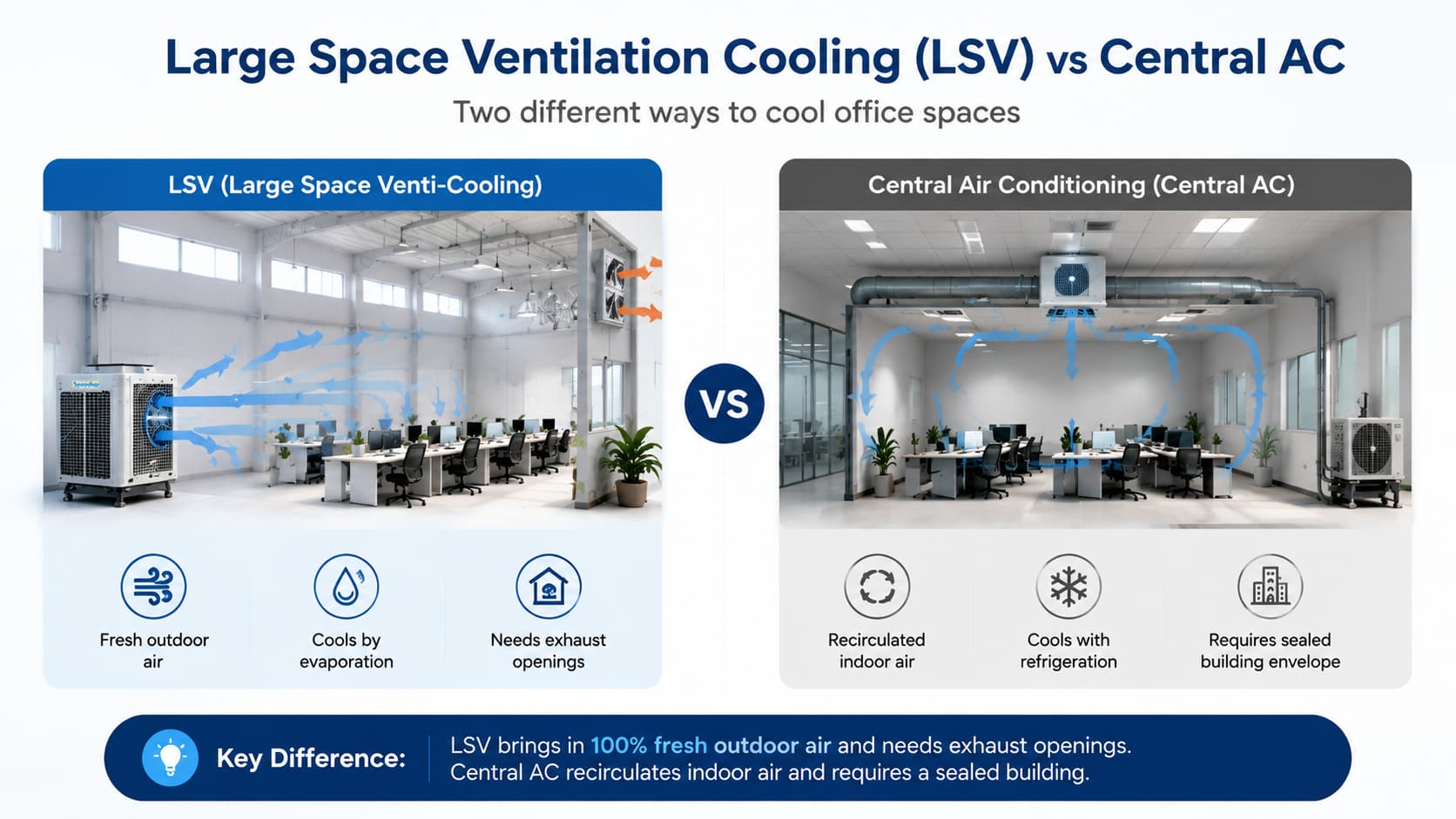
What is Large Space Ventilation Cooling and How Does It Differ from Central AC for Office Spaces?

What is Large Space Ventilation Cooling and How Does It Differ from Central AC for Office Spaces?

LSV, or Large Space Venti-Cooling, is Symphony’s category name for industrial and commercial evaporative cooling systems designed specifically for large-volume spaces. The fundamental difference from central air conditioning is architectural: central AC recirculates sealed internal air over a refrigerant-cooled coil, which requires a tightly sealed building envelope to work efficiently. LSV systems draw 100 percent fresh outdoor air, cool it through evaporation, and push it through the space, requiring exhaust openings rather than a sealed envelope.

For GCC campus zones like cafeterias, ground-floor lobbies, and common corridors where doors open constantly and ceiling heights exceed 15 feet, LSV is the appropriate technology. It does not fight against the physics of the space. It works with the ventilation dynamic that is already present.

How to Size an Evaporative LSV Cooling System for a GCC Campus

Step-by-Step Sizing Method

  1. Identify the zones in the campus where LSV cooling will apply. These are typically spaces that are not fully sealed or have ceiling heights above 14 feet: ground-floor lobbies, cafeterias, multi-purpose halls, transition corridors, and covered parking areas.
  2. Measure the floor area and ceiling height of each zone to calculate the volume in cubic feet.
  3. Determine the required Air Changes Per Hour (ACH) for each zone. Cafeterias with high occupancy need 15 to 20 ACH. Lobbies and transition zones need 10 to 15 ACH. Multi-purpose halls need 12 to 18 ACH.
  4. Calculate required airflow in CFM using the formula: Volume in cubic feet multiplied by ACH, divided by 60.
  5. Check the local wet bulb temperature for the city. In Pune it averages 22 degrees Celsius in summer. In Hyderabad it is approximately 24 degrees. In Bangalore it is 19 degrees. Lower wet bulb temperature means better evaporative cooling performance.
  6. Select the appropriate Symphony LSV unit model based on CFM output. Symphony LSV units deliver from 8,000 CFM at the smaller end to 60,000 CFM for the largest configurations.
  7. Plan duct routing so that cooled supply air enters on one side and exhaust air exits on the opposite side or through roof ventilators. Cross-ventilation is essential to the system’s effectiveness.
  8. Calculate total CAPEX and compare against the equivalent chiller plus AHU installation that would be needed to achieve the same cooling coverage.

Energy and Cost Comparison: Central AC vs Symphony Industrial / Commercial Coolers for a GCC Campus

LSV systems typically consume 0.3 to 0.5 kW per 1,000 CFM of airflow. Equivalent refrigerant-based systems consume 3 to 5 kW per 1,000 CFM. That is a ten-fold difference in power consumption for the same air movement.

For a 50,000 square foot GCC cafeteria and common area requiring 500,000 CFM of cooling capacity, the practical comparison is significant:

Parameter Central AC (12 x 5-ton units) Symphony LSV System
Installation CAPEX Rs 28 to 35 lakh Rs 8 to 12 lakh
Monthly electricity (summer) Approx 18,000 kWh Approx 2,000 kWh
Monthly electricity cost at Rs 8/unit Rs 1,44,000 Rs 16,000
Annual maintenance Rs 1.5 to 2 lakh Rs 40,000 to 60,000
5-year total cost of ownership Rs 1.2 to 1.5 crore Rs 18 to 25 lakh

The energy savings from LSV adoption in GCC common areas also directly reduce the campus’s Scope 2 carbon emissions, contributing to BRSR sustainability disclosures and global ESG targets.

Which Indian Cities Offer the Best Conditions for GCC Campus Evaporative Cooling?

City Avg Summer Temp Avg RH (Apr to Jun) LSV Effectiveness
Hyderabad 38 to 42 degrees C 25 to 45% Excellent
Pune 35 to 40 degrees C 30 to 50% Very Good
Bangalore 30 to 35 degrees C 35 to 55% Very Good
NCR (Gurugram) 40 to 44 degrees C 20 to 40% Excellent
Chennai 36 to 40 degrees C 60 to 80% Moderate (supplement)

For Chennai, where coastal humidity is higher, the recommendation is to use LSV systems for ventilation and partial cooling in combination with targeted split AC for enclosed, high-occupancy zones. All other major GCC hubs are well suited to LSV as the primary cooling method for common areas.

How Symphony LSV Supports LEED and GRIHA Green Building Certification

LEED certification rewards buildings that demonstrate energy efficiency, indoor air quality, and reduced environmental impact. Symphony LSV systems contribute directly to several LEED credit categories. Under Energy and Atmosphere, the dramatic reduction in cooling-related electricity consumption compared to equivalent AC improves the building’s Energy Use Intensity score. Under Indoor Environmental Quality, the 100 percent fresh air delivery of LSV systems satisfies ventilation rate requirements per ASHRAE 62.1 without the stale-air recirculation risk of conventional systems.

GRIHA, India’s national green building rating system, similarly rewards buildings that demonstrate energy efficiency and thermal comfort. LSV cooling systems, which use no refrigerants with global warming potential and consume minimal electricity, align naturally with GRIHA’s performance criteria.

For GCC campuses where LEED or GRIHA certification is a business requirement or brand commitment, documenting the energy savings from LSV adoption provides verifiable performance data that supports certification submissions and ongoing sustainability reporting.

Conclusion

India’s GCC sector is growing rapidly and its facilities teams are under pressure to manage cooling costs without compromising comfort or sustainability targets. Symphony Venti-Cool’s LSV system addresses the specific challenge of large semi-open campus zones that conventional air conditioning handles poorly and expensively. With installation costs typically 60 to 70 percent lower than equivalent AC, operating costs up to 90 percent lower, and a direct contribution to LEED, GRIHA, and ESG objectives, LSV is the logical cooling solution for GCC campus common areas, cafeterias, and lobbies across India’s key technology hubs.

Frequently Asked Questions

Cooling India’s New GCC Offices: What Their Large Commercial Facilities Need?

Does Symphony provide project design support and AMC for GCC clients?

Yes. Symphony Venti-Cool provides end-to-end support including site survey, airflow design, ducting layout drawings, installation supervision, commissioning, and Annual Maintenance Contracts. Facility managers can contact symphonyventicool.com to request a project consultation.

What certifications should a commercial evaporative cooling system carry for a LEED-certified GCC campus?

For LEED compliance, the cooling system documentation should include BIS certification (IS 8827 for evaporative air coolers), ISO 9001 manufacturing certification, energy consumption data in kWh per CFM for LEED Energy and Atmosphere credit submissions, and fresh air ventilation rate data to meet ASHRAE 62.1 requirements for LEED Indoor Environmental Quality credits.

What is the difference between a centralised LSV system and individual AHU units for a large GCC campus?

A centralised LSV system uses multiple high-capacity Symphony LSV units connected through a designed duct network, controlled from a single panel or Building Management System. Individual AHU units serve specific zones independently. For GCC campuses above 50,000 square feet of non-sealed space, a centralised system delivers better airflow uniformity, easier maintenance access, and lower per-CFM installation cost than an equivalent number of independent units.

<< 1 >>


About the Author
About the Reviewer

Sourav Biswas is a senior marketing leader heading the LSV (Large Space Venticooling – B2B) marketing function at Symphony Limited. He shapes the brand’s strategic narrative, strengthens market leadership, and ensures excellence across all B2B cooling solutions. With deep expertise in Strategic Marketing, Brand Management, Advertising, and PR, he reviews content with analytical precision and alignment to Symphony’s vision. Passionate about mentoring and tracking B2B trends, Sourav ensures every content piece reflects accuracy, relevance, and strategic depth.


×
×
Index