Symphony Venticool

Read AI-Generated Summary:

When a factory manager decides it is time to invest in a proper cooling system for factory operations, the first question is rarely “what brand?” — it is “what type?” The industrial cooling system market offers three fundamentally different architectural approaches

0:00 / 0:00

When a factory manager decides it is time to invest in a proper cooling system for factory operations, the first question is rarely “what brand?” — it is “what type?” The industrial cooling system market offers three fundamentally different architectural approaches: ducted systems, portable units, and centralised LSV installations. Each has distinct strengths, limitations, and ideal use cases. Choosing the wrong architecture is an expensive mistake that takes years to undo.

This guide compares the three main types of factory cooling system with the specificity that real purchase decisions require.

Need More Information?

Ducted Industrial Cooling Systems

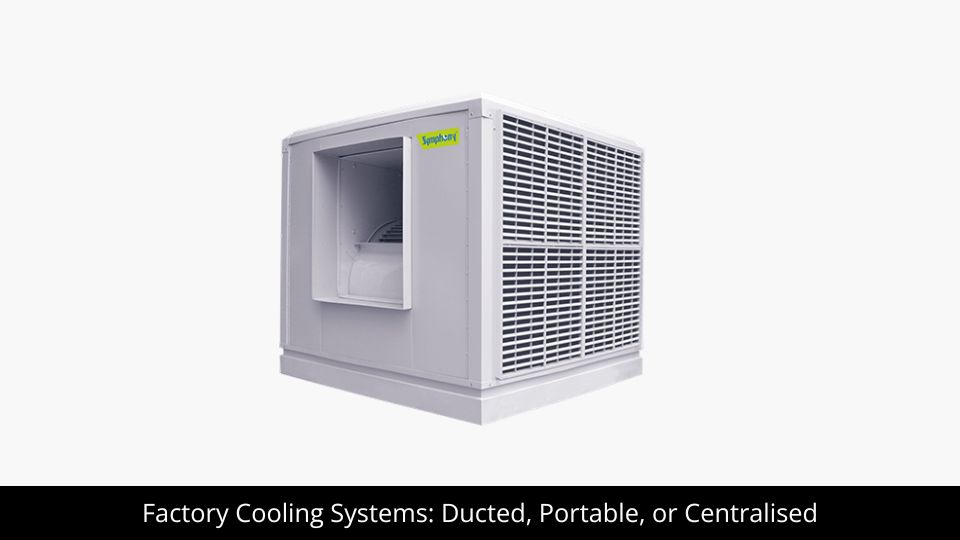
A ducted cooling system for factory use consists of one or more evaporative air cooler units mounted at the roofline or on exterior walls, connected via galvanised steel ductwork to discharge grilles positioned across the factory floor. The ducted approach delivers cooled fresh air to every point of the facility simultaneously.

Ducted systems are the right choice when the factory has a defined floor plan with fixed machinery and workstations, when temperature uniformity across the entire floor area is required, when the facility is enclosed and cannot rely on natural cross-ventilation, and when the space exceeds 8,000–10,000 sq ft.

Symphony Venti-Cool’s LSV ducted range delivers from 30,000 to over 1,00,000 CFM through duct networks engineered to match each facility’s specific layout. The system is commissioned with airflow balancing to ensure every workstation receives its designed air volume.

The limitation of ducted systems is upfront installation cost and the requirement for ceiling clearance and structural mounting points. For facilities with fixed layouts and permanent operations, this is the gold standard of industrial cooling.

Portable Industrial Air Coolers

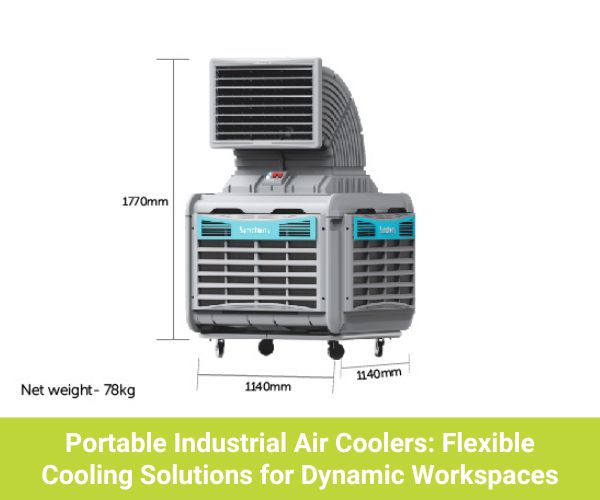
Portable industrial air coolers — including Symphony Venti-Cool’s heavy duty cooler and plastic air cooler models — are freestanding units that can be positioned anywhere with access to water and electricity. They require no duct installation and can be relocated as production layouts change.

Portable cooling is the right choice for facilities with frequently changing floor plans, construction sites and BOCW welfare areas, temporary work areas such as packaging lines or seasonal processing zones, spot cooling of specific high-heat zones — near furnaces, welding stations, or press machines, and facilities where a full ducted installation is not yet feasible.

The limitation of portable units is that their cooling effect is localised. A single portable industrial air cooler covers 2,000–4,000 sq ft effectively. For whole-facility cooling of a large factory, multiple units are required and airflow management is more complex.

Centralised LSV Systems

A centralised cooling system for factory use uses large-capacity Air Handling Units (AHU) positioned at the facility perimeter or on the roof, connected to a comprehensive duct network that distributes cooled fresh air to every zone of the building. This is the most sophisticated and comprehensive architecture for industrial cooling.

A central cooling system is the right choice when the facility is large — typically above 20,000 sq ft — when multiple distinct workrooms or zones require independent airflow control, when the facility has specific compliance requirements for documented temperature uniformity, and when the business requires a professional, built-in cooling infrastructure for long-term operations.

Symphony Venti-Cool’s centralised LSV systems include AHU specification, duct design, zone-by-zone airflow balancing, and a commissioning process that delivers documented temperature performance data for every area of the facility.

We are Fast in Response

Choosing the Right Architecture: Decision Framework

Use this framework to identify the right type of industrial cooling system for your floor plan:

If your facility is under 5,000 sq ft and has an open layout: portable heavy duty cooler units or small ducted systems are appropriate.

If your facility is 5,000–15,000 sq ft with a fixed layout: a ducted system using 2–4 LSV units is typically the most cost-effective approach.

If your facility is above 15,000 sq ft with multiple zones: a centralised LSV system with AHU units and full duct network is the recommended approach.

If your layout changes seasonally or your operations are temporary: portable industrial air coolers with supplementary ducting for fixed zones.

Mixed-use facilities — where production, warehousing, and office areas coexist — often benefit from a hybrid approach: centralised cooling for production areas and individual Air Cooling Unit installations for office and administrative zones.

Frequently Asked Questions

Cooling System for Factory: Ducted, Portable and Centralised – Which Architecture Fits Your Floor Plan?

Which type of cooling system for factory is most energy efficient?

All three architectures use evaporative cooling technology, which is inherently energy efficient — operating at 1/8th to 1/5th of the electricity cost of equivalent-capacity HVAC systems. Among the three, centralised LSV systems with properly balanced duct networks tend to be the most efficient per unit of cooled air delivered, as they minimise air leakage and maximise coverage uniformity.

Can I expand a ducted cooling system later if my factory grows?

Yes, Symphony Venti-Cool's LSV systems are designed with future expandability in mind. Additional AHU units can be added to an existing duct network, and new duct branches can be extended to cover expanded floor areas. It is important to communicate future expansion plans to your system designer at the outset so the initial installation is sized and routed to accommodate growth.

How does a centralised cooling system handle different zones with different cooling needs?

Zone-by-zone airflow control is achieved through dampers and variable-speed fans in the duct network. Areas with higher heat loads — such as machine bays or welding areas — receive higher air volumes, while administrative areas receive lower volumes appropriate for office environments. Symphony's system designs include zone mapping as part of the commissioning process.

What is the typical payback period for a ducted factory cooling system vs portable units?

Portable units have a lower upfront cost but higher per-square-foot cost for whole-facility coverage at large scale, and ongoing relocation and maintenance demands. Ducted systems have higher upfront installation cost but lower operating cost per square foot covered and longer service life. For facilities above 10,000 sq ft with permanent operations, a ducted system typically offers better payback over a 3–5 year horizon.

Does Symphony Venti-Cool supply both the cooling units and the ductwork?

Symphony Venti-Cool supplies and installs complete systems including the LSV evaporative air cooler units, ductwork, discharge grilles, water connections, electrical connections, and full commissioning. The entire installation is covered by Symphony's after-sales service network.

Is a plastic air cooler suitable for industrial factory environments?

Symphony's industrial-grade plastic air cooler models are UV-stabilised and designed for the temperature, humidity, and operational demands of industrial environments. They are particularly well-suited for facilities that require corrosion resistance — such as chemical processing areas or food production zones — where steel-framed units may be less appropriate.

<< 1 >>


About the Author
About the Reviewer

Sourav Biswas is a senior marketing leader heading the LSV (Large Space Venticooling – B2B) marketing function at Symphony Limited. He shapes the brand’s strategic narrative, strengthens market leadership, and ensures excellence across all B2B cooling solutions. With deep expertise in Strategic Marketing, Brand Management, Advertising, and PR, he reviews content with analytical precision and alignment to Symphony’s vision. Passionate about mentoring and tracking B2B trends, Sourav ensures every content piece reflects accuracy, relevance, and strategic depth.


×
×
Index