
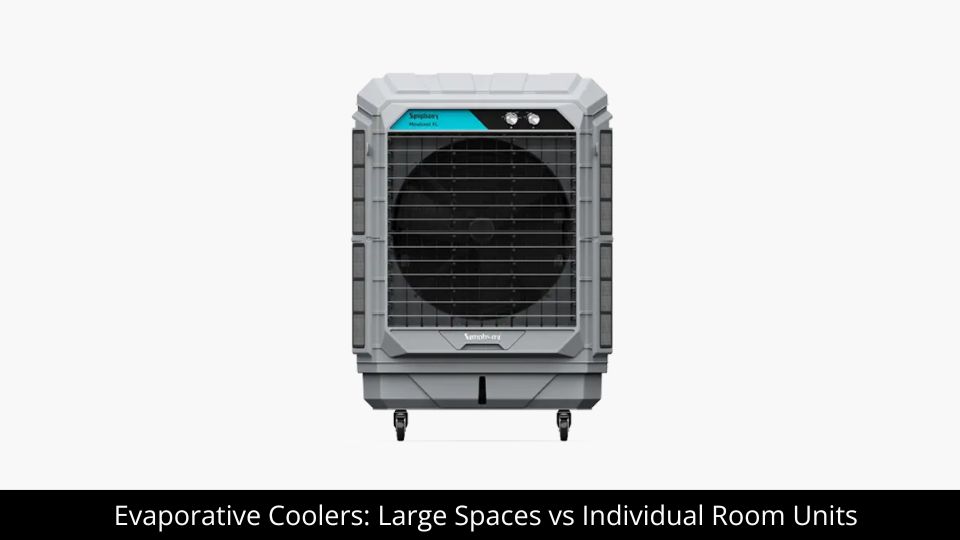




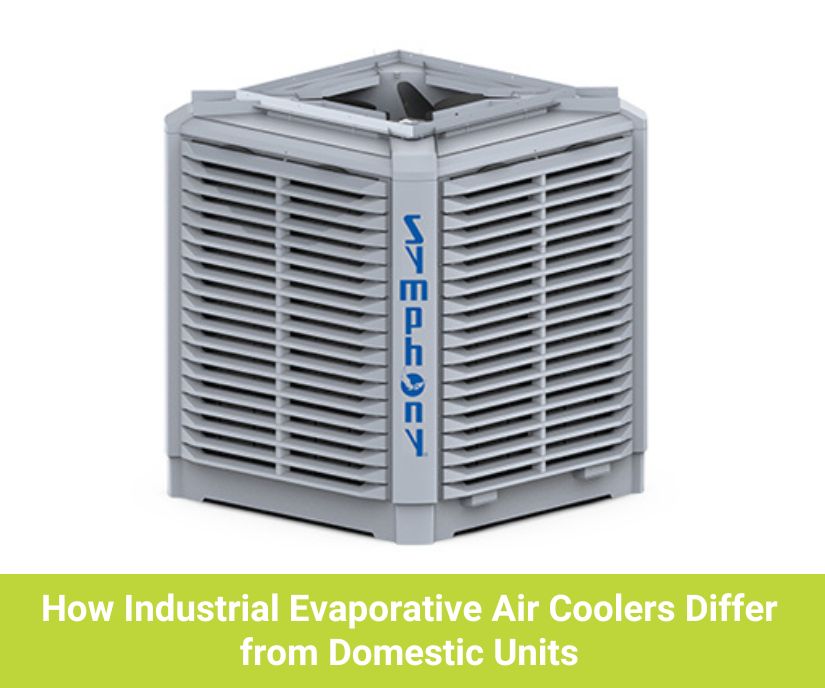

The domestic air cooler on a family’s veranda and the Symphony Venti-Cool LSV industrial evaporative air cooler in a 50,000 sq ft textile factory share the same fundamental technology – water evaporating through a pad, with air driven through it by a fan. Beyond this common principle, they are as different as a bicycle and a bus.
Scale changes everything in evaporative cooling. The engineering challenges of cooling a 300 sq ft bedroom are trivially different from those of cooling a 30,000 sq ft factory floor uniformly. Understanding why scale changes the technology, the economics, and the performance expectations is essential for any facility manager or business owner evaluating an air cooling solution for industrial or large commercial spaces.
Table of Contents
How Individual Room Coolers Work - and Why They Cannot Scale
An individual room cooler – whether a plastic air cooler or a domestic tower unit – is designed for a single enclosed space. It draws air through pads across its full face area, delivers cooled air through a front grille, and works by creating a cooling effect within a few metres of the unit.
The effective range of a domestic plastic air cooler is approximately 200–400 sq ft – roughly a medium bedroom or small office room. Beyond this range, the cooled air from the unit mixes with the warm ambient air of the larger space and the cooling effect becomes negligible.
The limitations of domestic coolers at scale are fundamental: insufficient CFM for large spaces, inadequate static pressure to push air more than a few metres from the unit, no provision for ducted distribution to different areas, consumer-grade motors not designed for continuous industrial duty cycles, and water tanks too small for the consumption rate of extended operation.
Placing ten individual plastic air coolers in a 10,000 sq ft factory does not produce the same result as a single properly designed industrial evaporative air cooler system of equivalent total CFM – because the individual units create ten small locally cooled bubbles that do not merge into a uniform cool environment.
What Industrial Evaporative Air Coolers Do Differently
An industrial evaporative air cooler designed for large spaces – like Symphony Venti-Cool’s LSV range – is engineered from the ground up to solve different problems at a different scale.
High static pressure fans: Industrial units deliver air under enough pressure to push it through duct networks of 20–50 metres, reaching every corner of a large facility. Domestic units cannot develop this static pressure.
Large CELdek pad areas: Industrial units use 100mm and 150mm thick CELdek pads with total face areas of 2–8 square metres, delivering the CFM volumes needed to air-change a large space at the required rate. A domestic unit’s pad area is typically 0.2–0.5 square metres.
Industrial-grade motors: Motors in LSV industrial systems are rated for continuous duty – 8,000 to 10,000 hours per year of operation. Domestic unit motors are rated for intermittent residential use – typically 1,000–2,000 hours per year.
High-capacity water systems: Industrial units include large water tanks, high-capacity float-valve-controlled water supply, and water distribution manifolds that wet the full face of large pad systems uniformly. Domestic units have small tanks and simple pump systems adequate for small pads.
Ducted distribution: Industrial cooling systems connect to duct networks that distribute cooled air across the full floor area of the facility – not just in the vicinity of the unit. This is the single feature that makes large-space cooling possible and effective.
Comparing Economics at Scale: Industrial vs Multiple Domestic Units
Consider a 15,000 sq ft garment factory. The comparison between multiple domestic coolers and a single properly designed industrial cooling system is instructive.
To achieve approximate coverage with domestic plastic air coolers: 30–40 units required, at ₹15,000–25,000 per unit installed, total capital: ₹4.5–10 lakh. But: non-uniform coverage, hot spots between units, no duct distribution, and consumer-grade reliability in an industrial environment. Annual replacement and repair: ₹1–2 lakh.
A Symphony Venti-Cool LSV industrial system for the same 15,000 sq ft: 2–4 industrial units with a full duct network, at ₹8–14 lakh installed. But: uniform temperature across the entire floor, industrial-grade reliability, 10-15+ year service life with planned maintenance, and full Factories Act compliance documentation.
Over five years, the multiple domestic unit approach costs more in total and delivers worse performance. The industrial evaporative air cooler system is the economically rational choice at factory scale, even though its commercial cooler price appears higher at point of purchase.
Note: The prices given here are only indicative examples to show the scale and not exact. For actual price you may contact Symphony Venti-Cool
When Are Individual or Portable Cooler Units the Right Answer?
Individual and portable cooler units have legitimate applications in industrial settings – they are not inherently inferior choices for every use case.
Spot cooling of specific heat zones: Near a furnace, a welding station, or a particularly hot machine cluster, a portable heavy duty cooler unit can provide targeted relief without requiring a full ducted extension.
Temporary or changing layouts: Factories with frequently changing production layouts benefit from portable units that can be repositioned as the floor plan changes.
BOCW welfare areas on construction sites: Portable industrial air coolers and larger plastic air cooler models are ideal for welfare facilities on construction sites – they are quick to deploy, require no installation, and can be moved as the site progresses.
Small enclosed rooms within a larger facility: Server rooms, quality control labs, and small enclosed offices within a factory can be served by individual Air Cooling Unit installations rather than tapped from the main industrial system.
Frequently Asked Questions
Evaporative Air Cooler for Large Spaces vs Individual Room Coolers: Why Scale Changes Everything
What is the CFM output difference between a domestic cooler and a Symphony LSV industrial unit?
A typical domestic plastic air cooler delivers 1,000–3,000 CFM. A Symphony LSV industrial unit delivers 30,000–1,20,000 CFM depending on the model. The difference is 10 to 100-fold - reflecting the fundamental difference in the scale problem each product is designed to solve.
Can I use industrial plastic air cooler models from Symphony Venti-Cool for a factory application?
Symphony Venti-Cool's industrial-grade plastic air cooler models - designed for industrial environments with UV-stabilised housings and industrial-duty motors - are suitable for factory spot cooling, small enclosed areas, and welfare facilities. They are not the same as domestic plastic coolers. Verify that the specific model you are considering is rated for industrial continuous duty operation.
How do I know if my factory needs an industrial cooling system vs multiple domestic units?
If your factory floor is above 3,000 sq ft, has enclosed areas requiring uniform temperature, has regulatory compliance requirements under the Factories Act, operates more than 8 hours per day in summer, or has workers whose productivity and safety depends on adequate cooling - you need an industrial cooling system, not multiple domestic units.
Does a larger factory always need a ducted industrial cooling system?
Not always. Open-sided factories and shed-type structures with natural cross-ventilation can sometimes be effectively cooled with multiple high-CFM portable industrial units without full duct installation. Symphony Venti-Cool's technical team can advise on whether a portable or ducted approach is more appropriate for your specific facility structure.
Are industrial evaporative air coolers more energy efficient than domestic coolers at the same CFM?
Yes. Industrial evaporative air coolers typically achieve higher saturation efficiency - delivering more cooling per unit of air volume - because of their thicker CELdek pads and better water distribution. Industrial motors are also more efficient at high continuous loads than domestic motors running at maximum intermittent capacity. The energy cost per square foot of cooling is consistently lower for a properly designed industrial system.
What plastic air cooler models does Symphony Venti-Cool offer for industrial applications?
Symphony Venti-Cool offers a range of industrial-grade air cooling units in plastic housing designed for corrosion-resistant applications including food processing, chemical environments, and outdoor industrial use. Contact Symphony Venti-Cool directly or visit symphonyventicool.com for the current industrial plastic cooler range and specifications.

Maulik Solanki is a seasoned B2B Product Marketing professional specializing in Industrial and Commercial Coolers in the LSV (Large Space Venticooling) segment. With 13+ years of experience, he drives brand building and audience engagement for Symphony’s LSV solutions through integrated offline and online strategies. Backed by an MBA in Marketing and earlier experience as a Regional Marketing Manager in banking, Maulik brings strong skills in sales, advertising, and events. He enjoys exploring new marketing ideas and cooling technologies and writes to help readers understand Symphony’s offerings.

Sourav Biswas is a senior marketing leader heading the LSV (Large Space Venticooling – B2B) marketing function at Symphony Limited. He shapes the brand’s strategic narrative, strengthens market leadership, and ensures excellence across all B2B cooling solutions. With deep expertise in Strategic Marketing, Brand Management, Advertising, and PR, he reviews content with analytical precision and alignment to Symphony’s vision. Passionate about mentoring and tracking B2B trends, Sourav ensures every content piece reflects accuracy, relevance, and strategic depth.