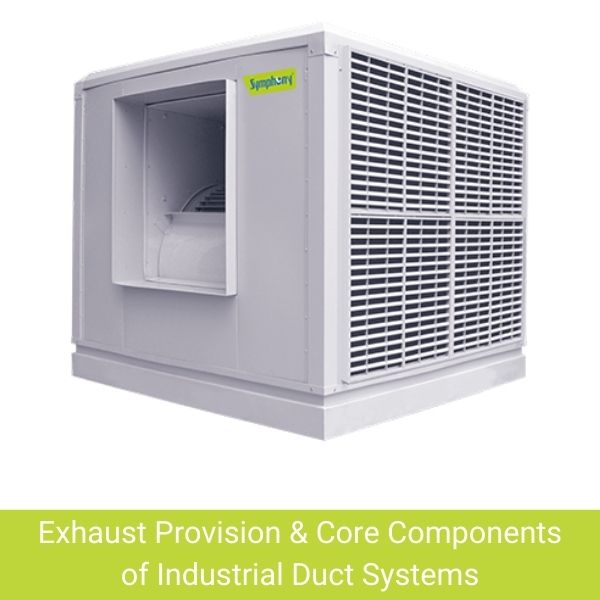
This article explains how ducting works in industrial evaporative coolers — covering the core principle, key components, duct types, design basics, common problems, and maintenance essentials.
Table of Contents
AI Summary
This article explains how ducting works in industrial evaporative coolers — covering the core principle, key components, duct types, design basics, common problems, and maintenance essentials. Key takeaways: (1) Ducting distributes cooled air from a single cooler unit to specific zones across a large facility. (2) The system works on positive pressure — the fan pushes air through ducts and out via outlet nozzles or diffusers. (3) GI sheet metal is the industry-standard duct material for permanent installations. (4) Correct duct sizing, branch balancing, and exhaust provision are the three most critical design factors. (5) Inadequate exhaust is the single most common reason a ducted cooler fails to cool effectively. (6) A structured weekly, monthly, and annual maintenance routine keeps the system performing at full capacity year-round.
Introduction
A standard industrial air cooler placed on a factory floor cools the immediate area round it — but what about workers 30 or 40 metres away, in enclosed side rooms, or along long production lines far from the machine? This is the problem that industrial duct coolers solve. By connecting the cooler’s discharge to a network of ducts and outlets, facility managers can distribute cooled air to every corner of a large facility – from a single, centrally located machine.
Understanding how this ducting system works is one of the most practical pieces of knowledge a facility manager can have. A well-designed duct system transforms an industrial evaporative cooler into a facility-wide cooling infrastructure. A poorly designed one with undersized ducts, unbalanced branches, or blocked exhaust will disappoint regardless of how powerful the cooler is. This guide covers everything you need to know.
How a Ducted Industrial Cooler System Works?
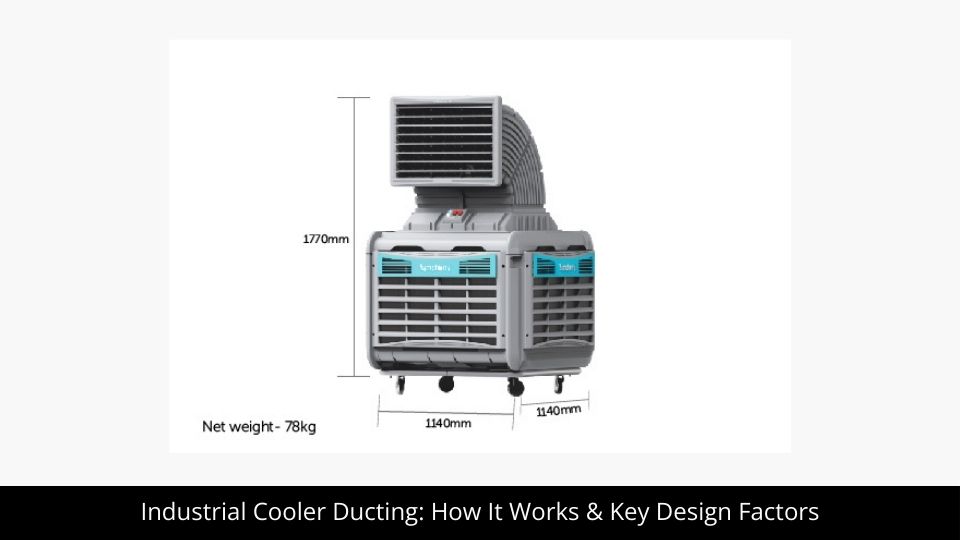
The operating principle is straightforward. The industrial duct cooler unit draws warm ambient air in through its water-saturated cooling pads. As air passes through the wet pads, water evaporates and absorbs heat from the air — dropping its temperature by 8°C to 15°C depending on ambient conditions. The cooled, humidified air is then pushed by the fan into the connected duct system under positive pressure, travelling through the main trunk duct, splitting into branch ducts, and finally exiting through outlet nozzles or diffusers into the occupied space.
For this to work effectively, warm air must simultaneously have an exit route from the space. This is called exhaust provision — and its absence is the single most common reason ducted cooler systems underperform. If warm air cannot escape, pressure builds up in the space, the cooler fan works against resistance, and airflow collapses. Exhaust fans, open windows, or roof ventilators must always be provided in spaces served by ducted evaporative coolers.
The Main Components of a Duct System
A complete industrial duct cooler system consists of six key components, each playing a specific role:
- Main Trunk Duct: The largest duct, connected directly to the cooler’s discharge collar. It carries the full volume of cooled air away from the machine toward the distribution branches.
- Branch Ducts: Smaller ducts that split off from the trunk to serve individual zones or rows of outlets. Each branch must be correctly sized to carry its allocated share of airflow.
- Duct Fittings: Elbows, tee junctions, and reducers that change direction or split the airflow. Every bend and junction adds pressure resistance — keeping these to a minimum improves system efficiency.
- Outlet Nozzles or Diffusers: The terminal points where cooled air enters the occupied space. Adjustable directional nozzles are standard in factories; circular diffusers suit commercial spaces.
- Volume Dampers: Butterfly or sliding plate devices installed in branch entries to control and balance airflow across all zones. Without these, zones close to the cooler always receive more air than distant zones.
- Exhaust Provision: Wall-mounted exhaust fans, roof vents, or open windows that allow warm displaced air to exit the space as cooled air enters.
Types of Ducting Used in Industrial Cooler Systems
The choice of duct material affects cost, performance, and longevity. The three most common options are:
GI (Galvanised Iron) Sheet Metal Ducting is the industrial standard for permanent installations. Fabricated from 0.5mm–1.0mm galvanised steel sheets, GI ducts offer excellent rigidity, smooth internal surfaces (low friction loss), corrosion resistance, and a service life of 15–25 years. They can be made in circular or rectangular cross-sections and are the best choice for most factory and warehouse applications.
Flexible Fabric Ducting (Textile Sox) distributes air through perforations along its length, creating extremely even air distribution. It is removable and washable, making it the preferred choice for food processing plants and pharmaceutical facilities where regular cleaning is essential. It is more expensive than GI but delivers superior hygiene compliance.
PVC Flexible Ducting is a low-cost, lightweight option suitable for small systems or short connecting runs between a rigid trunk duct and an outlet. Its corrugated internal surface creates higher friction losses than GI, making it unsuitable for long runs or large-capacity systems.
Three Critical Design Principles Every Facility Manager Must Know
Size Ducts for the Right Air Velocity
Ducts that are too small force air through at high velocity — creating excessive noise, turbulence, and pressure loss that starves distant outlets. Ducts that are too large allow air to slow down and stagnate. The recommended velocity for branch ducts in industrial cooler systems is 4–6 metres per second. Main trunk ducts can run at 6–10 m/s. Your cooler supplier or duct contractor should provide sizing calculations based on the required CMH (Cubic Metres per Hour) for each zone.
Balance All Branches with Volume Dampers
In any branched duct system, airflow naturally takes the path of least resistance — meaning branches close to the cooler receive the most air and distant branches receive very little. Volume dampers at each branch entry, adjusted during commissioning, correct this imbalance. After installation, use an anemometer to measure airflow at each outlet and adjust dampers until all outlets receive their target CMH. This commissioning step is skipped on many installations — and is almost always the cause of uneven cooling complaints.
Always Provide Adequate Exhaust
As a rule of thumb, the total exhaust opening area should be at least equal to the total duct outlet area. Install exhaust fans opposite the cooler inlets to create a cross-ventilation flow path. In enclosed rooms, a dedicated exhaust fan is essential. Never seal a space and expect an evaporative cooler to cool it — evaporative cooling is an open-fresh-air system, not a recirculating sealed system like air conditioning.
Common Problems and Quick Diagnosis
Even well-installed systems develop issues over time. Here are the four most common problems and how to diagnose them:
- Uneven cooling (some zones hot, others cold): Unbalanced branch dampers or blocked outlets. Check and reset all dampers; clean outlet grilles.
- Cooler running but no temperature drop: Inadequate exhaust, clogged cooling pads, or dry pads from pump failure. Check exhaust openings first, then inspect pads and water flow.
- Excessive noise from ducts: Air velocity too high in undersized sections, or loose duct joints vibrating. Check velocities and tighten all joints.
- Water dripping from outlets: Duct sloping toward outlets, or excess water carry-over from over-saturated pads. Ensure ducts slope back toward the cooler and reduce pump flow if over-saturated.
Essential Duct Cooler Maintenance Routine
A consistent maintenance schedule is what keeps a ducted cooler system performing at full capacity. Here is a simple framework:
- Weekly: Check pad wetness uniformity, sump water level, and do a quick walk-through to confirm all outlets are delivering airflow.
- Monthly: Clean cooling pads, check water pump flow, drain and clean the sump, and clean all outlet grilles of dust and lint.
- Annually (pre-season): Replace cooling pads, inspect motor and bearings, internally inspect duct runs for blockage, measure airflow at all outlets and re-balance, and check all electrical connections.
Frequently Asked Questions on Duct Coolers
How Ducting Works in Industrial Coolers?
What is the maximum duct length I can run from an industrial duct cooler?
There is no fixed maximum. It depends on the cooler's static pressure rating and the duct diameter. With properly sized GI ducting, effective cooling can be delivered over runs of 30–60 metres. For runs beyond 40 metres, always request a static pressure calculation from your supplier to confirm the cooler's fan can overcome the duct resistance at the required airflow volume.
Can I add ducting to my existing industrial air cooler?
Only if the existing unit is rated for ducted operation. Standard non-ducted coolers have fans designed for open (zero static pressure) discharge. Adding ducting restricts airflow and can cause motor overheating. Check with the manufacturer whether your unit has sufficient static pressure capability. If not, a purpose-built industrial duct cooler unit is the correct solution.
How many outlets should my duct system have?
Each outlet should typically deliver 500–2,000 CMH depending on the zone size. Space directional nozzle outlets at 10–12 metre intervals for a 15-metre throw nozzle, ensuring coverage patterns from adjacent outlets overlap. Your supplier should produce an outlet coverage diagram overlaid on your facility floor plan to confirm complete coverage before installation.
What is the difference between an industrial duct cooler and an AHU?
An industrial AHU (Air Handling Unit) uses refrigerant-based mechanical cooling to achieve precise temperatures (16–22°C) in sealed, recirculated air environments — consuming high amounts of electricity. An industrial duct cooler uses evaporative cooling of fresh outside air, is far less energy-intensive (70–90% lower running cost), but provides less precise temperature control and works best in semi-open or open environments. AHUs suit cleanrooms and precision environments; industrial duct coolers suit factories, warehouses, and large commercial spaces.
How do I calculate how many industrial duct cooler units I need?
Use this formula: Required CMH = Floor Area (m²) × Ceiling Height (m) × Air Changes per Hour (ACH). Recommended ACH is 20–30 for most industrial applications. Divide the total required CMH by the capacity of your chosen cooler unit to get the number of units. For example: a 60m × 40m × 7m factory = 16,800 m³ volume. At 25 ACH: 16,800 × 25 = 4,20,000 CMH. Using 30,000 CMH units: 4,20,000 ÷ 30,000 = 14 units, divided across multiple zones.
Conclusion
Ducting is what transforms an industrial evaporative cooler from a local comfort device into a facility-wide cooling system. When the duct network is correctly designed — with properly sized ducts, balanced branches, well-placed outlets, and adequate exhaust provision — the result is consistent, measurable cooling delivered to every worker in the facility at a fraction of the cost of air conditioning.
The principles are not complex, but they must be applied correctly. Facility managers who understand how ducting works are better equipped to evaluate supplier proposals, oversee installations, diagnose problems early, and ensure their ducted cooler system delivers the return on investment it was designed to provide. When in doubt, always engage an experienced industrial cooler supplier who can provide engineering support — not just a machine and a box of sheet metal.

Maulik Solanki is a seasoned B2B Product Marketing professional specializing in Industrial and Commercial Coolers in the LSV (Large Space Venticooling) segment. With 13+ years of experience, he drives brand building and audience engagement for Symphony’s LSV solutions through integrated offline and online strategies. Backed by an MBA in Marketing and earlier experience as a Regional Marketing Manager in banking, Maulik brings strong skills in sales, advertising, and events. He enjoys exploring new marketing ideas and cooling technologies and writes to help readers understand Symphony’s offerings.

Sourav Biswas is a senior marketing leader heading the LSV (Large Space Venticooling – B2B) marketing function at Symphony Limited. He shapes the brand’s strategic narrative, strengthens market leadership, and ensures excellence across all B2B cooling solutions. With deep expertise in Strategic Marketing, Brand Management, Advertising, and PR, he reviews content with analytical precision and alignment to Symphony’s vision. Passionate about mentoring and tracking B2B trends, Sourav ensures every content piece reflects accuracy, relevance, and strategic depth.