





Symphony Venticool

0:00 / 0:00

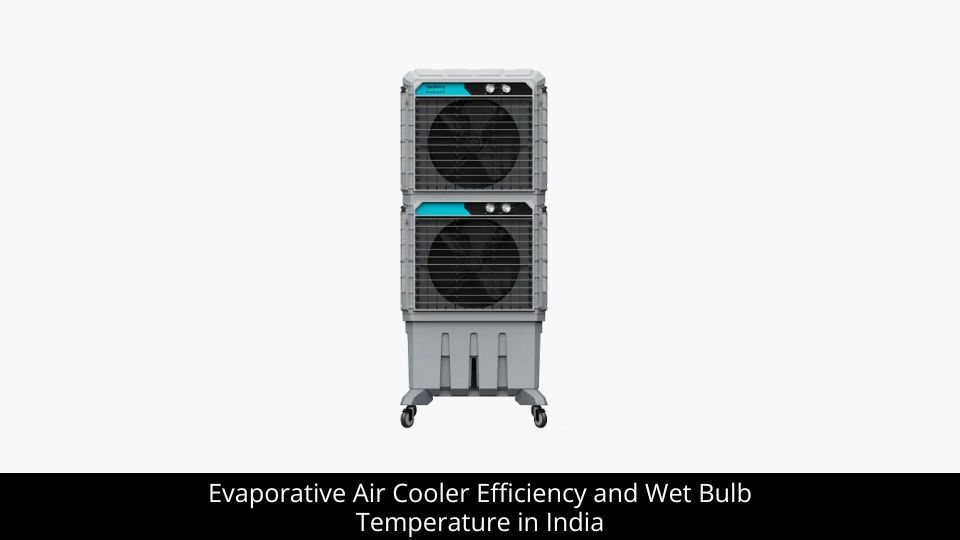
The most common question about evaporative air coolers – from facility managers evaluating purchases to engineers designing industrial cooling systems is: how much will it actually cool? The answer depends on one environmental variable that most buyers have never heard of: the wet bulb temperature.

Wet bulb temperature is the single most important factor determining evaporative air cooler efficiency. Understanding it is the difference between a buyer who installs a system that delivers exactly what was specified and one who is disappointed because they were sold a cooling number that applied to different conditions than their facility.

This is a technical guide to wet bulb temperature and its practical implications for industrial evaporative air cooler performance across India’s diverse climatic zones.

We are Available on Chat, Call, Email!

Dry bulb temperature is the standard air temperature measured by a thermometer in the shade. Wet bulb temperature is the temperature measured by a thermometer whose bulb is wrapped in a water-saturated wick – it measures the cooling effect of evaporation under current air conditions.

An evaporative air cooler works by evaporating water into the airstream. The maximum possible cooling effect – the theoretical limit – is the difference between the dry bulb temperature and the wet bulb temperature. This difference is called the wet bulb depression.

If the outdoor dry bulb temperature is 44°C and the wet bulb temperature is 24°C, the wet bulb depression is 20°C. An evaporative air cooler operating at 80% saturation efficiency will deliver approximately 0.8 × 20 = 16°C of cooling. Discharge air temperature would be approximately 28°C.

If the same 44°C outdoor temperature occurs at 70% humidity, the wet bulb temperature rises to approximately 38°C, and the wet bulb depression falls to 6°C. The same evaporative air cooler now delivers only 0.8 × 6 = 4.8°C of cooling – discharge air of approximately 39°C, which is essentially no cooling at all.

This is why humidity is not just a comfort factor – it is a fundamental technical parameter that determines whether an evaporative air cooler will perform.

Wet Bulb Temperature Across India: A Zone-by-Zone Guide

India’s climatic diversity means evaporative air cooler performance varies significantly by geography:

Rajasthan (Jaisalmer, Jodhpur, Bikaner, Barmer): Average summer wet bulb temperatures of 18–24°C with dry bulb temperatures reaching 44–48°C. Wet bulb depressions of 20–28°C. Among the best conditions for evaporative cooling in the world. Industrial evaporative air coolers deliver 15–18°C temperature drops routinely.

Gujarat and western Madhya Pradesh (Ahmedabad, Surat, Indore, Bhopal): Summer wet bulb temperatures of 22–27°C with dry bulb temperatures of 40–44°C. Wet bulb depressions of 15–20°C. Excellent evaporative cooling conditions. 12–16°C temperature drops achievable.

Punjab, Haryana, western UP (Ludhiana, Ambala, Kanpur, Agra): Wet bulb temperatures of 24–28°C with dry bulb of 42–46°C. Wet bulb depressions of 15–20°C. Very effective evaporative cooling conditions.

Maharashtra interior and Andhra Pradesh (Pune, Nashik, Nagpur, Nanded): Wet bulb temperatures of 24–28°C. Good cooling conditions with 10–14°C achievable temperature drops.

Coastal regions (Mumbai, Chennai, Kochi, Kolkata): Wet bulb temperatures of 28–34°C with moderate dry bulb temperatures of 32–36°C. Wet bulb depressions of only 4–8°C. Evaporative cooling is marginally effective and may require supplementary ventilation to provide meaningful comfort improvement.

How Saturation Efficiency Affects Performance

Not all evaporative air coolers achieve the same proportion of the theoretical maximum cooling. Saturation efficiency – the percentage of the wet bulb depression that the cooler actually delivers – depends on CELdek pad thickness, air velocity through the pads, and water distribution uniformity.

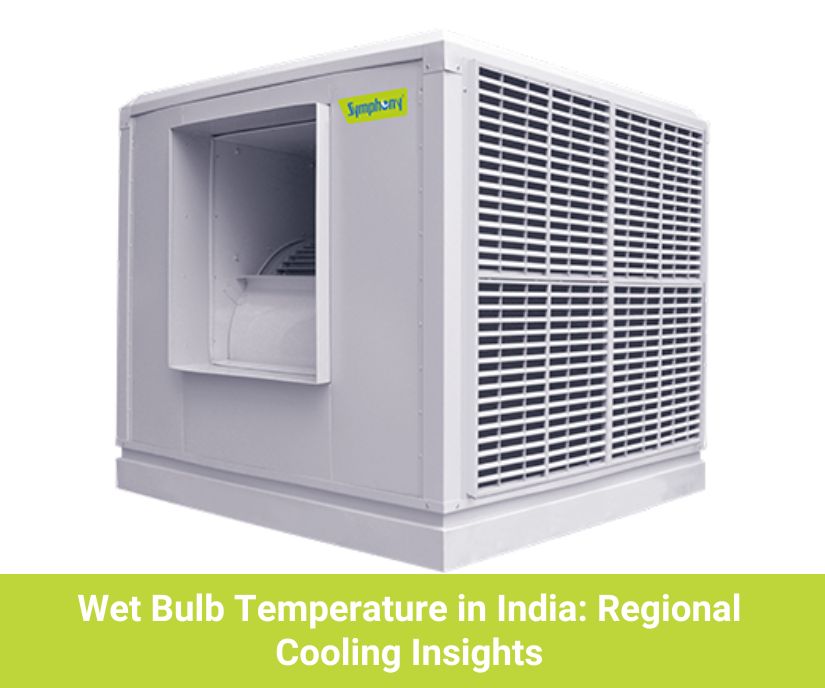
Symphony Venti-Cool’s industrial LSV systems achieve saturation efficiencies of 80–90% using 100mm and 150mm CELdek pads with precision water distribution systems. Thinner pads at higher velocities may achieve only 60–70% saturation efficiency – delivering significantly less cooling than the theoretical maximum for the same conditions.

When comparing evaporative air cooler specifications from different manufacturers, always ask for the saturation efficiency rating at the specified airflow. A unit with higher CFM but lower saturation efficiency may deliver similar or less cooling than a unit with lower CFM and higher saturation efficiency.

We’re Just a Call Away

Evaporative Cooling vs HVAC System: The Humidity Threshold

The decision between an industrial evaporative air cooler and a HVAC system for a given location depends primarily on the wet bulb temperature during the critical cooling months.

As a practical rule: if the wet bulb temperature during peak summer months stays below 24°C, evaporative cooling is highly effective and should be the first choice. If wet bulb temperature ranges from 24–28°C, evaporative cooling is effective and significantly more cost-efficient than HVAC for the achievable cooling. If wet bulb temperature consistently exceeds 28°C (typical of coastal India during monsoon), supplementary mechanical cooling or ventilation-only mode is required.

For most of inland India during the critical April-to-June cooling season, wet bulb temperatures are below 26°C – making evaporative cooling the effective and economical choice over HVAC systems.

Frequently Asked Questions

How Evaporative Air Cooler Efficiency Changes with Wet Bulb Temperature: A Practical Guide for India

Where can I find wet bulb temperature data for my city?

Wet bulb temperature data for Indian cities is available from the India Meteorological Department (IMD) and in ASHRAE's climatic design data. For specific industrial sites, a psychrometric weather station can measure wet bulb temperature directly. Symphony Venti-Cool's technical team uses IMD climate data in their system design calculations for every location.

Does wet bulb temperature vary seasonally in Indian cities?

Yes, significantly. In most inland Indian cities, wet bulb temperatures are lowest - and evaporative cooling most effective - in March, April, and May before monsoon arrives. During monsoon (July–August), wet bulb temperatures rise sharply as humidity increases. The cooling season for evaporative systems effectively runs from February to June and from September to November in most inland locations.

If I am in a coastal city, does an evaporative air cooler have any benefit?

In coastal cities during monsoon months, evaporative cooling provides minimal temperature reduction. However, these systems still provide valuable benefits year-round: significant fresh air ventilation that improves air quality and dilutes contaminants, air movement that increases the felt temperature reduction through convective cooling, and in the pre-monsoon and post-monsoon months (February–May and October–December), evaporative cooling is effective even in coastal locations.

What is the saturation efficiency of Symphony Venti-Cool's industrial evaporative air coolers?

Symphony Venti-Cool's LSV industrial systems achieve saturation efficiencies of 80–90% depending on the model and operating conditions. This high efficiency is a result of the thick CELdek pad specifications (100mm–150mm) and precision water distribution systems used in the LSV range.

How does a HVAC system compare to evaporative cooling in locations with wet bulb temperatures above 28°C?

In locations where wet bulb temperatures consistently exceed 28°C during the cooling season - coastal Maharashtra, Kerala, coastal Tamil Nadu, West Bengal - a HVAC system provides more reliable temperature control because its performance is independent of outdoor humidity. However, HVAC systems cost significantly more to operate. Many facilities in these locations use evaporative cooling for the majority of the year and supplement with HVAC only during peak monsoon months.

Can Symphony Venti-Cool provide a site-specific performance estimate for my location?

Yes. Symphony Venti-Cool's technical team uses your city's IMD climate data to calculate expected evaporative cooling performance for your specific location and facility configuration. This analysis is included in the system design and quotation process and provides realistic temperature performance expectations based on actual climate data for your location.

<< 1 >>


About the Author
About the Reviewer

Sourav Biswas is a senior marketing leader heading the LSV (Large Space Venticooling – B2B) marketing function at Symphony Limited. He shapes the brand’s strategic narrative, strengthens market leadership, and ensures excellence across all B2B cooling solutions. With deep expertise in Strategic Marketing, Brand Management, Advertising, and PR, he reviews content with analytical precision and alignment to Symphony’s vision. Passionate about mentoring and tracking B2B trends, Sourav ensures every content piece reflects accuracy, relevance, and strategic depth.


×
×
Index