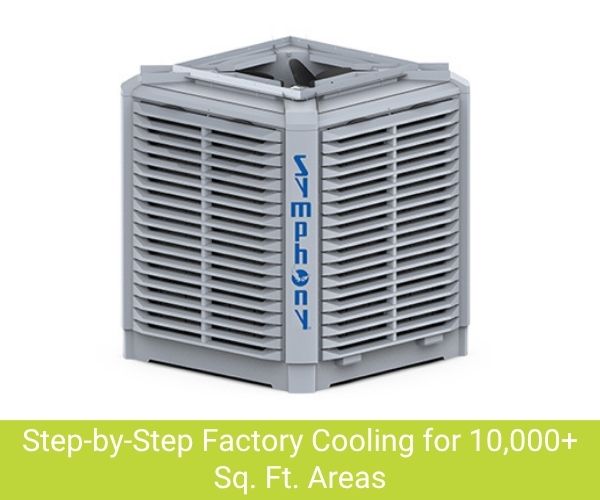
Cooling a large factory floor that spans 10,000 square feet or more demands a structured approach that goes well beyond simply purchasing equipment and turning it on. This guide walks facility managers and plant engineers through the complete planning process – from the initial heat load assessment to final system commissioning – with a focused emphasis on deploying industrial evaporative cooling as the primary thermal management strategy. Each step is designed to help teams make informed decisions about airflow design, equipment placement, zoning and ongoing performance monitoring, ensuring that the chosen industrial cooling solution delivers consistent results across every corner of the production floor.
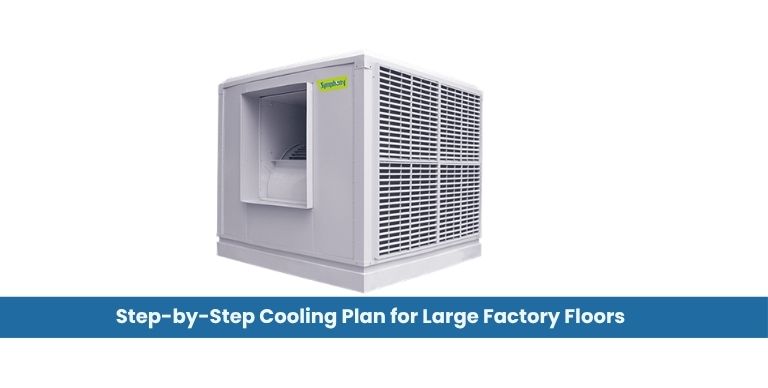
Table of Contents
Here is a step by step illustrations that how to cool a factory floor more than 10,000 Sq.ft Area
Step 1: Industrial Evaporative Cooler - Conduct a Comprehensive Heat Load Assessment
Before selecting any industrial evaporative air cooler, the first task is to understand exactly how much heat your facility generates and where that heat accumulates. A heat load assessment maps every thermal contributor on the floor – machinery, lighting rigs, roof radiation, personnel density and process-specific heat sources such as welding stations, furnaces or injection moulding machines.
Begin by walking the entire floor with a thermal imaging camera during peak production hours. Record ambient temperature readings at multiple heights – specifically at ground level, at worker breathing zones (approximately 4 to 6 feet) and near the ceiling. The difference between these readings reveals how stratified the air is and how aggressively hot air is pooling overhead.
Document the following for each zone: the type of equipment operating, the hours of operation per shift, the rated heat output in BTUs or kilowatts and whether the zone has direct roof exposure. This data becomes the foundation for every decision that follows. Skipping or rushing this step leads to undersized equipment, poor zone coverage and recurring comfort complaints from workers.
Step 2: Industrial Cooling Systems - Map the Floor into Thermal Zones
Not every part of a large factory floor heats up at the same rate. Industrial cooling systems perform best when the cooling load is divided into manageable zones rather than treating the entire floor as a single space. After completing the heat load assessment, use the thermal data to group areas by their heat intensity and occupancy level.
Typical zones in a 10,000+ sq. ft. facility include: high-heat process zones where heavy machinery runs continuously, moderate-heat assembly lines where workers are stationary for extended periods, lower-heat logistics and packing areas and transitional zones such as corridors between departments. Each zone will require a different cooling intensity and potentially a different equipment configuration.
Zoning also helps you allocate budget more precisely. A high-heat machining bay may require multiple units in a cross-ventilation arrangement, while a receiving dock may only need a single strategically positioned unit to maintain safe working temperatures. Drawing a scaled floor plan with these zones marked is an essential planning document for the rest of the project.
Step 3: Industrial Cooling Solutions - Evaluate Facility Ventilation Before Selecting Equipment
Evaporative cooling operates on a fundamentally different principle than refrigerant-based air conditioning. Industrial cooling solutions built around evaporative technology require a constant supply of fresh air and an equally constant path for hot, saturated air to escape. Without adequate ventilation, cooled air cannot circulate effectively and humidity levels rise to uncomfortable or even counterproductive levels.
Before selecting any unit, assess your facility’s existing ventilation infrastructure. Identify all supply air openings – roll-up doors, louvers, intake vents – and all exhaust points, including ridge vents, exhaust fans and open bays. Calculate the total free area available for air movement. A general planning target for evaporative cooling is one square foot of open exhaust area for every 500 to 1,000 CFM of airflow your cooling system will generate.
If your facility is tightly sealed for dust or noise control reasons, you will need to work with a mechanical engineer to introduce controlled exhaust pathways. These might include strategically placed wall exhaust fans, automatic ventilation louvers or modified roof panels. Getting this step right is non-negotiable – no evaporative cooling system, regardless of its rated output, will perform to specification in a poorly ventilated enclosure.
Step 4: Industrial Evaporative Cooling - Calculate the Total Airflow Requirement
Once you have zoned the floor and confirmed ventilation capacity, the next step is calculating the total airflow volume your industrial evaporative cooling system must deliver. This is typically expressed in cubic feet per minute (CFM) and directly determines how many units you need and what size they should be.
For high-heat manufacturing environments, the recommended air change rate is typically between 20 and 40 changes per hour. A factory with a 10,000 sq. ft. floor and a 20-foot ceiling running at 30 air changes per hour would require approximately 100,000 CFM of total airflow.
Divide this total across your zones, weighting higher CFM toward the most heat-intensive areas. Cross-check your zone CFM figures against the output ratings of the units you are considering. Keep in mind that real-world performance can vary based on wet-bulb temperature conditions in your region, so always build in a 15 to 20 percent buffer above your calculated requirement.
Step 5: Industrial Evaporative Air Cooler - Choose the Right Unit Type for Each Zone
Not all industrial evaporative air coolers are configured the same way and matching the unit type to the specific demands of each zone is critical for long-term performance. The two primary categories you will encounter are ducted fixed-mount units and portable units.
Fixed ducted units are typically mounted at height and connected to ductwork or distribution plenums. They deliver high-volume airflow across large, defined areas and are ideal for permanent installations in high-heat production zones. These units generally offer the highest CFM output and are preferred when the cooling requirement for a zone is predictable and consistent.
An industrial evaporative cooler offers a fundamentally different value proposition. These units can be repositioned as production layouts change, deployed to temporary work areas, used as supplemental cooling during peak heat seasons or moved to maintenance zones that are only occupied intermittently. For facilities with dynamic floor plans or seasonal production peaks, a portable industrial evaporative cooler adds flexibility that fixed systems cannot provide.
Many facility managers opt for a hybrid approach – fixed units covering the permanent high-heat zones and a fleet of portable units assigned to flexible or overflow areas. This combination tends to deliver the most adaptable and cost-effective deployment for large, varied factory floors.
Our Other Product
Commercial Portable Cooling SystemsStep 6: Industrial Evaporative Air Coolers - Develop a Strategic Equipment Placement Plan
Where you position your industrial evaporative air coolers determine how effectively cooled air reaches workers and how efficiently hot air exits the building. Placement planning should always account for airflow direction, obstruction patterns and the location of exhaust points.
Units should generally be positioned on the side of the building closest to the prevailing wind direction or closest to supply air openings, with their discharge aimed toward the center of the work zone and toward the exhaust outlets. This creates a consistent push-through airflow pattern that sweeps hot air away from the occupied zone.
Avoid positioning units so that their discharge blows directly toward walls, solid partitions or large machinery that will deflect or block airflow. Tight corridors and enclosed alcoves are particularly problematic – if a zone is surrounded by walls on three sides, you will need a dedicated exhaust fan paired with the cooler to prevent air from recirculating without exiting.
For high bays where the ceiling exceeds 25 feet, consider mounting units at mid-height using mezzanine platforms or structural brackets, directing airflow downward toward the worker zone rather than allowing it to dissipate into the upper volume of the building.
Step 7: Industrial Cooling Equipment - Plan the Water Supply and Drainage Infrastructure
Evaporative cooling relies entirely on water consumption and industrial cooler of this type requires a dedicated, reliable water supply. Planning the water and drainage infrastructure before installation prevents costly retrofits and operational interruptions later.
Each unit requires a potable water supply line sized to the unit’s consumption rate, which scales with airflow output. For multi-unit installations, this typically means running a dedicated water distribution header along the perimeter of the facility with individual branch connections to each unit location.
Water quality matters significantly in hard water regions. Mineral scale build up on evaporative media reduces thermal efficiency over time and shortens media life. If your facility has water with high mineral content, plan for a water treatment or filtration system at the main supply connection. Most manufacturers provide water quality guidelines; exceeding the recommended total dissolved solids level will void warranties and degrade performance.
Drainage is equally important. Each unit produces bleed-off water – deliberately discharged water that carries away concentrated minerals. This bleed-off must be directed to a floor drain or a dedicated drainage channel. Ensure your floor plan accounts for drainage proximity at each unit location before finalizing the placement map.
Step 8: Industrial Cooler Price - Develop a Total Cost and Procurement Plan
When building the procurement plan, it is important to look beyond the headline industrial cooler price of individual units and account for the complete lifecycle cost of the installation. Equipment cost is only one component of the total investment.
The full cost picture includes: the units themselves, installation labour for electrical and water connections, any structural modifications needed for mounting or ventilation, water treatment equipment if required, ongoing media replacement costs and routine maintenance labour. Facilities that focus exclusively on upfront equipment cost often discover that a cheaper unit with higher media replacement frequency or higher energy consumption outpaces the cost of a better-specified unit within two to three operating seasons.
When comparing options, request the industrial evaporative air cooler price on a total cost-of-ownership basis rather than a unit-only basis. Ask vendors to provide media replacement intervals, typical energy consumption in your climate conditions and expected service life. This information allows for a genuine apples-to-apples comparison between different best industrial evaporative air cooler candidates in your shortlist.
Also evaluate vendor support capabilities. For a deployment of this scale, reliable access to spare parts, technical support and on-site service from the vendor is worth factoring into the procurement decision alongside raw industrial evaporative air cooler price figures.
Step 9: Industrial Cooling Solution - Commission and Test the System Before Full Production Deployment
Commissioning is the phase where the industrial cooling solution is activated systematically and verified against the design targets established in the earlier planning steps. This is not a simple switch-on process – it requires methodical testing and adjustment.
Begin by activating one zone at a time during off-peak or non-production hours. Measure actual CFM output at each unit using an anemometer and compare against the unit’s rated output. Check that exhaust is occurring as planned by measuring airflow velocity at exhaust points. Record wet-bulb and dry-bulb temperatures at the inlet and outlet of each unit to verify cooling efficiency.
Walk the zone during operation and map the actual temperature distribution using a handheld thermometer or data loggers placed at worker height throughout the space. Compare this thermal map to your target temperatures from the heat load assessment. Zones that are running hot relative to the target should be investigated – possible causes include insufficient exhaust, obstructions deflecting airflow, undersized unit output or inadequate supply air.
Adjust unit positioning, exhaust fan speeds and damper settings based on commissioning data before declaring the system live. Document all final settings as a baseline for ongoing performance monitoring.
Step 10: Industrial Evaporative Cooler - Establish a Preventive Maintenance Schedule
The long-term performance of any industrial evaporative cooler deployment depends on consistent, disciplined preventive maintenance. Evaporative media degrades over time, water distribution systems scale up and pump and motor performance drifts. A structured maintenance schedule prevents these gradual performance losses from accumulating unnoticed.
Key maintenance tasks and recommended intervals include: cleaning or replacing evaporative media pads (typically every one to two seasons depending on water quality and operating hours), flushing and cleaning the water sump (monthly during active operation), inspecting and descaling water distribution tubes and nozzles (monthly), checking and replacing belt drives and motor bearings (per manufacturer intervals) and testing bleed-off flow rates (monthly).
Assign maintenance responsibilities clearly – whether to in-house facilities staff or a contracted service provider – and log all work completed against each unit. Units that underperform between scheduled service intervals should be flagged for inspection outside the normal cycle. Catching a failing pump or clogged distribution system early prevents the kind of total cooling failure that disrupts production on a hot day.
Conclusion
Cooling a factory floor of 10,000+ sq. ft. is a process that rewards careful planning at every stage. When industrial evaporative air coolers are selected, positioned and maintained based on accurate heat load data and proper ventilation design, they deliver consistent thermal comfort across even the most demanding production environments. The right combination of fixed and portable units, backed by a disciplined maintenance program, ensures reliable performance through every operating season.
FAQs
How many industrial evaporative air coolers do I need for a 10,000 sq. ft. factory?
The number of units depends on ceiling height, heat load intensity and the CFM rating of the units you select. As a general starting point, calculate total required CFM using the air changes formula, then divide by the rated output of your chosen unit. Always add a 15 to 20 percent buffer and verify that your exhaust capacity matches the total airflow you are introducing. For more information, you can contact Symphony Venti-Cool Experts, they will guide you in the best way.
Can industrial evaporative cooling work in humid climates?
Evaporative cooling is most efficient in dry climates where relative humidity is below 60 percent. In more humid environments, the cooling effect diminishes because the air can absorb less moisture. That said, even in moderately humid regions, directing high-velocity cooled air across workers provides meaningful comfort improvement through convective cooling, even when the temperature drop is smaller than in arid conditions.
What is the difference between a fixed unit and a portable industrial evaporative cooler?
Fixed units are permanently mounted, typically ducted and designed to cover a defined zone at high continuous output. A portable industrial evaporative cooler is self-contained and can be repositioned as needed. Portable units are ideal for supplemental cooling, flexible production layouts, temporary work areas or seasonal peaks where additional capacity is needed without permanent infrastructure investment.
How often does the evaporative media need to be replaced?
Media replacement frequency depends on water quality, operating hours and the type of media used. In facilities with good quality water and standard operating hours, media typically lasts one to two seasons. Hard water or extended daily operation can shorten this to a single season. Regular inspection - at minimum monthly during peak operation - allows maintenance teams to identify degrading media before it affects performance.
What water quality is required for industrial evaporative cooling equipment?
Most industrial cooling equipment manufacturers specify a maximum total dissolved solids (TDS) level for supply water, typically in the range of 500 to 1,000 parts per million (ppm). Water significantly above this threshold accelerates scale build-up on media and distribution components. If your facility supply water exceeds the manufacturer's specification, invest in a water softener or filtration system at the supply connection point.
Can I mix fixed and portable units in the same deployment?
Yes, and this is often the recommended approach for large, varied factory floors. Fixed units handle the permanent high-heat zones where consistent output is needed year-round. Portable units cover flexible areas, seasonal overflow, temporary stations or zones where production layout changes frequently. A mixed deployment maximizes coverage flexibility without requiring full fixed infrastructure across the entire floor.
How do I verify that my industrial cooling solution is performing as planned?
Post-commissioning performance verification involves three elements: measuring actual CFM output at each unit against rated specs, mapping temperature distribution at worker height across each zone using data loggers or handheld instruments and recording inlet and outlet wet-bulb temperatures to confirm cooling efficiency. If any zone is running significantly hotter than the design target, investigate exhaust adequacy, airflow obstructions and water system performance before assuming the equipment is undersized.
Conclusion
Cooling a factory floor of 10,000 square feet or more is a systematic process that begins with careful measurement and ends with disciplined maintenance. By working through each step – from heat load assessment and zone mapping to equipment selection, placement planning and commissioning – facility teams can deploy industrial evaporative air coolers that deliver consistent thermal comfort across the entire production environment. Choosing the right mix of fixed and portable units, ensuring adequate ventilation and maintaining the system to manufacturer standards ensures that the industrial evaporative cooler investment continues to perform reliably through every production season.

Maulik Solanki is a seasoned B2B Product Marketing professional specializing in Industrial and Commercial Coolers in the LSV (Large Space Venticooling) segment. With 13+ years of experience, he drives brand building and audience engagement for Symphony’s LSV solutions through integrated offline and online strategies. Backed by an MBA in Marketing and earlier experience as a Regional Marketing Manager in banking, Maulik brings strong skills in sales, advertising, and events. He enjoys exploring new marketing ideas and cooling technologies and writes to help readers understand Symphony’s offerings.

Sourav Biswas is a senior marketing leader heading the LSV (Large Space Venticooling – B2B) marketing function at Symphony Limited. He shapes the brand’s strategic narrative, strengthens market leadership, and ensures excellence across all B2B cooling solutions. With deep expertise in Strategic Marketing, Brand Management, Advertising, and PR, he reviews content with analytical precision and alignment to Symphony’s vision. Passionate about mentoring and tracking B2B trends, Sourav ensures every content piece reflects accuracy, relevance, and strategic depth.