Symphony Venticool

Read AI-Generated Summary:

India’s National Cooling Action Plan (NCAP), launched by the Ministry of Environment, Forest and Climate Change, sets a 20-year roadmap to reduce the country’s cooling energy demand by 20 to 25 percent and phase out high-GWP refrigerants. For industrial facility managers, NCAP has direct implications: it shapes equipment procurement decisions, energy audit requirements, ESG reporting expectations, and the selection of cooling technologies for factory floors, warehouses, and commercial spaces. This article explains what NCAP requires, why evaporative cooling is the most naturally aligned industrial technology, how to conduct an energy audit of your cooling system, and what the Scope 2 emission savings from LSV adoption look like in practice.

India’s National Cooling Action Plan and What It Means for Industrial Facility Managers
0:00 / 0:00

Launched in 2019, India’s National Cooling Action Plan is the government’s integrated strategy for addressing the country’s rapidly growing cooling demand across residential, commercial, and industrial sectors. Cooling accounts for 40 to 50 percent of India’s peak electricity demand and is one of the fastest-growing end-use loads in the economy, driven by rising temperatures, industrial expansion, and increasing purchasing power.

NCAP sets several key targets for the period through 2037 to 2038: reduce cooling energy demand by 20 to 25 percent across sectors, phase down the use of hydrofluorocarbon (HFC) refrigerants in line with India’s Kigali Amendment commitments, improve the minimum energy performance standards for air conditioning equipment, and promote alternative cooling technologies that are inherently low in refrigerant use and energy consumption.

For industrial facility managers, NCAP is not a distant policy document. It is the framework behind BEE star rating mandates, energy audit requirements under the Perform Achieve and Trade (PAT) scheme, and the growing expectation from global parent companies that Indian facilities demonstrate measurable progress in cooling energy reduction.

How NCAP Affects Industrial Cooling Decisions

Several NCAP-driven changes are directly relevant to facility managers making cooling procurement decisions in 2026:

  • BEE star ratings for commercial air conditioning equipment are becoming mandatory, raising minimum efficiency standards and making lower-rated equipment increasingly difficult to justify on a total cost basis.
  • Large industrial consumers classified as Designated Consumers under the PAT scheme must conduct periodic energy audits and demonstrate improvement in Specific Energy Consumption across operations, including cooling.
  • HFC refrigerant phase-down timelines are affecting the long-term serviceability of existing refrigerant-based cooling equipment, adding replacement cost uncertainty for facilities that invested in conventional AC systems.
  • Export-oriented manufacturers face additional pressure from the EU Carbon Border Adjustment Mechanism, which will assess the carbon intensity of manufacturing processes including cooling.

Taken together, these pressures create a clear financial case for transitioning large open industrial spaces from refrigerant-based cooling to evaporative systems wherever the climate and building envelope permit.

Why Evaporative Cooling is NCAP's Most Compatible Industrial Technology

Evaporative industrial air coolers align with NCAP’s objectives in every dimension. They use no HFC refrigerants, eliminating GWP impact from the cooling process entirely. They consume 80 to 90 percent less electricity than equivalent refrigerant-based systems, directly contributing to NCAP’s energy reduction targets. They deliver 100 percent fresh outdoor air rather than recirculating internal air, which improves indoor air quality and aligns with NCAP’s broader thermal comfort objectives. They operate effectively in the open and semi-open industrial environments where conventional AC is most inefficient.

Symphony Venti-Cool’s LSV systems are manufactured under ISO 9001 quality management systems, use CELdek evaporative pads with saturation efficiencies of 80 to 90 percent, and are BIS certified under IS 8827. These are the credentialing markers that BEE energy auditors and procurement teams look for when documenting compliance investments.

What is the BEE Star Rating System and How Does It Apply to Industrial Cooling?

What is the BEE Star Rating System and How Does It Apply to Industrial Cooling?

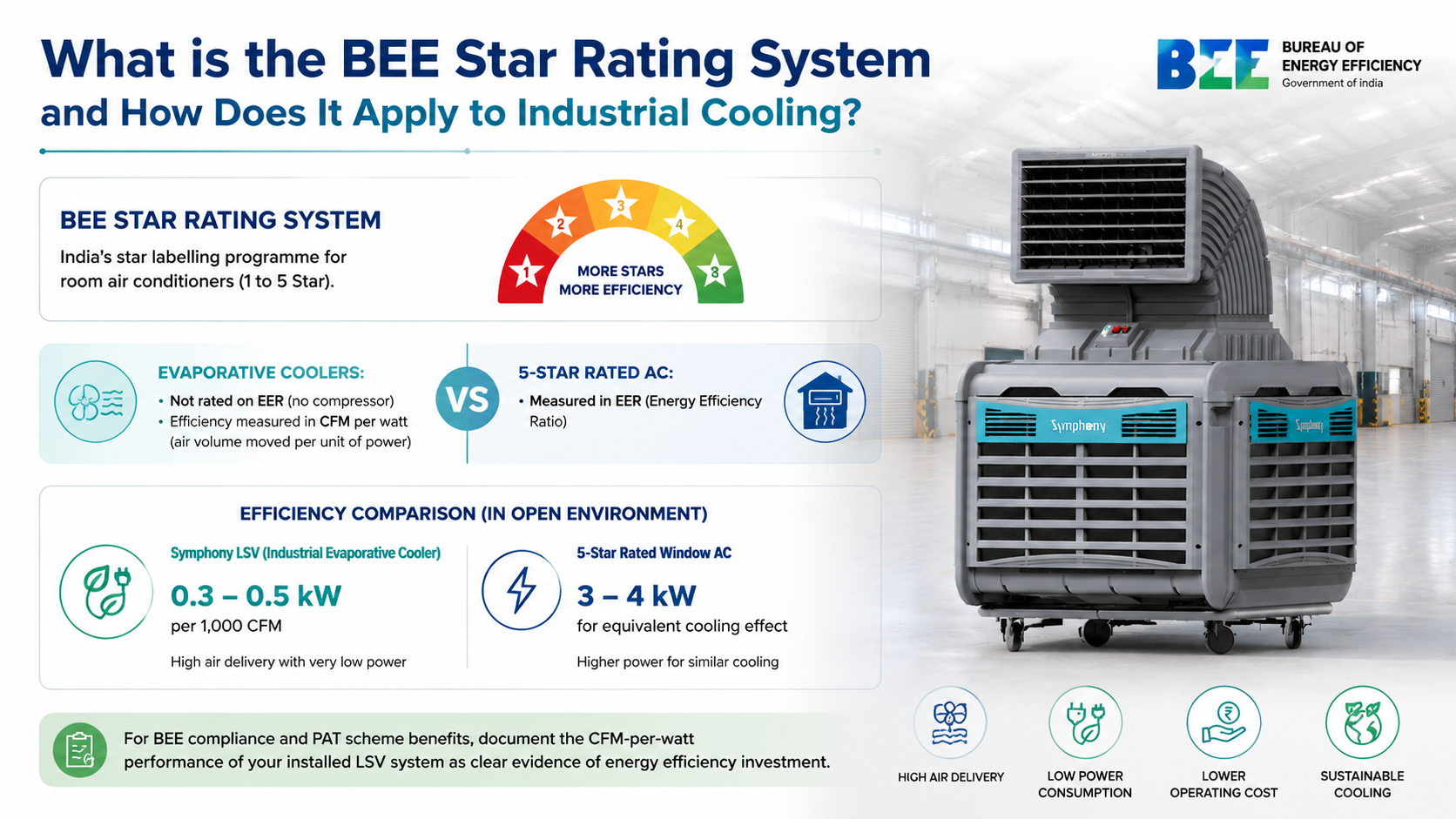
The Bureau of Energy Efficiency administers India’s star labelling programme, which currently mandates energy performance labelling for room air conditioners on a 1 to 5 star scale. A higher star rating indicates better energy efficiency, measured by the Energy Efficiency Ratio (EER) for cooling mode.

Evaporative air coolers are not rated on the same EER scale as compressor-based AC, because they use no vapour compression cycle. Their efficiency is measured in CFM per watt, which reflects how much air volume they move per unit of electricity consumed. On this metric, high-quality industrial evaporative coolers like Symphony LSV deliver dramatically better performance than any AC system. A Symphony LSV unit at full output consumes approximately 0.3 to 0.5 kW per 1,000 CFM. A 5-star rated window AC typically consumes 3 to 4 kW for an equivalent cooling effect in the same open environment.

For facilities seeking BEE compliance and PAT scheme performance improvement, documenting the CFM-per-watt performance of an installed LSV system provides clear evidence of energy efficiency investment.

How to Conduct an Energy Audit of Your Industrial Cooling System

Step-by-Step Audit Process

  • Document all cooling equipment currently installed across the facility: type and brand, cooling capacity in tons or CFM, motor power in kW, operating hours per day, and installation year.
  • Install submeters or energy loggers on all major cooling loads and record baseline electricity consumption over a 30-day period that includes peak summer conditions.
  • Calculate the Energy Consumption Intensity for cooling: total kWh consumed by cooling divided by the floor area cooled in square metres per month. This gives you a normalised benchmark.
  • Compare your ECI against BEE’s published norms for your industry sector to identify whether cooling energy consumption is above or below benchmark.
  • Map the highest-consumption cooling zones. For most manufacturing and warehousing facilities, these are large open floor areas, loading bays, and process areas where AC systems struggle against open-boundary conditions.
  • For each high-consumption zone, evaluate whether LSV evaporative cooling can replace or supplement the existing system. Check the local summer humidity profile: below 55 percent RH makes evaporative cooling highly effective.
  • Calculate projected energy savings by comparing the wattage of the existing system with the wattage of a Symphony LSV replacement of equivalent air volume.
  • Compile findings in a BEE-format energy audit report. For Designated Consumers under PAT, this document supports specific energy consumption improvement claims.

What Role Does Ventilation Play in NCAP-Compliant Facilities?

NCAP explicitly recognises fresh air ventilation as a priority strategy for industrial thermal comfort. India’s National Building Code and ASHRAE 62.1 both set minimum fresh air ventilation rates for occupied industrial spaces. Meeting these rates passively, using natural air movement, becomes harder as buildings grow larger and summer temperatures intensify. Mechanical ventilation becomes necessary.

Symphony LSV is both a ventilation system and a cooling system in a single unit. It draws fresh outdoor air at a high rate, cools it by evaporation, and delivers it to the occupied zone. For facilities that have been managing with ceiling fans and open windows, LSV installation simultaneously improves ventilation compliance and delivers meaningful temperature reduction. One investment satisfies two compliance requirements.

How Evaporative Cooling Reduces Scope 2 Emissions for Indian Manufacturers

Scope 2 emissions are the indirect greenhouse gas emissions arising from purchased electricity. For most Indian manufacturing facilities, cooling is the single largest contributor to Scope 2 emissions after production process energy. Reducing cooling electricity directly and proportionally reduces Scope 2 carbon impact.

To quantify the scale of the opportunity: replacing a 100-ton chiller installation serving a 50,000 square foot industrial facility with Symphony LSV evaporative cooling reduces annual electricity consumption by approximately 600,000 kWh. At India’s grid emission factor of 0.82 kg of CO2 per kWh, this equates to approximately 492 tonnes of CO2 avoided per year per facility. For a manufacturer with 10 large facilities, the annual Scope 2 reduction from LSV adoption across open factory areas approaches 5,000 tonnes of CO2.

This is a reportable, verifiable reduction that can be documented in BRSR (Business Responsibility and Sustainability Reporting) disclosures, communicated to global headquarters for ESG target tracking, and certified through third-party energy auditors.

Speak with an Expert

What State-Level Cooling Policies Should Facility Managers Know About?

Rajasthan has among the driest summer conditions in India, with humidity below 30 percent from March through June. This makes evaporative cooling maximally effective for Rajasthan’s extensive manufacturing base in Alwar, Bhiwadi, Neemrana, and Jodhpur. The state’s industrial energy conservation initiatives reward measurable energy reductions in manufacturing, making LSV adoption documentable under multiple incentive frameworks.

Gujarat mandates energy audits for large industrial electricity consumers and has an active solar energy policy that complements low-energy cooling. At electricity rates well above the national average for industrial consumers, the electricity savings from replacing AC with LSV cooling in open factory areas represent a significant annual cost reduction. For the packaging, chemical, pharmaceutical, and textile industries concentrated in Surat, Bharuch, Vadodara, and Ahmedabad, LSV systems are a commercially straightforward choice.

Maharashtra’s industrial electricity tariff structure includes time-of-day pricing with premium rates during peak demand hours, typically 6 am to 10 pm. AC systems contribute heavily to peak demand. Symphony LSV units, consuming one-tenth the wattage of equivalent AC, reduce peak demand charges substantially. For large manufacturing and logistics facilities in Pune, Nashik, Aurangabad, and Nagpur, the tariff structure actively rewards the switch to evaporative cooling.

Conclusion

NCAP is reshaping the economics of industrial cooling in India by raising energy efficiency standards, accelerating refrigerant phase-downs, and linking cooling performance to sustainability reporting requirements. Evaporative LSV cooling from Symphony Venti-Cool is the technology that aligns most directly with every dimension of NCAP’s objectives: no refrigerants, minimal electricity consumption, fresh air delivery, and compatibility with the open industrial environments where cooling is hardest and most needed. For facility managers responsible for PAT compliance, BRSR reporting, and operating cost reduction simultaneously, the case for LSV adoption is not just environmental. It is financial.

Frequently Asked Questions

India’s National Cooling Action Plan and What It Means for Industrial Facility Managers

What is the typical payback period for Symphony LSV cooling replacing industrial AC?

For most Indian industrial applications, the payback period from electricity savings alone is 12 to 24 months. For facilities with electricity tariffs above Rs 8 per kWh or large cooling areas above 20,000 square feet, payback can be achieved in 8 to 12 months. The system has an expected service life of 10 to 15 years, delivering significant net savings beyond the payback period.

Can Symphony Venti-Cool provide energy savings documentation to support BEE audit reports?

Yes. Symphony Venti-Cool provides technical documentation including unit specifications, rated power consumption, CFM output, and energy efficiency data that can be incorporated into BEE format energy audit reports, PAT scheme submissions, and BRSR sustainability disclosures.

What is the difference between an air washer and a Symphony LSV industrial evaporative cooler for NCAP purposes?

Both are evaporative technologies, but they serve different primary functions. An air washer uses a water spray chamber primarily for humidification and air cleaning, with limited temperature reduction. A Symphony LSV industrial evaporative cooler uses high-efficiency CELdek pads specifically designed to maximise saturation efficiency and temperature drop. For NCAP's energy reduction objectives, CELdek-based evaporative coolers deliver substantially better cooling per watt than air washers.

How does NCAP address cooling in large industrial sheds and open warehouses?

NCAP encourages ventilation-first and alternative cooling strategies for large industrial spaces, recognising that such environments are poorly suited to conventional sealed-envelope AC. Evaporative cooling systems like Symphony LSV are aligned with NCAP's guidance for these environments as a preferred technology that achieves meaningful cooling at a fraction of the energy cost of refrigerant-based systems.

<< 1 >>


About the Author
About the Reviewer

Sourav Biswas is a senior marketing leader heading the LSV (Large Space Venticooling – B2B) marketing function at Symphony Limited. He shapes the brand’s strategic narrative, strengthens market leadership, and ensures excellence across all B2B cooling solutions. With deep expertise in Strategic Marketing, Brand Management, Advertising, and PR, he reviews content with analytical precision and alignment to Symphony’s vision. Passionate about mentoring and tracking B2B trends, Sourav ensures every content piece reflects accuracy, relevance, and strategic depth.


×
×
Index