Symphony Venticool

Read AI-Generated Summary:

Choosing the wrong industrial air cooler is a costly mistake that is made more often than it should be. Undersized units that cannot cool the space, oversized units that raise humidity uncomfortably, inappropriate technology choices for open environments, cheap units that fail mid-summer, and poorly planned duct installations are the most common outcomes of purchases made without the right information. This article gives buyers a definitive 10-question checklist to evaluate before committing to any industrial or commercial evaporative cooling system. Each question covers a specific dimension of the buying decision: space sizing, humidity, building type, airflow capacity, system configuration, total cost, pad technology, service coverage, installation requirements, and certifications. Working through these questions produces a specification that prevents the most common and expensive mistakes.

Top 10 Questions to Ask Before Buying an Industrial Air Cooler: A Complete Buyer’s Checklist for Factories, Warehouses, and Commercial Spaces
0:00 / 0:00

A poorly chosen industrial air cooler does not just underperform. It creates a cascade of secondary costs. A unit that is too small for the space leaves workers uncomfortable and productivity low, meaning the cooling investment delivers no return. A unit with the wrong technology for an open-boundary space runs continuously without reaching temperature targets, generating electricity bills without solving the problem. A cheap unit without proper certifications may fail within the first season, requiring emergency replacement at peak demand time when supplier stock is depleted. A system with inadequate after-sales support means that a breakdown in May or June costs the facility thousands of rupees per day in lost productivity while waiting for a technician.

The 10 questions below are the ones that eliminate these outcomes before they happen.

Question 1: What Is the Exact Floor Area and Ceiling Height of the Space?

Every industrial cooling calculation begins here, and this is where the most common sizing errors are made. Floor area alone is an incomplete specification. A factory with a 12-foot ceiling and a factory with a 30-foot ceiling at the same floor area require entirely different cooling capacities because the volume of air to be moved is fundamentally different.

How to Measure Your Space for Cooling Sizing

  • Measure the length and width of the space to calculate floor area in square feet.
  • Measure the clear height from finished floor to the underside of the roof structure or ceiling at the lowest point. Use the lowest clear height, not the ridge height.
  • Calculate volume: floor area multiplied by ceiling height gives you cubic feet.
  • Note any internal partitions that divide the space into zones requiring separate treatment.
  • Identify heat-generating equipment inside the space: welding stations, CNC machines, ovens, refrigeration units, furnaces. Estimate their heat output in kW if possible.
  • Note all ventilation openings: loading bay doors, windows, roller shutters, and whether they are normally open or closed during operations.

The cooling calculation is built on volume, not floor area. Any supplier who gives you a recommendation based only on square footage without asking about ceiling height is not sizing the system correctly.

Speak with an Expert

Question 2: What Is the Outdoor Humidity at Your Location in Peak Summer?

Outdoor humidity is the single most critical variable for evaporative cooling performance. Evaporative coolers work by causing water to evaporate into hot dry air. The drier the incoming air, the more water can evaporate, and the greater the temperature drop. When air is already saturated with moisture, evaporation rate drops and so does cooling performance.

The technical term for this is wet bulb temperature. The lower the wet bulb temperature, the better an evaporative cooler performs. In practical terms, the rule of thumb for India is:

  • Outdoor relative humidity below 50 percent in peak summer: evaporative cooling delivers a temperature drop of 8 to 12 degrees Celsius. This covers Ahmedabad, Rajasthan, Delhi NCR, Hyderabad, Pune, and most of interior India from March through June.
  • Outdoor RH between 50 and 65 percent: evaporative cooling delivers upto 8 degrees of temperature drop with good ventilation. This covers many inland cities in the post-monsoon transition and certain periods in Bangalore.

Question 3: Is Your Space Open, Semi-Open, or Fully Sealed?

This question determines the fundamental technology choice. Evaporative coolers are designed for open and semi-open spaces. They supply fresh air and require exhaust paths to function. Air conditioning systems are designed for sealed spaces, where the investment in refrigerant compression is not wasted through air leakage.

Factories, warehouses, workshops, automobile service bays, large commercial sheds, and logistics facilities with loading bays are semi-open spaces. They have ventilation openings, loading bay doors that operate throughout the day, and building envelopes that cannot realistically be sealed during operations. Installing AC in such spaces wastes 50 to 70 percent of the cooling energy through air leakage every time a door opens. The unit runs continuously at maximum load without ever reaching its target temperature.

If your space is a fully enclosed, permanently sealed office or clean room with no regular opening to the outside, then sealed-envelope AC is appropriate. If it is a factory, warehouse, workshop, or any space that operates with doors, bays, or significant ventilation openings, evaporative cooling is the right technology.

What CFM of Airflow Do You Actually Need?

Question 4: What CFM of Airflow Do You Actually Need?

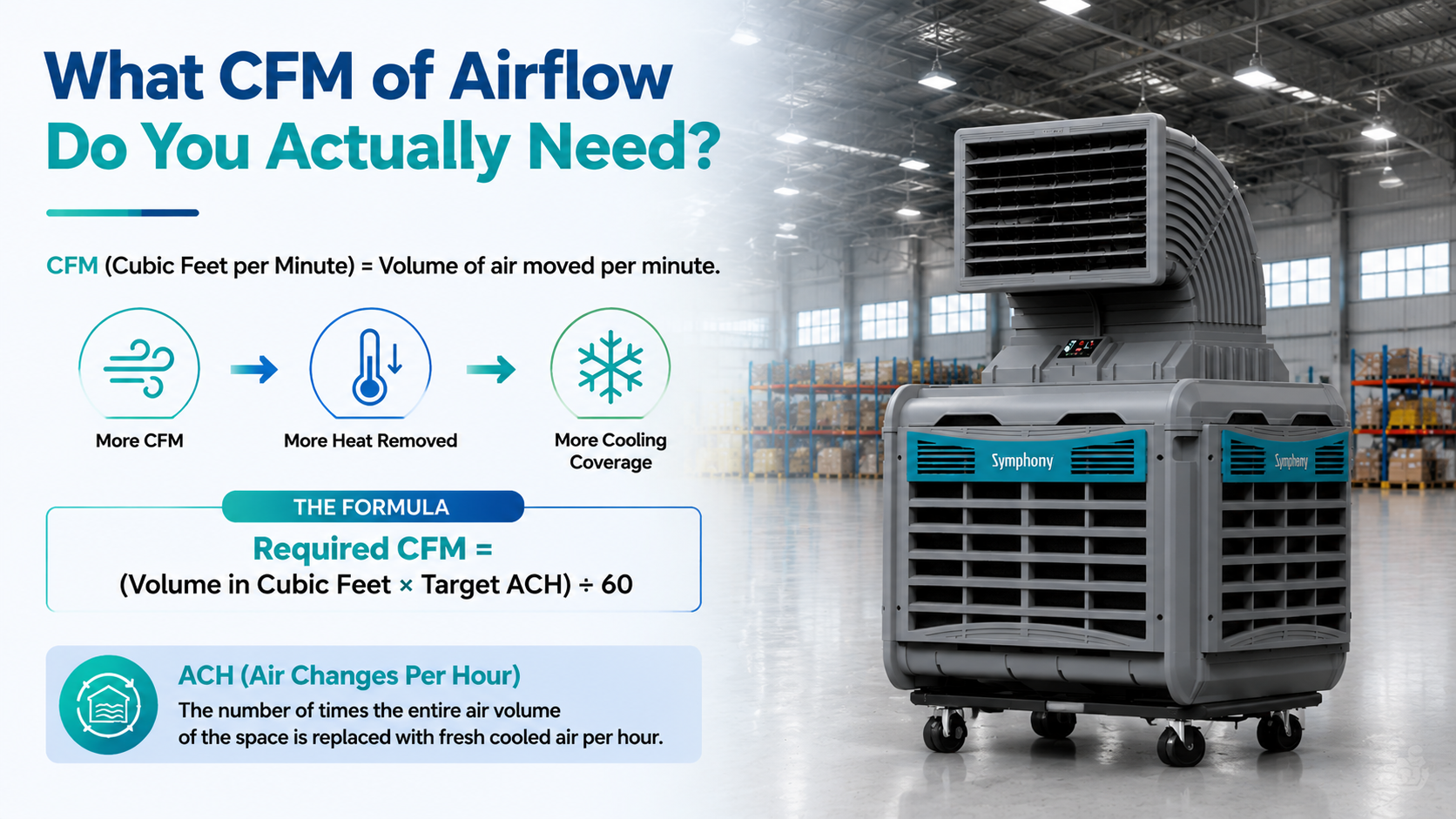
CFM stands for cubic feet per minute and represents the volume of air a cooler moves per minute. More CFM means more air moved, more heat removed, and more cooling coverage. The required CFM for your space is not a figure a supplier should quote from memory. It is calculated.

The formula is straightforward: Required CFM = (Volume in cubic feet multiplied by target ACH) divided by 60.

ACH is Air Changes Per Hour, the number of times the entire air volume of the space is replaced with fresh cooled air per hour. The right ACH depends on the type of space and the heat load:

Space Type Recommended ACH Example CFM for 10,000 cu ft space
Warehouse, light storage 15 to 20 ACH 2,500 to 3,333 CFM
Factory floor, assembly 20 to 35 ACH 3,333 to 5,833 CFM
Welding, heat-process areas 40 to 60 ACH 6,667 to 10,000 CFM
Commercial space, canteen 10 to 15 ACH 1,667 to 2,500 CFM
Restaurant kitchen 30 to 50 ACH 5,000 to 8,333 CFM
Dark store, picking area 20 to 30 ACH 3,333 to 5,000 CFM

Any supplier who recommends a specific unit without calculating CFM from your space volume and ACH requirement is guessing. Ask for the calculation.

Question 5: Should You Choose Portable, Ducted, or Centralised Cooling Systems?

The three configurations serve different applications and scale requirements. Choosing the wrong one for your situation results either in inadequate coverage or unnecessary installation complexity.

Portable Industrial Air Coolers

Portable industrial coolers are free-standing, wheeled units that connect to a standard power supply and either a water supply line or a built-in tank. They require no installation. They are best suited to spaces under 5,000 square feet, leased premises where permanent installation is not viable, applications where the cooler needs to move with operations across the facility, construction sites, event spaces, and temporary facilities. Symphony’s portable range includes the PAC-18 at 8,000 CFM, the SPS-30 at 10,000 CFM, and the SPS-45 at 12,000 CFM. These are industrial-grade units, not residential desert coolers, designed for continuous operation in demanding environments.

Ducted Wall-Mounted or Rooftop Units

Ducted systems mount on a wall above head height or on the rooftop and deliver cooled air through ductwork to specific zones within the space. They are appropriate for medium to large spaces between 5,000 and 50,000 square feet where uniform air distribution across multiple aisles or zones is required. The ducted configuration leaves the floor completely clear, delivers cooled air precisely where workers are present rather than in the general air mass, and integrates naturally with an exhaust system to create directional airflow. Symphony’s LSV ducted range covers this application with a variety of unit sizes and duct accessory options.

Centralised LSV Systems

A central cooling system uses multiple high-capacity units connected through a designed duct network and controlled from a single panel or BMS. This is appropriate for facilities above 50,000 square feet where zone-by-zone control, single-point maintenance access, and coordinated operation are priorities. Large manufacturing plants, logistics parks, GCC campuses, and defence assembly facilities are the natural applications. Symphony Venti-Cool provides full centralised system design, including airflow modelling, duct layout, and BMS integration specifications.

Question 6: What Is the Total Cost of Ownership Over 5 Years?

Purchase price is the least useful number for evaluating an industrial cooling investment. Total cost of ownership over five years tells you the real comparison.

Cost Component Residential Desert Cooler Industrial Evap Cooler (LSV) Industrial AC System
Purchase and install Rs 12,000 to 20,000 Rs 1 to 3 lakh Rs 4 to 8 lakh
Expected service life 2 to 3 years 12 to 15 years 8 to 10 years
Monthly electricity (summer) Low but covers only 400 sq ft Very low, covers 5,000+ sq ft High, open-space losses
Annual maintenance Rs 2,000 to 5,000 Rs 8,000 to 20,000 Rs 25,000 to 60,000
Pad replacement frequency Every season Every 5 to 7 years (CELdek) Not applicable

Water consumption is a common concern from buyers evaluating evaporative coolers. A Symphony industrial LSV unit consumes between 5 and 15 litres of water per hour depending on operating conditions. At a water cost of Rs 0.05 per litre in most Indian industrial settings, the water cost contribution to total operating cost is negligible compared to the electricity savings.

What Cooling Pad Technology Does the Air Cooling Unit Use?

Question 7: What Cooling Pad Technology Does the Air Cooling Unit Use?

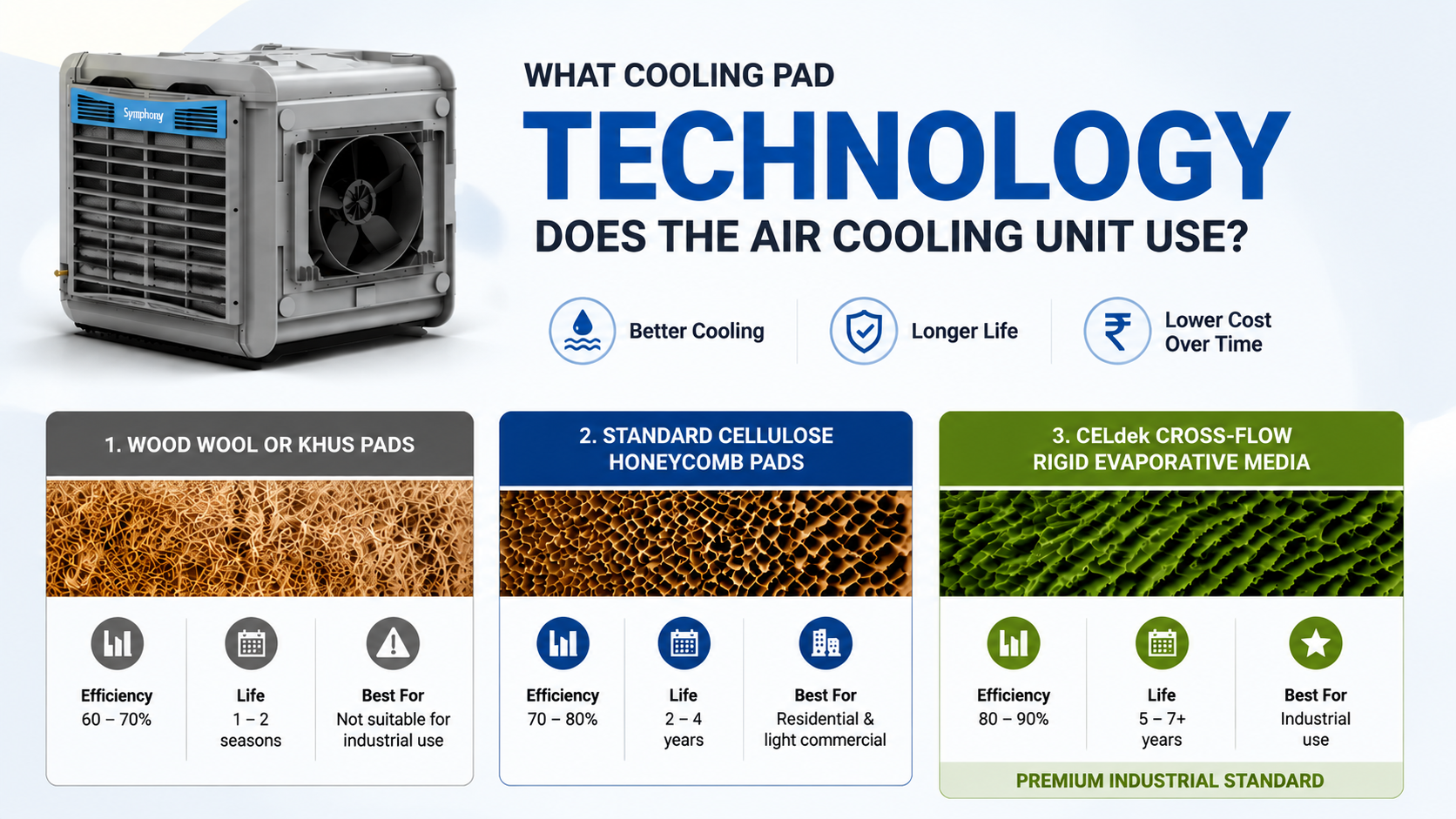
The cooling pad is the core of an evaporative cooler’s performance. There are three main technologies in the market, and the choice significantly affects both cooling effectiveness and long-term cost:

Wood wool or khus pads: The oldest pad technology. Cheap, widely available, but low saturation efficiency of 60 to 70 percent, short life of one to two seasons, prone to mould growth, and unsuitable for industrial continuous-use applications. Avoid for any industrial application.

Standard cellulose honeycomb pads: Medium performance, saturation efficiency of 70 to 80 percent, typical life of two to four years in industrial use. Adequate for residential and light commercial applications. Acceptable for industrial use if budget is the primary constraint.

CELdek cross-flow rigid evaporative media: The premium industrial standard. Saturation efficiency of 80 to 90 percent, designed for 12-plus hours of continuous operation, industrial service life of five to seven years minimum. Symphony LSV systems use CELdek pads. They cost more upfront but deliver better cooling and require replacement two to three times less frequently than standard honeycomb pads.

A unit with cheap honeycomb pads may be priced Rs 20,000 to 30,000 lower than a Symphony LSV equivalent. Over five years, the combination of lower cooling performance, more frequent pad replacement, and shorter unit life makes the cheaper unit more expensive in total.

Question 8: Does the Industrial or Commercial Cooler Manufacturer Have a Nationwide Service Network at Your Location?

Industrial cooling systems fail at the worst possible time: peak summer, maximum load, when spare parts are in short supply across the market. A failed unit in May or June costs a mid-size factory between Rs 10,000 and Rs 50,000 per day in reduced productivity and order delays. The quality of the manufacturer’s after-sales network is not a secondary consideration. For facilities in single-source supply situations, it is as important as the product specification.

Ask the following before committing to any manufacturer or supplier: How many authorised service centres are within 100 kilometres of your facility? What is the response time commitment for a breakdown call under an AMC? Are CELdek pads, motors, pump assemblies, and control boards stocked locally or must they be shipped from a central warehouse? Can the manufacturer demonstrate active installations and client references within your region?

Symphony Venti-Cool has a pan-India installation and service network with coverage across major industrial cities including Ahmedabad, Surat, Rajkot, Pune, Hyderabad, Bangalore, Chennai, Delhi NCR, Kolkata, Ludhiana, and Indore among others. For facilities in these cities and their surrounding industrial areas, emergency service response is available under AMC terms.

Question 9: What Are the Evap Cooler Installation Requirements at Your Site?

Before placing a purchase order, a site survey is essential for anything beyond portable units. The survey should confirm:

  • Water supply availability near the intended unit location and the connection type required (direct plumbing or tanker fill).
  • Power supply availability: single-phase 240V for most portable and smaller wall-mounted units, three-phase 415V for larger LSV systems.
  • Structural suitability of the wall or roof section where the unit will be mounted, including load-bearing capacity and attachment method.
  • Duct routing path from the unit to the delivery points within the space, including any obstructions from equipment, structural beams, or services.
  • Exhaust provision: is there an adequate opening on the opposite side or the roof to allow through-flow without air recirculation?

Symphony portable units are ex-stock and can be delivered within days. Ducted LSV systems require a three to six week manufacturing lead time followed by two to five days of installation depending on the configuration complexity. Planning the installation for April at the latest, before peak summer demand arrives in May, avoids both stock shortages and installation scheduling delays.

Question 10: What Warranty and Certifications Does the Cooler Product Carry?

The certifications a manufacturer carries reflect the quality and testing rigour behind the product. For industrial evaporative coolers procured for Indian facilities, the relevant certifications are:

  • BIS certification under IS 8827 is the Indian national standard for air coolers. BIS-certified products have passed mandatory testing for safety and performance. Uncertified products have no independent performance verification.
  • ISO 9001 manufacturing certification confirms that the manufacturer operates a documented quality management system. Symphony Venti-Cool’s manufacturing is ISO 9001 certified.
  • Motor warranty of at least two years. The motor is the highest-cost single component in an industrial cooler and the most likely to require replacement.
  • Frame and body warranty of at least five years for industrial units. Rotomoulded plastic bodies with five-year warranties indicate a manufacturer who stands behind the structural integrity of their product.
  • CE marking for facilities that are part of export supply chains with European customer requirements.

Buying from an uncertified local fabricator based on a lower headline price is a risk that typically materialises as a quality failure or service void within the first season of operation.

Conclusion

The 10 questions in this checklist are the difference between a cooling investment that works and one that becomes a recurring problem. Space volume (not just floor area), local humidity, building type, CFM requirements, system configuration, total cost of ownership, pad technology, service coverage, installation requirements, and certifications are not optional details. They are the determinants of whether the system you buy will deliver the cooling your facility needs across a 10 to 15-year service life. Symphony Venti-Cool’s industrial and commercial range, from portable units for small spaces to centralised LSV systems for large facilities, is built to answer every one of these questions with a positive specification: CELdek pads, BIS and ISO certification, a pan-India service network, and a product range that has been designed for the specific conditions of Indian industrial environments.

Frequently Asked Questions

Top 10 Questions to Ask Before Buying an Industrial Air Cooler: A Complete Buyer’s Checklist for Factories, Warehouses, and Commercial Spaces

What is the difference between a desert cooler and an industrial evaporative air cooler?

A desert cooler is a residential product designed for a single room of 200 to 400 square feet, with a small plastic body, a simple pad, and a low-powered fan. An industrial evaporative air cooler is engineered for spaces of 1,000 to 50,000 square feet and beyond, using CELdek pads, heavy-duty motors rated for 12-plus hours of continuous operation, structural frames, and airflow capacities of 5,000 to 60,000 CFM. Symphony's industrial range starts at the SPS-30 and scales through the LSV series. Comparing these on price alone, without considering performance or durability, leads to the expensive mistake of buying the wrong category of product.

How is the price of an industrial air cooler determined?

Industrial air cooler price is a function of airflow capacity in CFM, cooling pad type (CELdek commands a premium over standard honeycomb), body material (standard plastic, galvanised steel, or stainless steel), motor type (BLDC motors are more energy-efficient but priced higher than standard motors), and control features (manual, automated, or BMS-integrated). Symphony Venti-Cool's range starts from approximately Rs 50,000 for portable industrial units and extends to Rs 5 to 20 lakh and above for large centralised LSV systems. Site-specific quotations based on a measured space survey are more reliable than catalogue price lists for industrial procurement.

Can a large residential cooler (200 litre) replace an industrial cooler for a factory floor?

A 200-litre residential desert cooler delivers a maximum of 3,000 to 5,000 CFM, which covers approximately 500 to 1,000 square feet in a residential room. For a factory floor of 10,000 square feet with industrial heat loads, you would need 15 to 25 residential units to approximate the coverage of a single Symphony LSV industrial unit. The result would be chaotic installation, high maintenance burden, inconsistent air distribution, and significantly higher total energy consumption than a single properly sized industrial unit. A single Symphony LSV unit at Rs 1.5 to 3 lakh outperforms that entire array while delivering uniform cooled air through a designed duct system.

How should I compare industrial cooler prices across different manufacturers?

Compare on CFM per rupee of purchase cost as the primary efficiency metric, not headline price. Then evaluate the pad type (CELdek versus honeycomb, including replacement frequency and cost), motor warranty duration, body corrosion resistance relevant to your environment, after-sales service coverage in your city, and BIS certification status. A lower-priced uncertified cooler with annual pad replacement and no local service support will cost substantially more over five years than a Symphony LSV unit with seven-year CELdek pad life and a pan-India AMC network.

Is Symphony Industrial Cooler suitable for cooling outdoor spaces such as gardens, terraces, and outdoor event areas?

Yes. Symphony Venti-Cool's outdoor cooler range includes garden coolers, terrace coolers, and wheeled outdoor coolers designed for open-air environments. These units are built with weather-resistant bodies and positioned to direct high-velocity cooled air toward the occupied zone. They are widely used for outdoor dining areas, event marquees, terrace common areas, construction site rest zones, and open commercial spaces where conventional cooling is not feasible.

What is the right time of year to buy and install an industrial air cooler in India?

February to June is the optimal purchasing window for Indian industrial and commercial buyers. Stock of popular models is fully available, installation teams have scheduling availability before peak season, and the system can be commissioned and any teething issues resolved before temperatures reach their peak in May and June.

<< 1 >>


About the Author
About the Reviewer

Sourav Biswas is a senior marketing leader heading the LSV (Large Space Venticooling – B2B) marketing function at Symphony Limited. He shapes the brand’s strategic narrative, strengthens market leadership, and ensures excellence across all B2B cooling solutions. With deep expertise in Strategic Marketing, Brand Management, Advertising, and PR, he reviews content with analytical precision and alignment to Symphony’s vision. Passionate about mentoring and tracking B2B trends, Sourav ensures every content piece reflects accuracy, relevance, and strategic depth.


×
×
Index