Symphony Venticool

Read AI-Generated Summary:

Every summer, factory floors across India become battlegrounds between rising temperatures and worker productivity. In textile mills in Surat, automobile plants in Pune, pharmaceutical units in Ahmedabad, and food processing facilities in Chennai, the question of how to keep workers safe and comfortable is not just an operational matter — it is a legal one.

Workplace Safety Complying Cooling System Standards
0:00 / 0:00
1948
Factories Act enacted
1996
BOCW Act enacted
IS 3315
BIS Standard for Air Coolers
10–15°C
Temp drop via LSV Evaporative Cooler

Every summer, factory floors across India become battlegrounds between rising temperatures and worker productivity. In textile mills in Surat, automobile plants in Pune, pharmaceutical units in Ahmedabad, and food processing facilities in Chennai, the question of how to keep workers safe and comfortable is not just an operational matter — it is a legal one. Indian law is unambiguous: employers have a statutory obligation to provide adequate ventilation and temperature control in every workroom.

Choosing the right industrial cooling system is therefore not simply a matter of commercial cooler price or energy efficiency — it is a compliance decision with real legal consequences. This article explains what India’s key workplace safety regulations require from industrial employers, and how Symphony Venti-Cool’s Large Space Venti-Cooling (LSV) solutions help manufacturers meet and exceed these obligations.

Need More Information?

India’s occupational safety framework has long recognised that excessive heat is not just uncomfortable — it is dangerous. Heatstroke, heat exhaustion, reduced cognitive function, increased accident rates, and long-term cardiovascular effects are all well-documented consequences of working in high-temperature environments. These health risks translate directly into legal liability for facility owners who fail to provide adequate factory cooling.

The Factories Act 1948 — Section 13: Ventilation and Temperature

The cornerstone of India’s factory temperature regulation is Section 13 of the Factories Act, 1948. This provision mandates that every factory must make “effective and suitable provision” in every workroom for:

The Act goes further. Where the manufacturing process involves or is likely to involve the production of excessively high temperatures — as is the case in foundries, chemical plants, glass manufacturing, and food processing environments — the factory must take “such adequate measures as are practicable” to protect workers. This includes insulating hot processes, separating heat-generating equipment from workrooms, or deploying an effective air cooling solution.

⚠  Legal Alert:

The Chief Inspector of Factories has the authority to serve a written order on any occupier whose factory has excessively high temperatures, requiring specific measures to be adopted within a defined deadline. Non-compliance can result in prosecution and penalties under the Act.

The BOCW Act 1996 — Safety on Construction Sites

The Building and Other Construction Workers (BOCW) Act, 1996 applies specifically to establishments engaged in building and other construction work employing ten or more workers. Importantly, the BOCW Act and the Factories Act are mutually exclusive: establishments covered by the Factories Act fall under that Act’s provisions, while construction sites and infrastructure projects fall under BOCW.

The BOCW Act mandates health and safety measures for workers in construction activities, requiring adequate sanitation facilities, drinking water, and safe working conditions. On large construction sites — where workers are exposed to outdoor summer temperatures often exceeding 42°C — providing an effective air cooling solution in rest areas, site offices, welfare facilities, and enclosed work zones is a welfare obligation under the Act.

For construction site contractors and infrastructure developers, deploying portable industrial air coolers, plastic air coolers, and compact Air Cooling Units in enclosed site structures and welfare facilities is one of the most practical methods of meeting BOCW welfare obligations for thermal comfort.

We are Responsive

IS 3315:2024 — BIS Standards for Evaporative Air Coolers

From a product quality and safety perspective, the Bureau of Indian Standards (BIS) has issued and regularly revised IS 3315, the Indian Standard for Direct Evaporative Air Coolers. The IS 3315:2024 (Fourth Revision) specifies requirements including performance criteria, constructional features, safety norms, air delivery testing, cooling efficiency testing, water consumption testing, power consumption testing, durability testing, and safety tests confirming electrical insulation and fire resistance.

📋  BIS Mandate:

All goods or articles related to air coolers and air filters must adhere to IS 3315:2024. These products must bear the Standard Mark and obtain a licence from the Bureau of Indian Standards. Industrial buyers should specify BIS-certified equipment from a registered industrial air cooler manufacturer to ensure full product compliance.

What Industrial Compliance Requires from Your Cooling System

Understanding the regulatory requirements translates into specific technical demands on the industrial cooling system deployed in a facility. Here is what compliance-driven industrial buyers need to evaluate:

Adequate Fresh Air Circulation

The Factories Act’s requirement for “ventilation by the circulation of fresh air” is key. Unlike a HVAC system that recirculates indoor air, an evaporative air cooler operates on a 100% fresh air principle — drawing hot outdoor air through water-saturated CELdek pads, cooling it by 10–15°C through the process of evaporative cooling, and pushing it through the factory floor as a continuous stream of fresh, cooled air.

This fresh air approach makes Symphony’s LSV evaporative air cooler systems inherently more compliant with ventilation requirements than sealed recirculation HVAC systems — because they deliver what the law specifically demands: fresh air circulation at every point of the workroom.

Temperature Reduction Measurable Against Factories Act Standards

State Governments are empowered under Section 13(2) of the Factories Act to prescribe specific temperature standards for factories. Many states benchmark acceptable workroom temperatures for light manufacturing at 30–35°C. A properly designed central cooling system using Symphony LSV Air Handling Units (AHU) can reduce factory floor temperatures by 10–15°C from peak ambient — bringing a facility that peaks at 44°C in June down to 29–34°C across the production floor. This is the direct operational evidence a facility needs to demonstrate compliance to a Factory Inspector.

Full Workroom Coverage — Not Just the Production Floor

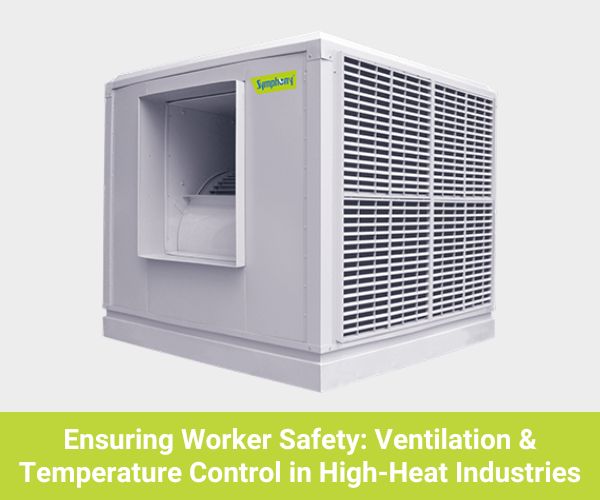
The Factories Act applies to “every workroom” — not just the main production floor. This means rest rooms, canteens, packaging areas, quality control labs, dispatch bays, and maintenance workshops all require adequate ventilation and temperature control. Symphony’s ducted LSV system architecture — combining centralised AHU units with distributed duct networks — enables systematic coverage of every zone in a large industrial or commercial facility. For offices and administrative areas within the factory, a cooler for office zones can be provided through smaller Air Cooling Unit installations drawing from the same central cooling system.

Humidity Management in Artificial Humidification Environments

Factories that artificially increase humidity — including textile spinning and weaving mills, tobacco processing units, and some food processing facilities — must comply with Section 15 of the Factories Act, which mandates adequate ventilation and cooling of the air in workrooms where humidification is used. In such environments, Symphony’s Air Handling System configurations — which can be set up for ventilation-only or indirect cooling modes — provide the necessary flexibility to meet the statutory requirement without increasing humidity further.

Speak with an Expert

How Symphony Venti-Cool LSV Systems Support Compliance

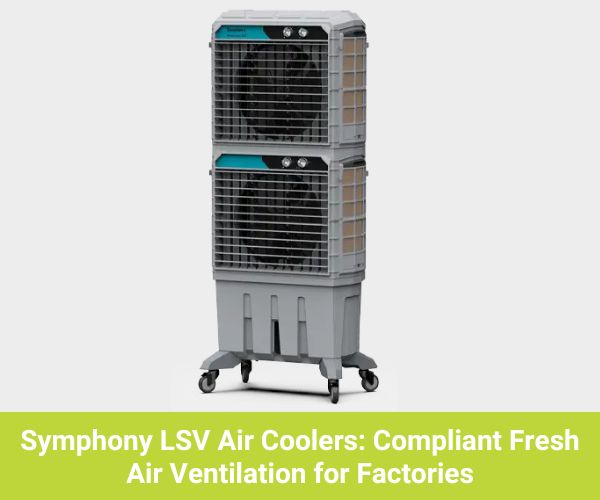
Symphony Venti-Cool is India’s leading industrial air cooler manufacturer for large-space commercial and industrial applications. The LSV (Large Space Venti-Cooling) system range is specifically engineered for the scale, airflow demands, and operational continuity requirements of Indian industrial facilities.

Feature Compliance Relevance
High CFM Output (30,000–1,80,000 CFM) Delivers sustained fresh air volumes required by Factories Act across 5,000 to 2,00,000 sq ft facilities
100% Fresh Air Delivery Every cubic foot of air is cooled fresh outdoor air — directly satisfying the Factories Act ventilation clause
BIS-Aligned Manufacturing Products built to quality standards aligned with IS 3315:2024 specifications for evaporative cooling systems
Centralised AHU + Duct Architecture Systematic, verifiable coverage of all workrooms — supports documentation for Factory Inspector audits
Energy Efficiency vs HVAC System Reduces commercial cooler price barrier that leads facilities to under-invest in coverage area
Plastic Air Cooler & Heavy Duty Cooler Range From lightweight plastic air cooler models for welfare facilities to heavy duty cooler formats for extreme environments

The Business Case Beyond Compliance

Compliance with the Factories Act and BOCW requirements is the minimum standard. The business case for investing in a high-quality industrial cooling system extends significantly beyond avoiding penalty:

Frequently Asked Questions

Industrial Cooling System and Workplace Safety – Meeting BOCW, Factories Act and IS Standards in India

Does the Factories Act 1948 specify an exact temperature that factories must maintain?

The Factories Act itself does not prescribe a single fixed temperature for all factories. Section 13 requires "reasonable conditions of comfort" and temperature levels that prevent injury to health. However, Section 13(2) empowers State Governments to prescribe specific temperature standards for particular classes of factories. Most State Factories Rules benchmark acceptable workroom temperatures between 29°C and 35°C for light manufacturing. The Chief Inspector of Factories can direct specific cooling measures if temperatures are found to be excessively high.

Does the BOCW Act apply to factories, or only to construction sites?

The BOCW Act 1996 and the Factories Act 1948 are mutually exclusive in scope. The BOCW Act explicitly excludes any building or other construction work to which the Factories Act applies. Factories registered under the Factories Act are governed by that legislation for temperature and ventilation requirements. Construction sites, infrastructure projects, and establishments not covered by the Factories Act fall under BOCW provisions.

Is an evaporative air cooler compliant with Section 13 of the Factories Act?

Yes — in most Indian climatic conditions, an evaporative air cooler directly addresses both requirements of Section 13: it delivers fresh air through continuous ventilation, and it reduces workroom temperature to comfort levels. The 100% fresh air principle of evaporative cooling is specifically aligned with the "circulation of fresh air" requirement. In high-humidity environments above 65–70% RH, supplementary ventilation or Air Handling System configurations may be required.

What IS standard applies to industrial evaporative air coolers in India?

IS 3315:2019 (now updated to IS 3315:2024) is the Indian Standard established by the Bureau of Indian Standards (BIS) for evaporative air coolers. It prescribes air capacity, construction, and performance requirements and gives testing methods regarding safety and efficiency. Industrial buyers should specify BIS-certified equipment from a registered industrial air cooler manufacturer to ensure full product compliance.

What is the difference between an AHU and a standard industrial air cooler for compliance purposes?

A standard industrial air cooler — portable or fixed — delivers cooled fresh air to an open or semi-open space. An Air Handling Unit (AHU) is a sophisticated Air Handling System that conditions and distributes air through a duct network, enabling precise control of airflow direction, volume, and temperature across multiple zones of a large facility. For factories with multiple workrooms or areas requiring documented temperature uniformity, an AHU-based central cooling system provides superior compliance evidence compared to standalone units.

Can a factory fulfil the Factories Act requirement by using a HVAC system instead of evaporative cooling?

Both HVAC systems and evaporative air coolers can fulfil the temperature requirement of Section 13. However, a HVAC system that recirculates indoor air without fresh air introduction may not fully satisfy the ventilation requirement for "circulation of fresh air." The advantage of an evaporative air cooler is that it delivers 100% fresh air by design, making compliance with the ventilation clause automatic and verifiable.

How does Symphony Venti-Cool support factories in documenting their cooling compliance?

Symphony Venti-Cool provides comprehensive technical documentation for its LSV industrial cooling systems — including CFM output specifications per unit, coverage area calculations, installation drawings, and commissioning reports. This documentation package equips factory occupiers with the evidence base needed to demonstrate compliance to Factory Inspectors, insurance auditors, and ESG reporting frameworks.

<< 1 >>


Conclusion

India’s workplace safety legislation — the Factories Act 1948, the BOCW Act 1996, and BIS IS 3315:2024 — creates a clear and enforceable obligation for industrial employers to provide adequate ventilation and temperature control. This obligation is not discretionary, and it cannot be deferred until a Factory Inspector arrives.

The right industrial cooling system is the most direct and cost-effective way to fulfil this obligation. Symphony Venti-Cool’s LSV evaporative air cooler systems, AHU-based Air Handling Systems, and central cooling system configurations are specifically designed for the scale and operational demands of Indian industrial and commercial facilities — delivering the fresh air circulation, temperature reduction, and documented performance that compliance programmes require.

For facility owners navigating the intersection of workplace safety law and practical factory cooling investment decisions, Symphony Venti-Cool offers site assessments, system design, and product supply that turn regulatory obligation into operational advantage.

Lorem ipsum dolor sit amet, consectetur adipiscing elit. Ut elit tellus, luctus nec ullamcorper mattis, pulvinar dapibus leo.

Ready to Make Your Facility Compliant?

Contact Symphony Venti-Cool for a compliance-focused cooling assessment for your factory, warehouse or commercial facility.

symphonyventicool.com

About the Author
About the Reviewer

Sourav Biswas is a senior marketing leader heading the LSV (Large Space Venticooling – B2B) marketing function at Symphony Limited. He shapes the brand’s strategic narrative, strengthens market leadership, and ensures excellence across all B2B cooling solutions. With deep expertise in Strategic Marketing, Brand Management, Advertising, and PR, he reviews content with analytical precision and alignment to Symphony’s vision. Passionate about mentoring and tracking B2B trends, Sourav ensures every content piece reflects accuracy, relevance, and strategic depth.


×
×
Index