Symphony Venticool

Read AI-Generated Summary:

India’s quick commerce sector has built over 5,000 dark stores across urban India to fulfil grocery and household orders within 10 minutes. These compact urban warehouses face an acute summer cooling challenge: open loading bays, constant foot traffic, and limited infrastructure budgets make conventional air conditioning impractical. This article explains how industrial evaporative air coolers, particularly Symphony Venti-Cool’s portable and ducted LSV range, deliver effective ambient zone cooling for dark stores, why they outperform AC in this environment, how to size the system correctly, and what the energy cost comparison looks like for operators running multiple dark store locations.
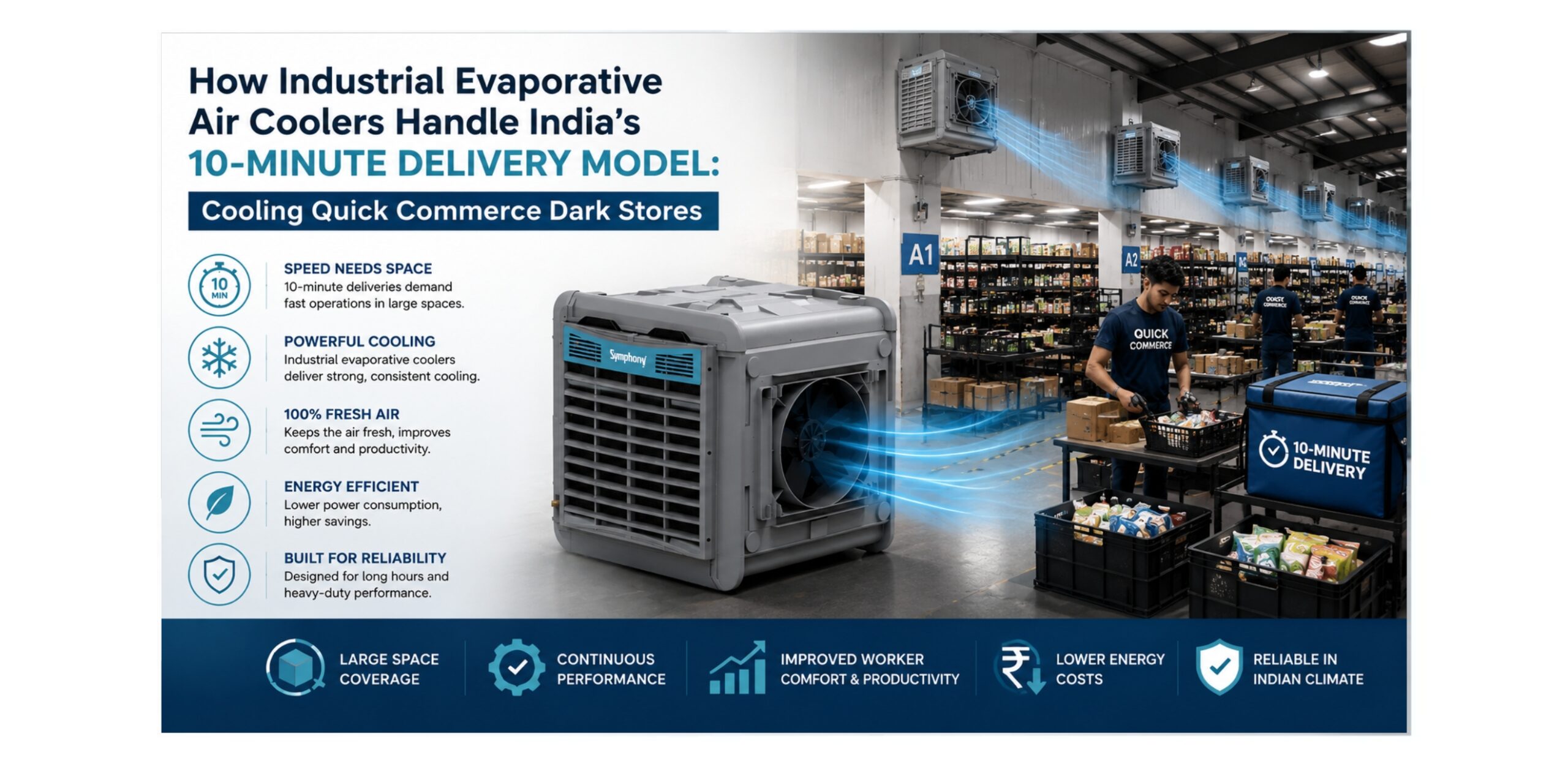

How Industrial Evaporative Air Coolers Handle India’s 10-Minute Delivery Model: Cooling Quick Commerce Dark Stores
0:00 / 0:00

A dark store is a compact fulfilment warehouse, typically 2,000 to 8,000 square feet, located within dense urban areas. Unlike a conventional retail store or distribution centre, it has no customer-facing area. Its sole purpose is to receive stock, store it across ambient, chilled, and frozen zones, and dispatch picker-packed orders to delivery riders within minutes.

Blinkit, Zepto, Swiggy Instamart, and BigBasket Now collectively operate thousands of these stores across Indian cities, with the total count expected to cross 8,000 by 2027. Speed and product quality are the two pillars of the business model. Both are threatened by heat.

When ambient zone temperatures in a dark store exceed 28 degrees Celsius during Indian summer, packaged goods deteriorate faster, cardboard packaging weakens and deforms, and the pickers working in tight aisles slow down significantly due to heat fatigue. An order that sits in a 35-degree dark store for 30 minutes before dispatch arrives in compromised condition. One bad experience is enough to lose a customer permanently.

What Temperature and Humidity Levels Does an Ambient Zone Need?

Dark store zones have distinct temperature requirements. The frozen zone operates below minus 18 degrees Celsius and the chilled zone between 2 and 8 degrees Celsius. These are served by refrigeration equipment. The ambient zone, which holds packaged food, beverages, household goods, and personal care products, needs to be maintained between 22 and 26 degrees Celsius with relative humidity between 45 and 55 percent.

FSSAI’s food safety guidelines require ambient storage areas to be clean, properly ventilated, and free from excessive heat. A dark store ambient zone that regularly exceeds 30 degrees Celsius in summer is not only a product quality problem but a regulatory compliance issue.

Evaporative industrial air coolers address the ambient zone specifically. They do not serve the chilled or frozen sections, which need refrigeration. Their role is to keep the ambient zone and the picking aisles within a temperature range that protects goods and allows workers to maintain accuracy and pace across a full shift.

Why Air Conditioning Fails in Dark Store Environments

The instinct to install split AC units in a dark store is understandable, but the environment works against it. Air conditioning requires a sealed building envelope to function efficiently. A dark store is fundamentally semi-open. Loading bay shutters cycle open and closed throughout every operating hour. Delivery riders enter and exit the dispatch area constantly. Fresh stock arrives through roll-up doors. The number of air changes caused by this activity makes it impossible for a sealed AC system to maintain temperature without running at full capacity continuously.

In practice, dark store operators who install split AC units find that the units struggle to reach their target temperature when loading bays are open, run for extended periods at maximum load, consume far more electricity than anticipated, and require frequent servicing due to the outdoor air exposure. The economics break down quickly, particularly for operators managing dozens of locations.

How an Industrial Evaporative Air Cooler Works in a Dark Store

Step-by-Step Cooling Process

  • Hot outdoor air at 35 to 42 degrees Celsius during Indian summer enters the Symphony industrial cooler through a pre-filter that removes dust and airborne particles.
  • The filtered air passes through Symphony’s CELdek evaporative pads, which are continuously wetted by a recirculating water pump.
  • Water evaporates from the pad surface, absorbing heat from the air. The air temperature drops by 8 to 12 degrees Celsius through this process.
  • The unit’s fan delivers this cooled fresh air at targeted velocity into the ambient picking zone.
  • Stale, heat-laden air exits the dark store through loading bay openings, exhaust vents, or dedicated exhaust fans installed on the opposite wall or roof.
  • The continuous once-through airflow prevents humidity from accumulating, removes carbon dioxide produced by worker activity, and maintains fresh air quality throughout the shift.
  • The result is an ambient zone maintained between 24 and 28 degrees Celsius even on a 40-degree day in Delhi or Ahmedabad, without requiring the space to be sealed.
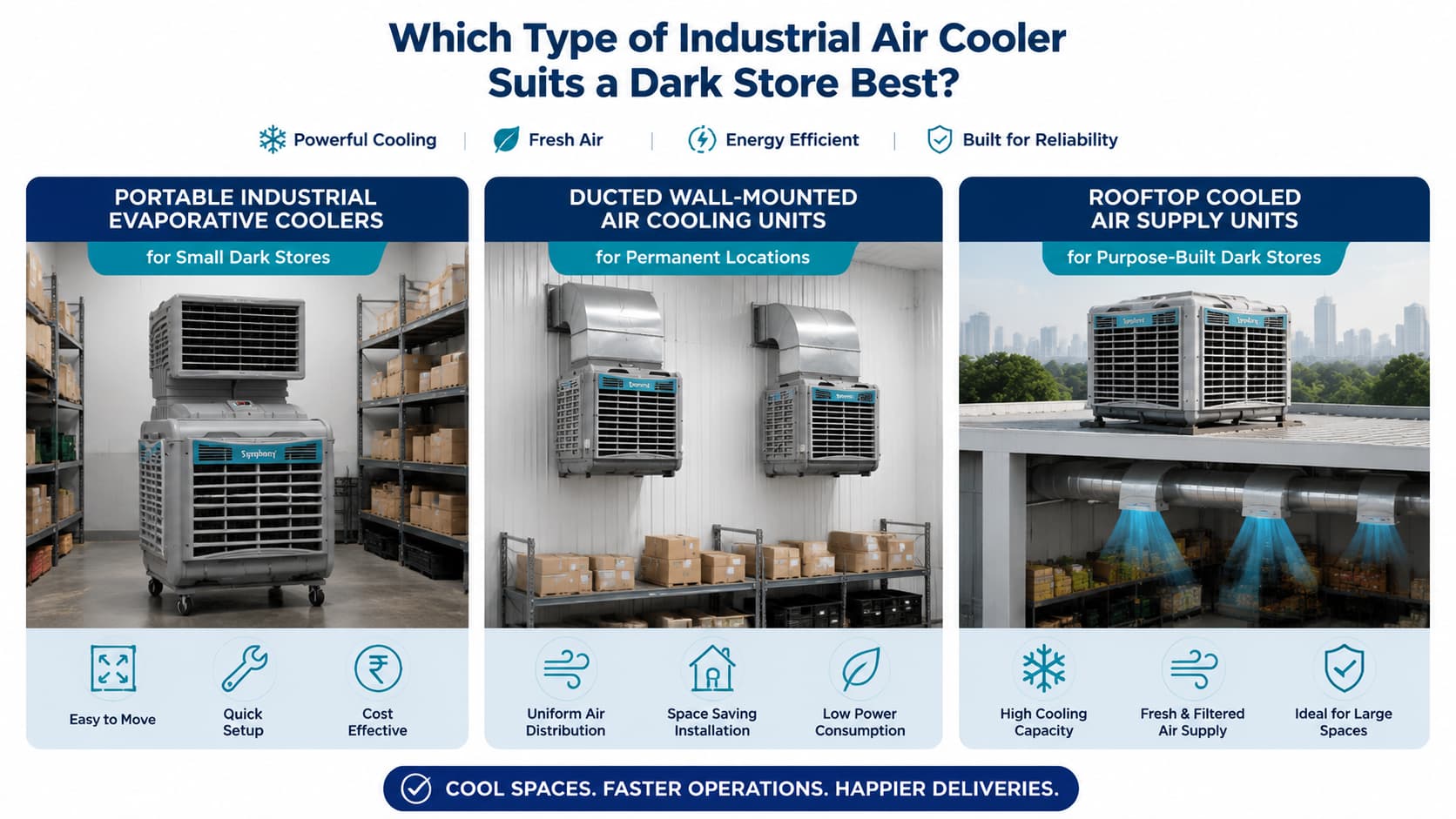
Which Type of Industrial Air Cooler Suits a Dark Store Best?

Which Type of Industrial Air Cooler Suits a Dark Store Best?

Portable Industrial Evaporative Coolers for Small Dark Stores

For dark stores under 3,000 square feet, Symphony’s portable industrial range (PAC-18 and SPS-30 models) is the most practical option. These units run on standard 240V power, require no installation, and can be repositioned as the store layout changes. The PAC-18 delivers 8,000 CFM and the SPS-30 delivers 10,000 CFM, both with built-in water tanks and wheels. For leased urban premises where permanent installation is not viable, portable industrial coolers provide immediate relief without any civil work.

Ducted Wall-Mounted Air Cooling Units for Permanent Locations

For dark stores between 3,000 and 8,000 square feet that are owner-operated or on long-term leases, a wall-mounted ducted Symphony LSV unit is the preferred configuration. The unit mounts above head height on a wall, connects to a short duct run that distributes cooled air along the picking aisles, and leaves the entire floor free for shelving and operations. Air distribution is uniform, there is no floor obstruction, and the system integrates naturally with exhaust fans to create a consistent through-flow of cool air.

Rooftop Cooled Air Supply Units for Purpose-Built Dark Stores

For purpose-built dark store buildings where rooftop access is available, a rooftop-mounted Symphony LSV unit with vertical duct drops into the picking zone is the most efficient configuration. Cooled air descends from above, distributes evenly across the ambient zone, and warm air exits at low level through loading bay openings. This arrangement is particularly effective in stores with ceiling heights above 14 feet.

How to Calculate the Number of Cooling Units Required for a Dark Store

Sizing Calculation Method

  • Measure the floor area of the ambient picking zone, excluding the chilled and frozen sections.
  • Measure the clear ceiling height of the ambient zone.
  • Calculate the zone volume: floor area multiplied by ceiling height in cubic feet.
  • Set the target ACH. For a busy dark store with 10 to 30 pickers active at peak: 20 to 30 ACH is appropriate.
  • Apply the CFM formula: Volume in cubic feet multiplied by ACH, divided by 60.
  • Divide the total required CFM by the rated CFM of the Symphony model you are selecting to get the number of units.
  • Add a 15 to 20 percent margin to the unit count to account for cooling losses through open loading bay doors.

Worked example: A 4,000 square foot dark store with a 14-foot ceiling and a target of 25 ACH has a volume of 56,000 cubic feet. Required CFM equals 56,000 multiplied by 25 divided by 60, which is approximately 23,333 CFM. Two Symphony SPS-45 units, each delivering 12,000 CFM, provide 24,000 CFM. With the 20 percent door-opening margin applied, this configuration adequately covers the ambient zone.

Energy and Cost Savings for Dark Store Operators

The economics of evaporative cooling versus AC become particularly compelling when a quick commerce operator is managing 50 to 200 dark stores across Indian cities, as the leading players are.

Parameter AC Option (4 x 2-ton splits) Symphony Evaporative (2 x SPS-45)
Installation cost Rs 2.4 to 3.2 lakh Rs 80,000 to 1.2 lakh
Monthly electricity (summer, 16 hrs/day) Approx 4,800 kWh Approx 720 kWh
Monthly electricity cost at Rs 8/unit Rs 38,400 Rs 5,760
Annual maintenance per location Rs 30,000 to 50,000 Rs 8,000 to 12,000
Performance in open-bay conditions Degrades significantly Unaffected

For an operator running 100 dark stores, the monthly electricity saving from evaporative cooling versus AC amounts to approximately Rs 32 lakh. Over a summer season of four months, that is Rs 1.28 crore in electricity savings across the network, plus reduced installation CAPEX across new store openings.

Speak with an Expert

Handling Monsoon Months in Dark Stores

Evaporative cooling efficiency is tied to outdoor humidity. During India’s monsoon season from July to September, when outdoor relative humidity climbs above 70 percent in most cities, the temperature drop achievable through evaporation reduces to 3 to 5 degrees Celsius rather than 8 to 12 degrees. The units continue to provide ventilation, fresh air circulation, and partial cooling during this period.

For dark store operators, the practical recommendation for monsoon months is to reduce the water pump flow rate to lower moisture addition to the incoming air, maintain exhaust fan operation to ensure through-flow, and use the units in ventilation mode during the highest-humidity hours. Monsoon season is also cooler overall in most Indian cities, reducing the absolute cooling demand.

Conclusion

Quick commerce dark stores need a cooling solution that works with their semi-open, high-traffic environment rather than fighting against it. Symphony Venti-Cool’s industrial evaporative range, from portable units for small leased stores to ducted wall-mounted systems for permanent locations, provides the ambient zone cooling that protects product quality, keeps pickers productive, and meets FSSAI ventilation requirements. The energy savings compared to split AC are substantial enough to matter at the scale that India’s leading quick commerce operators are working at, and the installation simplicity makes rapid rollout across new store openings practical.

Frequently Asked Questions

How Industrial Evaporative Air Coolers Handle India’s 10-Minute Delivery Model: Cooling Quick Commerce Dark Stores

Can evaporative air coolers maintain FSSAI-compliant ambient storage conditions in a dark store?

Yes, for ambient product zones. FSSAI requires ambient storage to be properly ventilated and free from excessive heat. Symphony's industrial coolers maintain temperature between 22 and 27 degrees Celsius in the ambient zone and deliver continuous fresh air ventilation. Chilled and frozen sections require separate refrigeration systems, which operate independently of the evaporative cooling.

How do I prevent humidity from rising when running an evaporative cooler in a dark store?

Adequate exhaust is the key. Every 1,000 CFM of supply air from the cooler needs a corresponding exhaust path through loading bay gaps, roof vents, or dedicated exhaust fans on the opposite wall. Once-through ventilation prevents moisture accumulation. During high-humidity monsoon months, reducing the water pump flow rate lowers moisture addition while maintaining the ventilation benefit.

What is the best Symphony portable industrial cooler for a dark store under 2,000 square feet?

The PAC-18 delivers 8,000 CFM from a compact, wheeled body running on standard 240V power. For stores between 2,000 and 3,000 square feet, the SPS-30 at 10,000 CFM is more appropriate. Both models require no installation, connect to a standard plumbing supply or operate from a built-in water tank, and can be repositioned as store layout changes.

Do evaporative coolers add humidity that could spoil packaged goods in a dark store?

No, when correctly sized and exhausted. Symphony evaporative coolers raise indoor relative humidity by approximately 10 to 15 percentage points in a well-ventilated space. In Indian summer conditions where outdoor RH is typically 25 to 50 percent, indoor RH with evaporative cooling stays within the 40 to 60 percent range, which is safe for packaged food, beverages, household goods, and personal care products.

How quickly can a Symphony industrial cooler be installed in a new dark store opening?

Portable units are operational within minutes of delivery. Plumbing connection or tank filling, power connection, and positioning are the only steps required. For ducted wall-mounted installations, a single-unit setup with standard duct runs is typically completed within four to six hours by a trained installation team. For operators opening multiple dark stores simultaneously, Symphony's dealer network can coordinate parallel installations across locations.

<< 1 >>


About the Author
About the Reviewer

Sourav Biswas is a senior marketing leader heading the LSV (Large Space Venticooling – B2B) marketing function at Symphony Limited. He shapes the brand’s strategic narrative, strengthens market leadership, and ensures excellence across all B2B cooling solutions. With deep expertise in Strategic Marketing, Brand Management, Advertising, and PR, he reviews content with analytical precision and alignment to Symphony’s vision. Passionate about mentoring and tracking B2B trends, Sourav ensures every content piece reflects accuracy, relevance, and strategic depth.


×
×
Index