
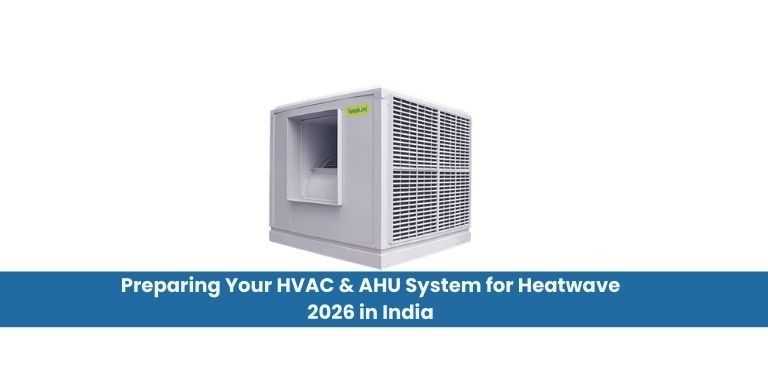




India is bracing for its most severe heatwave season in recent memory. Temperatures in industrial zones across Ahmedabad, Delhi NCR, Pune, Hyderabad, and Chennai are forecast to breach 47°C — pushing traditional HVAC infrastructure to the breaking point. This guide equips facility managers, operations heads, and CFOs with the intelligence to act before the heat does.
Table of Contents
Heatwave Reality Check
Problem Awareness for HVAC & AHU Operators
Why Heatwave 2026 Is More Severe for Indian Industrial Zones
The summer of 2026 is not an anomaly — it is the new normal. The India Meteorological Department (IMD) has issued red alerts across 14 major states, with industrial corridors in Rajasthan, Gujarat, Madhya Pradesh, and the Indo-Gangetic Plain recording ambient temperatures 3–5°C above the 30-year average. For industrial operators, this is not a weather event; it is an infrastructure stress event.
Industrial zones are disproportionately affected due to the Urban Heat Island (UHI) effect. Dense concrete construction, metal roofing, machinery heat dissipation, and minimal green cover combine to create micro-climates that are routinely 5–8°C hotter than surrounding residential areas.
Key Factors Amplifying 2026 Severity
- El Niño weather pattern extending Indian summer beyond May into late June
- Urban heat island effect intensifying in tier-1 and tier-2 manufacturing clusters
- Load-bearing infrastructure (power grids, cooling towers) already stressed from record 2025 summer
- Climate change compressing the ‘acceptable temperature window’ for equipment operation
- Worker density in factories and warehouses creating additional internal heat load
How Rising Ambient Temperatures Affect AHU Efficiency
Air Handling Units (AHUs) are the workhorses of central HVAC systems in commercial and industrial buildings. They are designed to operate within specific ambient temperature parameters — typically 25°C to 42°C. When outdoor temperatures consistently breach 45°C, the fundamental thermodynamic efficiency of an AHU begins to deteriorate.
An AHU’s performance is measured by its ability to deliver conditioned air at the desired temperature and humidity. The cooling coil inside the AHU relies on refrigerant circuits that must reject heat to the outside environment. When the outside temperature rises, the pressure differential across the compressor increases — requiring more energy to achieve the same cooling output.
Engineering Fact: For every 1°C rise in outdoor ambient temperature above the AHU’s design point, the unit’s Coefficient of Performance (COP) degrades by approximately 2–3%. At 47°C ambient — 7°C above a typical 40°C design point — an AHU may be operating at 85–90% of its rated capacity while consuming 115–120% of its rated power.
HVAC System Overload During Peak Summer in India
Peak summer in India creates a convergence of demand factors that overwhelm centralized HVAC systems. The combination of high ambient temperature, increased solar radiation, higher occupancy (workers seeking shelter indoors), and equipment heat generation creates a cooling load that standard HVAC installations were not engineered to handle.
Grid instability during peak summer further compounds this issue. Voltage fluctuations cause compressors to cycle irregularly, increasing wear and reducing efficiency. Many industrial facilities report a 30–40% spike in HVAC-related maintenance calls between April and June, with compressor failures accounting for the majority.
Condition | Normal Operation | 45°C+ Heatwave |
|---|---|---|
AHU Power Consumption | 100% (baseline) | 115–130% of rated load |
Cooling Capacity Output | 100% (baseline) | 80–90% of rated capacity |
Compressor Cycling Frequency | Normal (designed) | 2–3x increased |
Maintenance Call Frequency | Monthly check | Weekly intervention |
Equipment Lifespan Impact | Nominal | Accelerated wear by 20–35% |
Cooling Load Miscalculations in Older Commercial Buildings
A significant portion of India’s industrial and commercial building stock was designed before 2010, when cooling load calculations were based on historical temperature data that no longer reflects current climate reality. Engineers used peak design temperatures of 40–42°C; buildings are now regularly experiencing 46–48°C.
This means millions of square feet of commercial and industrial floor space are operating with HVAC systems that are structurally undersized for today’s climate. The cooling load shortfall is not a malfunction — it is a design obsolescence issue that requires strategic supplementation rather than wholesale system replacement.
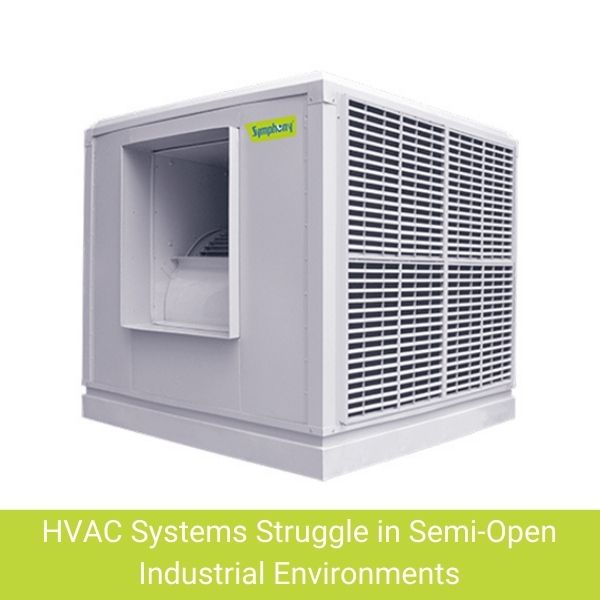
Why Sealed HVAC Systems Struggle in Semi-Open Industrial Spaces
Central HVAC systems are designed for sealed, insulated environments where the air volume is controlled and recirculated. Industrial spaces — warehouses, factories, logistics hubs, and processing plants — are fundamentally different environments. They have loading docks, ventilation gaps, high ceilings, heat-generating machinery, and constant human movement that prevents maintaining a sealed air envelope.
Attempting to cool a semi-open 50,000 sq. ft. warehouse with a central AHU is equivalent to running an air conditioner with the windows open. The economics are punishing, and the results are inadequate. This architectural reality is the single biggest driver of HVAC inefficiency in Indian industry today.
Energy & Cost Shock During Heatwaves
The CFO-Level Perspective on Summer Cooling Costs
How Heatwaves Spike HVAC Electricity Bills
The financial impact of heatwaves on industrial electricity bills is immediate, substantial, and often invisible until the bill arrives. HVAC systems typically account for 35–55% of a commercial building’s total electricity consumption under normal conditions. During a severe heatwave, this share can climb to 65–70%.
The cost escalation happens across multiple vectors simultaneously: higher base consumption from struggling equipment, demand charges triggered by peak load events, power factor penalties from compressor cycling, and generator fuel costs during grid outages.
Industry Data: Indian manufacturing facilities in high-temperature zones report HVAC electricity costs 40–60% higher in the April–June quarter compared to the October–December quarter. For a mid-sized facility with a monthly electricity bill of ₹15–20 lakhs, this represents an additional ₹6–12 lakhs per month during peak summer — without any increase in production.
AHU Power Consumption During 45°C+ Conditions
A standard industrial AHU unit rated at 50 TR (Tons of Refrigeration) consumes approximately 60–70 kW under normal operating conditions (ambient 35–38°C). At 45°C+ ambient, the same unit may draw 85–95 kW while delivering less cooling — a double penalty of higher consumption and lower output.
Across a large industrial campus running 10–15 AHU units, this inefficiency compounds to an additional 150–250 kW of continuous wasted power draw — translating to ₹8,000–₹15,000 per day in additional electricity costs at industrial tariff rates.
AHU Size (TR) | Normal kW Draw | 45°C+ kW Draw | Monthly Extra Cost (₹) |
20 TR | 24–28 kW | 34–40 kW | ₹45,000–65,000 |
50 TR | 60–70 kW | 85–95 kW | ₹1.1–1.5 lakhs |
100 TR | 120–140 kW | 165–190 kW | ₹2.2–3.0 lakhs |
200 TR (central) | 240–280 kW | 330–380 kW | ₹4.5–6.0 lakhs |
Diesel Generator Load Due to Central HVAC Systems
During peak summer, grid instability and scheduled load-shedding force industrial facilities to run diesel generators (DGs) to power their HVAC systems. HVAC is the largest single load on a DG set in most commercial buildings. Running a central 200 TR HVAC system on DG costs approximately ₹180–220 per kWh in diesel cost alone — 4–5x the grid tariff.
A facility running its central HVAC on DG for even 4–6 hours per day during peak summer load-shedding can accumulate ₹50,000–₹1,20,000 in additional daily diesel costs. Over a 45-day peak summer period, this represents ₹22–54 lakhs in unbudgeted expense.
Demand Charges & Peak Load Penalties in Industrial Estates
Industrial electricity tariffs in India include a demand charge component — a fixed charge based on the maximum power drawn (kVA) during any 15-minute interval in the billing cycle. HVAC systems, particularly compressor-heavy AHU installations, create enormous peak demand spikes during startup and during the hottest afternoon hours (2–5 PM).
A single peak demand event — where the HVAC system pulls 20–30% more power than the contracted demand — can add ₹2–5 lakhs to a month’s electricity bill through demand charges alone. Facilities with multiple AHU units running simultaneously during a heatwave regularly trigger these penalties.
Reducing HVAC Operational Costs During Extreme Summers
The strategic response to summer energy cost escalation is not to simply accept higher bills or compromise on worker comfort. The financially astute approach is to reduce the load on expensive HVAC infrastructure by supplementing it with lower-cost cooling alternatives — specifically, evaporative cooling technology that consumes a fraction of the energy while delivering meaningful temperature reduction in appropriate settings.
The bridge question every CFO should be asking is not ‘How do I run my HVAC better?’ but ‘Is there a more energy-efficient architecture for cooling my specific facility type?’ In most Indian industrial settings — where buildings are large, semi-open, and mechanically intensive — the answer is a hybrid cooling model.
Performance Gap - AHU vs. Evaporative Cooling
The Technical Case for Rethinking Your Cooling Architecture
Does AHU Performance Drop in 45°C+ Temperatures?
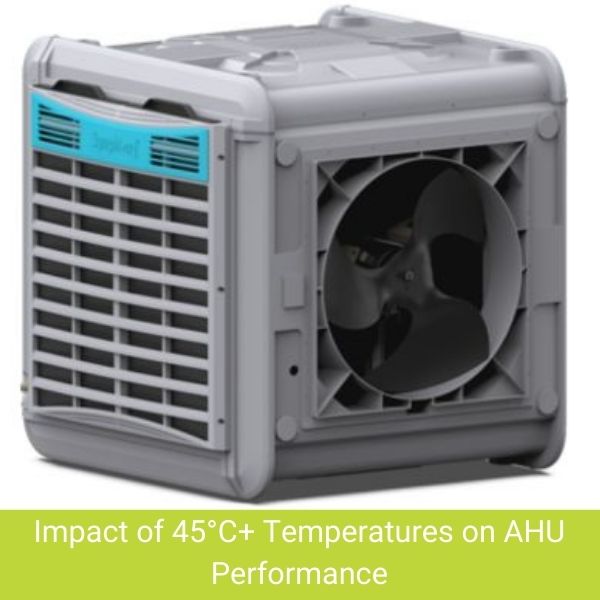
The short answer is yes — significantly. AHU performance is fundamentally limited by the laws of thermodynamics. The refrigeration cycle in an AHU compressor requires rejecting heat to the outdoor environment. When the outdoor temperature rises, the condensing pressure in the refrigerant circuit rises proportionally, forcing the compressor to work harder for less output.
Most AHUs are factory-rated at conditions of 35°C dry bulb and 24°C wet bulb temperature — conditions that represent a ‘standard’ Indian summer afternoon. In a 2026 heatwave scenario of 47°C dry bulb, the unit is operating 12°C above its rating conditions. This is not a marginal exceedance — it fundamentally changes the operating envelope of the system.
Evaporative Cooling Efficiency in Dry Indian Climates
Evaporative cooling operates on a completely different thermodynamic principle from vapor-compression cooling used in AHUs. It works by passing hot, dry outdoor air through water-saturated cooling pads. As water evaporates, it absorbs heat from the air, reducing its temperature by 10–18°C depending on ambient humidity. The process consumes only electricity for fan motors — no compressors, no refrigerants.
Critically, evaporative cooling becomes MORE effective as outdoor temperatures rise, because higher temperatures mean lower relative humidity (in most inland Indian locations), which means greater evaporative potential. This is the exact inverse of AHU performance, which degrades as temperatures rise.
In Ahmedabad at 47°C and 15% relative humidity — typical June heatwave conditions — an industrial evaporative cooler can achieve a temperature drop of 14–17°C, delivering supply air at 30–33°C. At the same conditions, an AHU working overtime delivers similar or slightly lower supply temperatures at 4–5x the electricity cost.
Fresh Air vs. Recirculated Air During Heatwaves
One of the most consequential and underappreciated differences between AHU-based cooling and evaporative cooling is the air quality dimension. AHUs recirculate indoor air, refreshing it with only a small percentage (typically 10–20%) of outdoor fresh air. In industrial environments with fumes, particulates, heat from machinery, and high occupancy, recirculated air quality degrades significantly.
Evaporative coolers supply 100% fresh outdoor air — continuously. Every cubic meter of air delivered to the workspace is new, filtered through the cooling media. This creates positive air pressure within the building, continuously flushing out stale, contaminated air. During heatwaves, when workers are physiologically stressed, fresh air quality is directly linked to productivity, alertness, and heat illness prevention.
Parameter | Central AHU System | Industrial Evaporative Cooler |
Air Type | Recirculated (80–90%) | 100% Fresh Air |
Performance at 45°C+ | Degrades 15–25% | Improves with lower humidity |
Energy Consumption (per CMH) | High — compressor driven | Low — fan motor only |
Installation Complexity | High — ducting, chiller plant | Low — modular units |
Suitable for Semi-Open Spaces | No | Yes |
Typical Power Draw (10,000 CMH) | 15–25 kW | 2–4 kW |
Running Cost per Hour (₹) | ₹150–250 | ₹20–40 |
Temperature Drop Comparison: HVAC vs. Industrial Air Coolers
The temperature reduction achievable by evaporative cooling is dependent on the wet bulb depression — the difference between dry bulb and wet bulb temperature. In dry, hot Indian summer conditions (May–June in northern and western India), wet bulb temperatures of 22–28°C are common even when dry bulb temperatures exceed 45°C. This creates a wet bulb depression of 17–25°C, of which evaporative coolers can achieve 80–85% efficiency.
For humid coastal locations (Chennai, Mumbai), wet bulb temperatures rise proportionally with dry bulb temperatures, limiting the wet bulb depression to 8–12°C and making evaporative cooling less effective. This geographic distinction is critical for cooling strategy selection.
Air Changes Per Hour (ACH) — Why It Matters in Summer
Air Changes Per Hour (ACH) measures how many times the entire volume of air in a space is replaced per hour. In industrial settings, sufficient ACH is critical for heat removal, contaminant control, and worker comfort. Most industrial spaces require a minimum of 20–40 ACH during summer operations.
Central AHU systems designed for office environments typically achieve 6–12 ACH — adequate for sealed, insulated spaces but wholly insufficient for large industrial volumes with high heat generation. Industrial evaporative coolers, deployed at appropriate density, can achieve 30–60 ACH in warehouse and factory environments, making them inherently better matched to the ventilation requirements of Indian industrial spaces.
Application-Based Cooling Solutions
Right Cooling Technology for Every Industrial & Commercial Setting
Warehouses & Logistics Centres
Heat Stress in Warehouse Workers During Heatwaves
Warehouse workers face some of the most acute heat stress risks in the Indian industrial workforce. They operate in large, often poorly ventilated spaces, engage in physically demanding work (lifting, carrying, operating machinery), and have limited access to cooling. The combination of external heat, internal machinery heat, and physical exertion creates conditions where wet bulb globe temperature (WBGT) — the heat stress index — regularly exceeds safe work thresholds.
The Occupational Safety and Health Administration (OSHA) equivalent guidelines in India (under the Factories Act and state-level labor regulations) mandate cooling provisions for workers in high-heat environments. Heatwave conditions of 45°C+ make compliance not just a legal requirement but a moral imperative — heat stroke fatalities in industrial settings increase dramatically during heatwave periods.
Productivity Impact: Studies from Indian manufacturing associations indicate that warehouse worker productivity drops 15–25% for every 5°C rise in ambient temperature above 32°C. At 47°C, unprotected workers operate at 60–70% productivity. A single industrial cooler serving 20–30 workers typically recovers ₹8,000–15,000 per day in productivity value.
Cooling Large Non-Insulated Warehouses Efficiently
Non-insulated metal-roofed warehouses are the dominant structure in Indian logistics and manufacturing infrastructure. They absorb solar radiation intensely through the roof — surface temperatures of 65–70°C are common on corrugated metal roofs during June afternoons. Radiant heat from the roof significantly raises the effective temperature at worker level even when ambient outdoor temperature is ‘only’ 44°C.
Industrial evaporative coolers — particularly high-volume units like the Symphony Venticool series — are designed for exactly this application. Deploying units with sufficient CMH (Cubic Meters per Hour) capacity to achieve 25–40 ACH in the warehouse volume creates a continuous positive-pressure fresh airflow that overcomes radiant heat gain and maintains workable temperatures at the human occupancy zone.
Factories & Manufacturing Shopfloors
Shopfloor Cooling Without Fully Air-Conditioned Setup
Manufacturing shopfloors present a unique cooling challenge: they generate significant internal heat from machinery, processes (welding, casting, heat treatment, baking), and high worker density, while simultaneously being structurally incompatible with sealed HVAC operation. Attempting to seal a factory shopfloor — with its material handling openings, overhead cranes, and process ventilation requirements — is both impractical and unsafe.
Industrial evaporative coolers address this challenge naturally. Because they supply fresh air rather than recirculated conditioned air, they work with the open nature of the shopfloor rather than against it. Strategically positioned units create cooling corridors and worker comfort zones without requiring the building envelope to be sealed.
Open Production Areas Where AHUs Are Not Practical
Steel fabrication yards, automobile assembly halls, textile weaving floors, food processing areas with high humidity generation, and chemical manufacturing spaces all share a common characteristic: they cannot be effectively cooled by central AHU systems without prohibitive expense and operational compromise.
These spaces are the natural domain of large-capacity industrial air coolers. Mounted on walls, suspended from overhead structures, or positioned on the floor with directional ducting, evaporative coolers provide zone-specific cooling exactly where workers need it — without the massive capital expense and operational complexity of central cooling infrastructure.
Commercial Spaces
Cooling for Malls, Airports & Transit Areas
Large-format commercial spaces — shopping malls, airport terminals, railway stations, bus terminuses — combine enormous air volumes with high foot traffic and frequent air infiltration through entry/exit points. Central HVAC systems in these spaces are designed for sealed environments but operate in practice in semi-open conditions.
During heatwave conditions, the thermal load on central HVAC in malls and transit areas surges as the temperature differential between inside and outside grows. Every person entering from the 47°C exterior brings a heat load. Every door opening exchanges conditioned interior air for hot exterior air. Industrial supplemental cooling at strategic points (near main entrances, food courts, waiting areas) reduces this dynamic load on the central system.
Semi-Open Food Courts & Large Halls Cooling Solutions
Food courts and large exhibition halls present a specific combination of challenges: they have high internal heat generation (cooking, serving equipment), high occupancy density, and are typically semi-open by design (atrium roofing, natural light features that preclude full sealing). Central HVAC systems in these areas frequently struggle to maintain comfort conditions during peak summer.
Industrial air coolers are more practical in such scenarios — they can be deployed incrementally, positioned to serve specific seating zones, and scaled to match occupancy patterns throughout the day. For food courts, the continuous fresh air supply also helps manage cooking odors and maintains better indoor air quality than recirculated AHU air.
Sustainability & ESG Angle
Cooling Decisions That Align with Your Corporate Climate Commitments
Carbon Footprint of HVAC Systems During Heatwaves
The environmental cost of HVAC-intensive cooling is substantial and growing. A typical 100 TR central AHU system operating at full load during a heatwave consumes 150–180 kW continuously. At India’s current grid emission factor of approximately 0.82 kg CO₂ per kWh, this translates to 123–148 kg of CO₂ per hour — or nearly 3 tonnes of CO₂ per day from a single large AHU installation. Summer HVAC energy consumption represents a significant and visible emissions spike that is increasingly difficult to justify without a clear reduction strategy.
Eco-Friendly Cooling Solutions for Industrial India
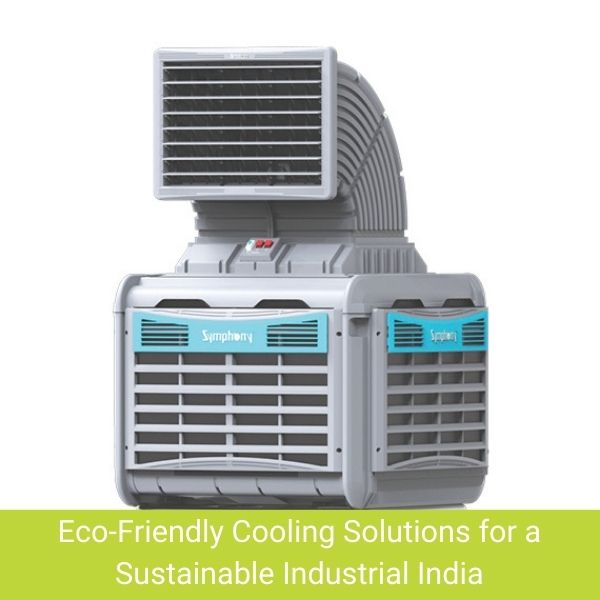
Evaporative cooling uses no refrigerants (no HFCs, no HCFCs), has zero direct greenhouse gas emissions, and consumes 80–90% less electricity than equivalent vapor-compression cooling. The environmental profile of industrial air coolers is fundamentally superior to any refrigerant-based cooling technology.
Water consumption — often cited as a concern for evaporative cooling in water-scarce India — is genuinely modest in context. A large industrial evaporative cooler consuming 50–80 litres of water per hour delivers the same comfort effect as an AHU consuming 150–180 kW of electricity. Given India’s coal-heavy grid, the lifecycle environmental impact of water use in evaporative cooling is far lower than the CO₂ impact of equivalent HVAC electricity consumption.
Water vs. Electricity Trade-Off in Cooling Systems
The water vs. electricity debate in evaporative cooling is often framed simplistically. A nuanced analysis must account for the full lifecycle impact of both resources. Thermal power generation for grid electricity in India consumes significant quantities of water for cooling towers — estimates suggest 1.5–2 litres of water per kWh of electricity generated.
An industrial evaporative cooler consuming 50 litres of water per hour while drawing 3 kW of electricity has a total water footprint (direct + indirect through electricity generation) of approximately 55–56 litres per hour. An equivalent AHU drawing 80 kW of electricity consumes zero direct water but indirectly requires 120–160 litres of water per hour at the power plant. The water trade-off often favours evaporative cooling when full lifecycle accounting is applied.
Green Cooling Alternatives to Traditional HVAC
India’s push toward net-zero by 2070, combined with state-level energy efficiency mandates (Bureau of Energy Efficiency ratings, PAT scheme compliance for large industries), is creating regulatory and market incentives to reduce cooling-related energy intensity. Industrial evaporative cooling aligns naturally with these policy directions.
Companies that proactively deploy energy-efficient cooling solutions — and document the reduction in both energy consumption and emissions — are better positioned for regulatory compliance, green building certifications (LEED, IGBC Green Factory), and ESG investor scrutiny. Evaporative cooling is not just operationally smart; it is strategically aligned with where Indian industry regulation is heading.
City-Specific Cooling Strategies
Local Intelligence for India's Major Industrial Centres
Ahmedabad & Gujarat: Ground Zero for Heatwave Cooling Challenges
Ahmedabad consistently records some of India’s highest summer temperatures, with May and June regularly seeing 45–48°C dry bulb temperatures. The city’s vast textile, pharmaceutical, chemical, and FMCG manufacturing clusters face the most acute cooling challenges in the country. Sanand and Mandal-Becharaji industrial corridors — home to automotive and electronics manufacturing — operate under extreme thermal stress conditions throughout summer.
Gujarat’s low humidity during peak summer (relative humidity dropping to 10–20% in inland areas during May–June) makes it among the most favourable geographies in India for evaporative cooling. Wet bulb depression of 20°C+ is common, enabling industrial evaporative coolers to achieve temperature drops of 16–18°C — genuine, meaningful cooling that transforms worker comfort and productivity.
- Recommended cooling strategy: Evaporative cooling as primary for open production areas, AHU for sealed offices and temperature-sensitive storage
- Key sectors benefiting: Textiles, pharmaceuticals, chemicals, automotive components, food processing
- Symphony Venticool advantage: Units engineered for high-dust, high-temperature environments common in Gujarat industrial estates
Delhi NCR: Heat Stress in India's Largest Industrial Cluster
The Delhi National Capital Region — encompassing Gurugram, Faridabad, Noida, Greater Noida, and Ghaziabad — is India’s most diverse and sprawling industrial cluster. Manufacturing ranges from electronics and garments to heavy engineering and food processing. The NCR urban heat island is particularly intense, with industrial areas in Faridabad and Manesar recording temperatures 6–8°C above the official Delhi Observatory readings.
Delhi NCR’s heatwave pattern differs from Gujarat in its inclusion of high humidity episodes (particularly in May before the monsoon), which can temporarily reduce evaporative cooling effectiveness. The cooling strategy must therefore be robust to variable humidity — either through evaporative cooling during the dry heat period (March–mid-June) supplemented by increased ventilation during humid periods, or through a hybrid model that maintains base comfort across humidity variations.
- Key challenge: Variable humidity requiring adaptive cooling approach across the summer season
- Priority sectors: Logistics warehouses in NH-48 corridor, garment factories in Okhla, electronics in Noida
- Labour law context: Delhi’s Factories Act enforcement increasingly scrutinizing worker heat safety — documented cooling compliance becoming essential
Pune & Hyderabad: Rising Summer Cooling Demands in Tech-Manufacturing Hubs
Pune and Hyderabad represent India’s rapidly growing advanced manufacturing and technology-integrated production hubs. Pune’s Chakan and Ranjangaon industrial areas (automotive, defence manufacturing) and Hyderabad’s Patancheru and HMDA industrial zones (pharmaceuticals, electronics, food processing) have seen rapid industrial densification over the past decade.
Both cities have experienced significant increases in summer peak temperatures — Pune recording 42°C+ episodes that were rare a decade ago, and Hyderabad’s industrial zones regularly hitting 43–45°C. The cooling infrastructure in many of these facilities was designed for the more moderate historical climate and is now consistently under-specified.
Hyderabad’s position on the Deccan Plateau gives it relatively low humidity during pre-monsoon summer (April–May), making it a good candidate for evaporative cooling. Pune’s slightly higher humidity during the same period requires careful wet bulb assessment for evaporative cooling deployment decisions.
Chennai vs. North India: Why Cooling Strategy Differences Matter
Chennai represents the most distinct cooling environment among India’s major industrial cities. As a coastal city with year-round high humidity (relative humidity rarely dropping below 60% even during summer), Chennai’s wet bulb depression is limited to 8–12°C — significantly restricting evaporative cooling potential compared to inland cities.
For Chennai’s significant industrial base (automobile manufacturing, electronics, petrochemicals, port logistics), the cooling strategy must rely more heavily on conventional HVAC for conditioned spaces, with evaporative cooling suitable primarily for enhanced ventilation and partial ambient reduction in large open areas rather than as a primary cooling solution.
City | Peak Temp (2026 Forecast) | Typical Humidity (May-Jun) | Evaporative Cooling Suitability | Recommended Strategy |
Ahmedabad | 47–48°C | 10–20% | Excellent | Primary cooling + AHU for sensitive zones |
Delhi NCR | 45–47°C | 20–40% | Good (early summer) | Seasonal hybrid — evaporative Mar–mid Jun |
Pune | 42–44°C | 35–50% | Moderate | Supplemental to AHU, high-ACH ventilation |
Hyderabad | 43–45°C | 25–40% | Good | Hybrid — evaporative primary for open areas |
Chennai | 40–42°C | 60–80% | Limited | AHU primary, evaporative for ventilation only |
Emergency Preparedness & Action Guide
What to Do Now — Before the Heat Becomes a Crisis
Heatwave Preparedness Checklist for Facility Managers
The following checklist is designed for facility managers to assess and strengthen their cooling preparedness before peak summer arrives. The ideal window for action is February–March; after April, procurement timelines and installation scheduling become severely constrained.
Immediate Assessment (Complete by March 15)
- Audit existing HVAC/AHU system capacity against current building usage and occupancy levels
- Review AHU service history — identify units with elevated compressor temperatures, refrigerant shortfalls, or recent repair history
- Map all semi-open and open areas of your facility that are not adequately served by existing HVAC
- Document temperature records from last two summers at multiple points in your facility
- Assess worker health records for heat-related illness incidents during previous summers
System & Capacity Actions (Complete by April 1)
Commission a professional cooling load calculation for the current building configuration and usage
- Schedule full preventive maintenance for all AHU units — coil cleaning, refrigerant check, compressor inspection, belt tension
- Identify zones for supplemental evaporative cooling deployment and calculate required CMH capacity
- Procure and install industrial evaporative coolers with adequate lead time before peak season
- Verify adequacy of electrical supply (load capacity, phase balance) for both HVAC and evaporative cooling systems
Operational Protocols (Implement by May 1)
Establish temperature monitoring at multiple points in all occupied areas with automated alerts at threshold temperatures
- Create shift scheduling adjustments that minimize heavy physical work during 12–4 PM peak heat hours
- Ensure adequate hydration stations throughout the facility - 1 station per 25 workers minimum
- Train supervisors on heat stress recognition and first response protocols
- Establish backup cooling activation protocols for HVAC failure scenarios
Signs Your HVAC System Will Fail During Heatwaves
The following warning signs indicate an HVAC system at elevated risk of failure during peak summer conditions. Any of these symptoms in the pre-summer period (March–April) should be treated as urgent intervention signals:
- Compressor taking longer than usual to reach setpoint temperatures on cool mornings — indicates reduced refrigerant capacity or compressor wear
- Condenser unit fins visibly dirty, bent, or corroded — reduces heat rejection efficiency by 15–25%
- Supply air temperature consistently 2–3°C warmer than specified — indicates capacity degradation
- Frequent high-pressure trips or safety cutouts in the compressor circuit — often indicates insufficient refrigerant charge or airflow restriction
- Unusual vibration, noise, or intermittent operation from any AHU component — mechanical wear indicators
- Electricity consumption rising year-over-year without corresponding increase in usage — efficiency degradation signal
- Refrigerant top-ups required more than once per year — indicates leak that will worsen under summer pressure conditions
Evaporative Cooling Systems for Industrial Safety
A cooling system failure during a peak heatwave event is an industrial safety emergency, not merely an inconvenience. Without cooling, temperatures in enclosed industrial spaces can reach dangerous levels within 30–60 minutes on a severe heatwave day. Workers face acute heat stroke risk; temperature-sensitive inventory (pharmaceuticals, electronics, food products) can be destroyed; and production shutdowns create significant financial losses.
Backup cooling capacity should be part of every facility’s emergency response plan, with the same seriousness applied to backup power (DG sets). The critical advantage of industrial evaporative coolers as main or backup cooling is their ease of rapid deployment — they require no permanent installation, can be positioned and operational within hours, and operate independently of the central HVAC infrastructure.
Rapid Deployment Cooling Solutions for Factories
When a heatwave emergency strikes — an AHU failure, an unexpected temperature spike, a sudden peak in occupancy — the ability to deploy cooling rapidly can mean the difference between business continuity and a forced shutdown. Large-space industrial air coolers from Symphony Venticool are specifically designed for rapid deployment scenarios:
- Portable/semi-portable configurations that can be repositioned within the facility as cooling needs shift
- Single-phase power connection requiring no special electrical infrastructure
- Single-phase power connection requiring no special electrical infrastructure
- High-CFM output that immediately impacts temperature in large areas
- Stackable or wall-mounted configurations for facilities requiring permanent supplemental cooling stations
Symphony Venticool Advantage: Industrial air coolers can be procured, delivered, and operational within short time across most Indian industrial locations — compared to 4–8 weeks for HVAC equipment. In a heatwave emergency, speed of deployment is the critical differentiator. Large Space Industrial Coolers are the fast-deployment solution every facility manager should have in their emergency preparedness plan. |
Taking Action: Your 5-Step Cooling Upgrade Roadmap
Step | Action | Timeline | Priority |
1 | Conduct a facility cooling audit — map hot zones, assess AHU adequacy | Immediately | Critical |
2 | Schedule AHU preventive maintenance for all units before May | February–March | High |
3 | Identify zones for evaporative cooling supplementation | March | High |
4 | Procure Symphony Venticool units for main/supplemental/backup deployment | March–April | High |
5 | Implement worker heat safety protocols and temperature monitoring | Before May | Essential |
Conclusion: The Heatwave-Ready Facility
The 2026 Indian heatwave season is not a future risk — it is an imminent operational challenge that demands strategic action today. Facility managers and CFOs who wait until May to assess their cooling adequacy will find themselves in a reactive crisis mode, competing for scarce contractor time, equipment availability, and financial resources.
The most resilient industrial facilities will be those that have adopted a hybrid cooling architecture — leveraging their existing HVAC investment for sealed, critical spaces while deploying industrial evaporative cooling technology for the large, semi-open areas where AHUs are economically and technically unsuitable. This approach delivers lower operating costs, higher worker productivity, better ESG outcomes, and longer equipment lifespan.
Symphony Venticool’s industrial air cooler range is engineered for Indian industrial conditions — built to withstand dust, heat, and the operational realities of Indian factories and warehouses. As both a supplemental cooling solution for HVAC-served facilities and a primary cooling solution for open industrial spaces, Venticool units represent the most cost-effective investment a facility can make before the 2026 heatwave season peaks.
The cost of doing nothing is not zero. It is higher electricity bills, earlier equipment failure, reduced worker productivity, increased heat illness risk, and potential regulatory exposure. The cost of acting — deploying industrial evaporative cooling as part of a Primary or hybrid strategy — is a fraction of what heatwave-driven inefficiency will cost you this summer. Act before the heat does.

Maulik Solanki is a seasoned B2B Product Marketing professional specializing in Industrial and Commercial Coolers in the LSV (Large Space Venticooling) segment. With 13+ years of experience, he drives brand building and audience engagement for Symphony’s LSV solutions through integrated offline and online strategies. Backed by an MBA in Marketing and earlier experience as a Regional Marketing Manager in banking, Maulik brings strong skills in sales, advertising, and events. He enjoys exploring new marketing ideas and cooling technologies and writes to help readers understand Symphony’s offerings.

Sourav Biswas is a senior marketing leader heading the LSV (Large Space Venticooling – B2B) marketing function at Symphony Limited. He shapes the brand’s strategic narrative, strengthens market leadership, and ensures excellence across all B2B cooling solutions. With deep expertise in Strategic Marketing, Brand Management, Advertising, and PR, he reviews content with analytical precision and alignment to Symphony’s vision. Passionate about mentoring and tracking B2B trends, Sourav ensures every content piece reflects accuracy, relevance, and strategic depth.