Symphony Venticool

Read AI-Generated Summary:

India’s defence production ambition of Rs 3 lakh crore by FY2029 is driving rapid expansion of manufacturing capacity across two dedicated Defence Industrial Corridors in Uttar Pradesh and Tamil Nadu, as well as existing HAL and OFB facilities. Aircraft hangars, ammunition plants, composite fabrication units, precision machining shops, and large assembly bays all present demanding industrial cooling challenges that require heavy-duty, reliable, and in some cases intrinsically safe solutions. This article covers why the defence sector is a growing market for industrial air coolers, what the specific cooling challenges are at each facility type, how to approach hangar and ammunition plant cooling correctly, and where Symphony Venti-Cool’s LSV range fits in this environment.

Industrial Cooling for India’s Growing Defence Manufacturing Sector and Private Defence Parks
0:00 / 0:00

India has set a defence production target of Rs 3 lakh crore by FY2029, with Rs 35,000 crore earmarked for exports. Achieving this requires a substantial scale-up of manufacturing capacity, both in existing public sector facilities and in new private sector plants entering the defence space through the Make in India framework.

Two Defence Industrial Corridors have been established to anchor this expansion. The UP corridor runs through Lucknow, Aligarh, Agra, and Kanpur and covers land and air systems, electronics, and precision engineering. The Tamil Nadu corridor connects Chennai, Coimbatore, Salem, and Tirunelveli, focusing on aerospace, missiles, naval systems, and advanced materials.

Within and around these corridors, a range of facility types require industrial cooling: aircraft maintenance and assembly hangars at HAL Nashik, HAL Bangalore, and HAL Lucknow; ammunition, propellant, and explosive manufacturing at Ordnance Factory Board units in Kanpur, Itarsi, and Pune; missile component assembly and testing at DRDO facilities in Hyderabad and Pune; and private sector defence manufacturing campuses operated by L&T Defence, Tata Advanced Systems, Bharat Electronics, Mahindra Defence, and several new entrants attracted by the defence PLI scheme.

The cooling requirements across these facility types are varied and technically demanding. Aircraft hangars are massive open structures. Ammunition plants have strict temperature limits and safety requirements around ignition risk. Composite fabrication requires controlled temperature and humidity for curing processes. Precision machining shops need to manage heat from CNC equipment while keeping operators comfortable. Defence industrial park common areas and administrative buildings need cost-effective cooling at scale.

Speak with an Expert

Cooling Challenges in Defence Manufacturing Facilities

Aircraft Assembly and Maintenance Hangars

An aircraft hangar is among the most challenging large-space cooling applications in any industry. A medium-scale fighter jet bay may cover 80,000 to 200,000 square feet with ceiling heights of 40 to 80 feet. Multiple large roll-up doors remain open during maintenance operations to allow aircraft movement. The heat load from aircraft engines, ground power units, and lighting in a high-ceiling space creates stratification, with temperatures near the roof significantly higher than at worker level.

Conventional AC is not a viable option. The scale, ceiling height, and open-door operating mode make sealed-envelope cooling physically and economically impossible. Industrial evaporative cooling with high-CFM output is the appropriate technology for bringing down effective working temperature at floor level.

Ammunition and Propellant Manufacturing Units

Ammunition and propellant manufacturing imposes the strictest cooling requirements of any industrial environment. Certain processes require the ambient temperature to remain below 28 degrees Celsius at all times to maintain material stability. The presence of explosive dust or vapour means that cooling equipment must not introduce ignition sources: no sparks, no hot surfaces, no refrigerant vapours.

Evaporative industrial air coolers have a natural safety advantage in these environments. They have no compressors, no hot surfaces, no refrigerant handling, and no spark-generating components if specified correctly. For hazardous zone installations, ATEX-rated motors and wiring can be specified.

Composite and Advanced Materials Fabrication

Composite manufacturing for aerospace structures requires stable temperature and humidity during layup and curing. Too much humidity causes delamination in certain resin systems. Insufficient ventilation allows solvent vapours to accumulate. The cooling system must deliver controlled temperature with consistent humidity management, and it must maintain clean air quality to avoid contamination of composite surfaces.

Precision Machining Shops

CNC machining generates significant heat from spindle motors, cutting friction, and coolant. Workers operating in a poorly ventilated machining shop experience fatigue that directly affects precision and error rate. Industrial evaporative cooling provides the fresh air throughput and temperature reduction needed to keep operators alert and machinery within thermal tolerance.

How to Size and Position Industrial Coolers for an Aircraft Hangar

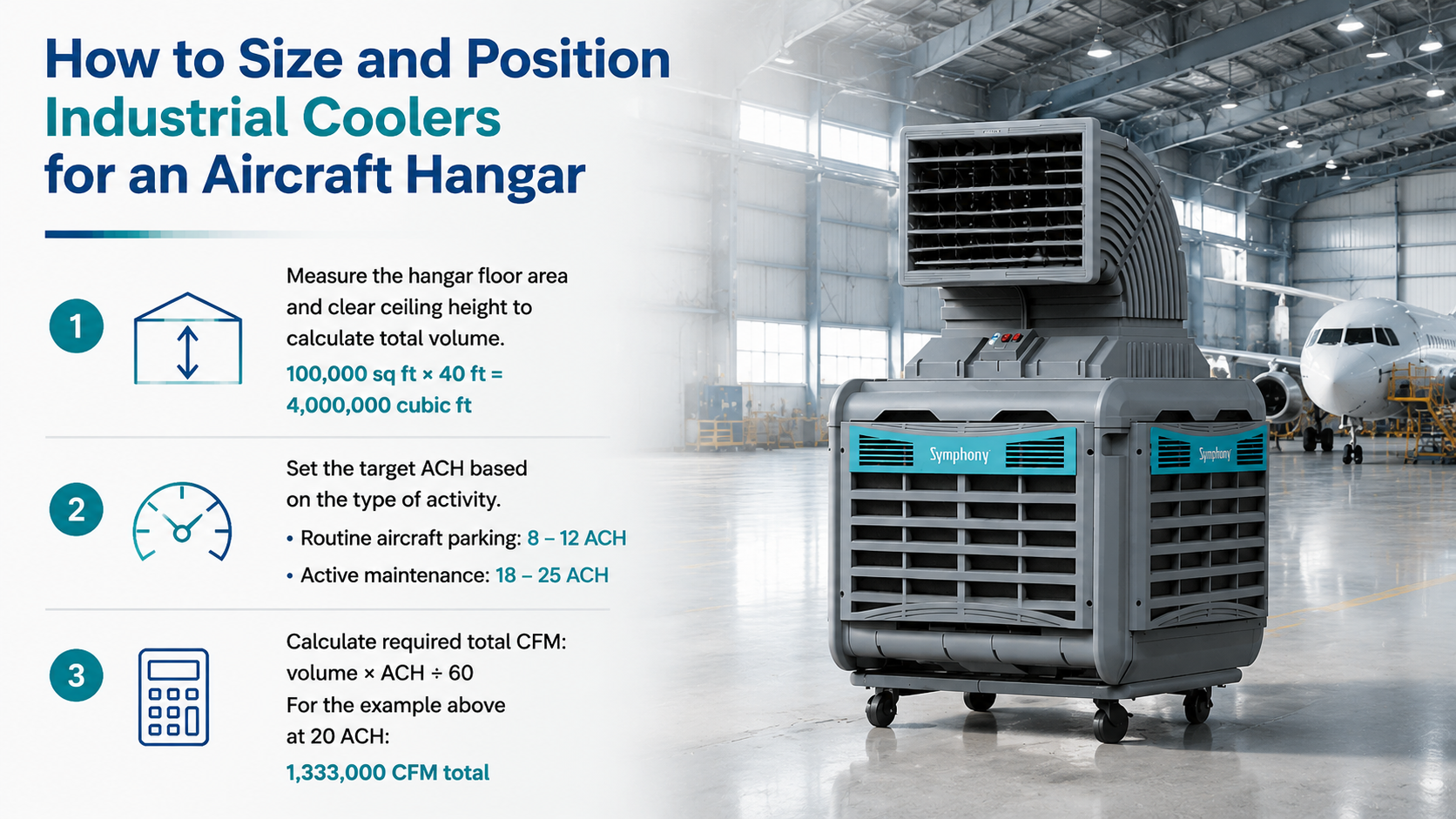
How to Size and Position Industrial Coolers for an Aircraft Hangar

Hangar Cooling Approach

  • Measure the hangar floor area and clear ceiling height to calculate total volume. A 100,000 square foot hangar with a 40-foot ceiling has a volume of 4,000,000 cubic feet.
  • Set the target ACH based on the type of activity. For routine aircraft parking: 8 to 12 ACH. For active maintenance with workers present: 18 to 25 ACH.
  • Calculate required total CFM: volume multiplied by ACH divided by 60. For the example above at 20 ACH: 1,333,000 CFM total.
  • Select Symphony LSV units rated at 30,000 to 60,000 CFM each, depending on the configuration available for wall or roof mounting. A 1,333,000 CFM requirement is met by approximately 25 units at 55,000 CFM each, or 45 units at 30,000 CFM each. In practice, the actual unit count is determined by airflow distribution requirements across the hangar bay, not just total CFM.
  • Position supply units on the windward wall at a height of at least 3 metres above the floor to avoid ground-level air disturbance near ground crews and tooling. Exhaust openings should be on the leeward wall or at the roof ridge to draw air diagonally across the working zone.
  • Install G4 or better pre-filters on all supply units to prevent ingestion of metal shavings, hydraulic mist, or fuel residue from hangar activity.
  • For very large hangars, divide the cooling into zones aligned with each aircraft bay to allow zone-by-zone operation when only part of the hangar is in use.

How to Cool an Ammunition or Explosive Manufacturing Facility Safely

Safety-First Cooling Protocol

  • Classify the zones within the facility according to ATEX zone definitions (Zone 0, Zone 1, Zone 2 for gas; Zone 20, Zone 21, Zone 22 for dust) based on the presence and frequency of explosive atmosphere.
  • For units installed in or adjacent to hazardous zones, specify ATEX-rated motors with the appropriate Ex rating for the zone classification.
  • Evaporative coolers inherently eliminate the ignition risks associated with compressor-based AC: no hot compressor surfaces, no refrigerant handling, and no high-voltage capacitor banks in the cooling circuit.
  • Maintain positive pressure in the cooled space by sizing supply CFM slightly above exhaust CFM. Positive pressure prevents ingress of dust or vapour from adjacent hazardous process areas.
  • Set minimum fresh air supply at 15 ACH to dilute any solvent, propellant, or reactive vapours below their Lower Explosive Limit.
  • Install temperature and humidity sensors with automated cooler shutdown triggered if the water supply fails, to prevent the unit operating in dry mode at elevated temperatures.
  • Specify Symphony SS range stainless steel body units for areas requiring regular chemical decontamination cleaning, as stainless steel resists the solvents used in such procedures.

The Role of AHU Systems in Defence Facility Climate Control

Air Handling Units serve the controlled-environment zones within defence campuses: precision instrument calibration laboratories, avionics testing bays, inertial navigation system assembly rooms, medical facilities, and administrative buildings. These zones require temperature and humidity maintained within tight tolerances that evaporative cooling alone cannot achieve.

Symphony’s evaporative cooler concept replaces or pre-cools the conventional chilled water coil with an evaporative cooling section. In hot and dry locations such as Rajasthan, UP, and parts of Tamil Nadu, evaporative pre-cooling can reduce the chiller’s cooling load by 30 to 50 percent before the air reaches the precision conditioning stage. This hybrid approach reduces chiller CAPEX, reduces chiller energy consumption, and improves the overall system efficiency without compromising the temperature and humidity control precision that sensitive instruments require.

For large defence campuses with multiple building types, a modular AHU strategy allows each facility to receive the conditioning it requires: fully controlled chilled-water AHU for sensitive labs, evaporative AHU for semi-controlled storage and staging areas, and direct LSV for assembly bays and common areas.

Symphony's Heavy-Duty Industrial Coolers in Harsh Outdoor Defence Environments

Defence facilities in Rajasthan, including the Jodhpur and Bikaner air bases, face summer conditions above 45 degrees Celsius with frequent dust storms. The UP corridor locations of Kanpur and Lucknow reach 42 to 44 degrees in summer. Tamil Nadu coastal locations introduce high humidity. Each environment requires specific design considerations.

Symphony LSV units for defence applications are available in rotomoulded plastic bodies that are impact-resistant, corrosion-proof, and unaffected by the thermal cycling that causes cracking in conventional plastic or rusting in mild steel. CELdek evaporative pads have significantly higher tolerance to airborne dust than standard honeycomb cellulose pads, making them better suited to the sand and grit conditions prevalent in Rajasthan and UP facilities. Units can be specified with auto-drain functionality that flushes the water tank on a timer, preventing mineral and dust accumulation that degrades performance in hard-water or dusty locations.

Conclusion

India’s defence manufacturing expansion is creating a growing need for industrial cooling solutions that are heavy-duty, reliable, and in some cases intrinsically safe. Symphony Venti-Cool’s LSV range, evaporative AHU systems, and stainless steel heavy-duty units address the distinct requirements of aircraft hangars, ammunition plants, composite fabrication facilities, and defence campus common areas. With BMS integration capability, ATEX-compatible motor options, and a pan-India service network that can support remote defence campus locations, Symphony Venti-Cool is a credible cooling partner for both public sector defence facilities and private sector manufacturers in India’s expanding defence industrial base.

Frequently Asked Questions

Industrial Cooling for India’s Growing Defence Manufacturing Sector and Private Defence Parks

Are evaporative air coolers safe to use near aircraft inside a maintenance hangar?

Yes. Symphony LSV systems deliver cooled air through duct diffusers and produce no refrigerant vapours, sparks, or combustible outputs. Units should be positioned so that high-velocity airflow is not directed at aircraft instrumentation panels or open engine bays during active maintenance. Symphony's large-space systems use high-volume, low-velocity airflow that is safe for hangar environments when properly positioned and commissioned.

Can Symphony LSV systems integrate with a defence facility's Building Management System?

Yes. Symphony Venti-Cool's LSV range can be specified with Modbus or BACnet communication interfaces for integration with standard BMS platforms. This allows centralised control of fan speeds, water pumps, and operating schedules from the facility's control room, which is a practical requirement for large, multi-building defence campuses.

What is the lead time and installation timeline for a large defence campus cooling project?

For standard LSV configurations, manufacturing and delivery lead time is four to eight weeks from order. Installation of a ten-unit system covering a typical 50,000 square foot assembly bay takes five to seven working days with a qualified installation team. Symphony provides full project documentation including site survey reports, engineering drawings, installation supervision, and commissioning test records.

What maintenance schedule does Symphony recommend for defence facility installations?

Weekly: check water level, inspect CELdek pads, verify fan operation. Monthly: clean pre-filters, check pump and water distribution system. Pre-summer seasonal: replace CELdek pads if saturation efficiency has dropped, descale water distribution headers, lubricate fan bearings. Annual: full service including motor inspection and control panel check. Symphony offers AMC contracts with defined SLA response times for defence facility clients.

<< 1 >>


About the Author
About the Reviewer

Sourav Biswas is a senior marketing leader heading the LSV (Large Space Venticooling – B2B) marketing function at Symphony Limited. He shapes the brand’s strategic narrative, strengthens market leadership, and ensures excellence across all B2B cooling solutions. With deep expertise in Strategic Marketing, Brand Management, Advertising, and PR, he reviews content with analytical precision and alignment to Symphony’s vision. Passionate about mentoring and tracking B2B trends, Sourav ensures every content piece reflects accuracy, relevance, and strategic depth.


×
×
Index